Our Brilliant NHS Workers

We live in a country where healthcare is free to all. As we are all aware people who work in the NHS are all part of a big team put together to keep us alive and without the need to worry about huge medical bills as well as your illness.

Thats absolutely brilliant but the people who enable this system are underpaid for the risk they take to save your life.

We are due another stretch of covid variant and the nurses and hospital porters and surgeons are going to risk their lives to save somebody you know. How can you thank people for something like that. Also this time last year we were all outside clapping the NHS staff whereas now we seem to be taking it all for granted and see it as our own problem with the NHS less considered.

I cant cure a covid sufferer or even guess how to help with the medical side of things. What I CAN do is make the lives of those who put theirs on the line is offer my services at a 50% reduced rate.

So thats the new policy.

If you work for the NHS then you get a 50% discount on all labour charges up to £500 (I cant extend this to parts cost unfortunately).

Thank you to all NHS workers. What you do is really appreciated and courageous. I dont care if you work in the back office or do the laundry or your a surgeon – your all fine people and Ill happily work at a discounted rate for you because we know you love your clocks and we love you!.

There are some limits on how far I can go with this as I have to pay the bills too but Ill make your clock bills good deal easier to pay. If you could mention your NHS employed and send a pic of your NHS ID tag in your initial email then Ill make sure you pay a good deal less than…people who dont work for the NHS!. The other thing I can do for NHS employees is staged payments. Ill work on a 3 month staged payment plan if this makes your life easier. Thats what Im doing. Not exactly saving a bus load of nuns and kittens, but something at least.

You probably dont work for the NHS and are reading this purely because you read my blog. Have you thought about what you could do for NHS workers?. Its not something that immediately springs to mind when all we hear is bad news but Im sure there is something you can do for NHS workers somehow. I dont know what that might be or how you might implement it, however, these people do and will need our support. A donation to the NHS is laudible but does it get through to the people who do the work and take the risks?. Call me cynical, but I doubt it. If you can do something directly for an NHS employee I would say that its the way to go. that assumes you want to help and you can. If you dont and you cant then fair enough. Im not trying to change the world or judge anyone. I mean fine. You sit there with scantily clad maidens feeding your peeled grapes and then call an ambulance because you need your fingernails cut. Medically. And your not paying. I mean do you have to pay for everything. What are the overheads? Clippers I suppose. No, theres not judgement going on here.

Joking aside, if you know an NHS worker why not offer an open invitation to dinner once or twice a week so they don’t have to cook when they get home. It sounds odd and overly personal but thats how I grew up. There was more community. And how much time does a nurse or hospital porter get to mow the lawn or wash the car. I know it all sounds rather high minded and vaguely religious but when I grew up in the 70’s people were like this already. You knew your neighbours as friends. Things were just more socially integrated despite the absence of Facebook/Meta and computers. People did spend a long time on the phone mind you.

My point overall in offering an NHS discount is more about that sort of thing. Its got nothing to do with money from my point of view. Theres no publicity, no headline, just what I hope will become normality. Quite frankly it went wrong with the digital watch in my opinion. I was getting my first Timex Junior when the rich kids had red LED watches that lit up and told you the time in writing!. As an aside, Ive had three since, each of which has failed almost immediately and seems unrepairable but I still love them. Anyway, given that there is a chance of the NHS getting overwhelmed I believe its probably time to think about offering support, in whatever way, to those on the front lines.

I rarely do this type of article because who cares what I think. People want to know what I know about clocks and hear about interesting clock related things, however, there is a tenuous link in that Ive had a few NHS customers recently and the only reason they got their (prior) 25% discount was that I tend to get to know my customers to some degree and they obviously mention or refer to their work.

I cant become “Dr Clock” and just do NHS work so Ill have to limit it to a couple of clocks per month but that allowance should be more than adequate. If it goes over this estimate then Ill either cut the service and offer it to certain people on a face to face basis, or ill cut back the percentage or limit the financial elements in some way. Just a warning!.

Ill do a clock article now.
Christmas Opening Hours

I am shutting up shop for the holidays from 4 pm Saturday the the 18th of December. I will still be working but the workshop and the Saturday clock clinic wont be operating until the 8th of January 2022.

So, The workshop closes for xmas between 4pm Saturday the 18th December 2021 to 10am Wednesday the 5th January. The first clock clinic runs on the 8th – this is for simple low cost fixes and quotes / collections / deliveries and runs every Saturday normally.

I will be working at my home workshop during this time except for the 4 days of Christmas inclusive of the two bank holidays.

Most of the rest of the two weeks I will be available on the phone to book a a January call out or just offer a bit of advice e.g. a 3 minute phone call about how to set up your new cuckoo clock.

If you need me to come round for something urgent then just give me a ring. I cant promise any specific availability but I expect to be doing at least two call outs while the Antiques Centre is closed as is normally the case over the Christmas shut down.

My number is: 07462 269529

Email: admin@braintreeclockrepairs.co.uk

So, dont be afraid to ring. Things are happening and Christmas is just an inconvenience as far as I am concerned although the idea of working from home for a couple of weeks does appeal to me greatly!.

Have an excellent Christmas, be the best you can be and remember Christmas is about other people so get round and visit those who might me lonely or felt forgotten. Im 55 and Im lucky if I get 3 people visiting but then again, I live with my two sons so I always have company. Providing I can sabotage any girlfriend relationships they may attempt to engage in I should be able to have them around for quite a few more Christmases.

Reviews Technical Hitch

To my horror I saw this morning that the seventy 5 star reviews on google have dissappeared!. Im currently trying to sort out the issue with google but in the meantime if you wish to check my credentails or talk to an existing customer about their experience with our service please call me on 07462 269529

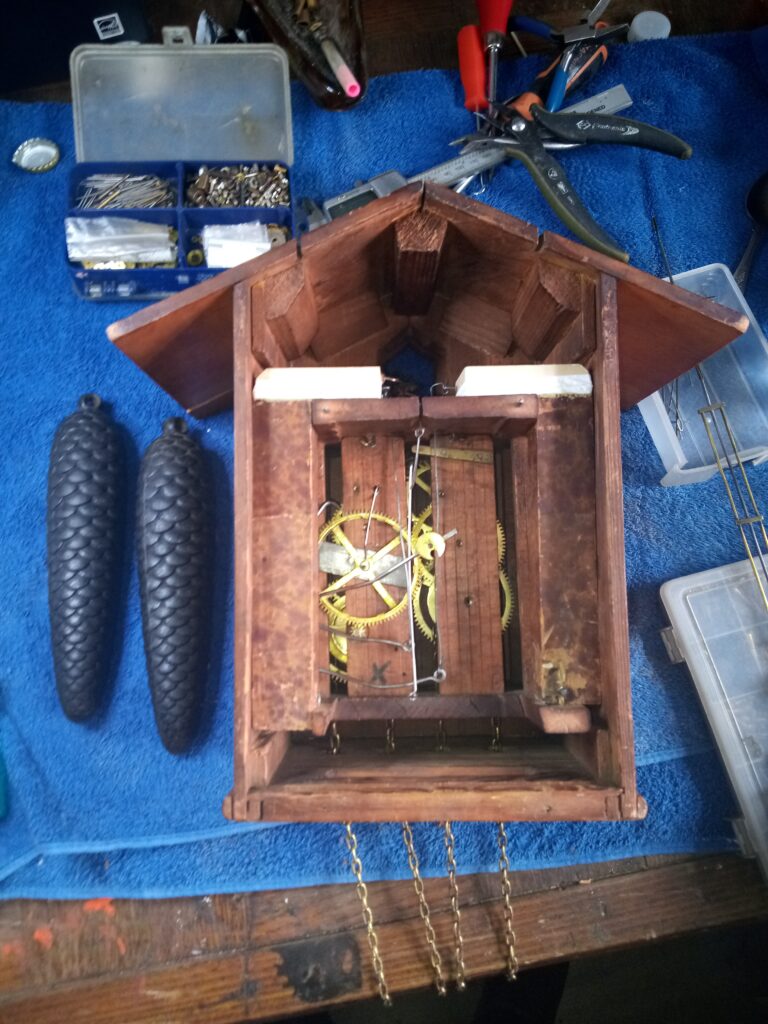
Victorian Cuckoo Restoration (Wooden Cage)

This is a job we recently completed. Its due to be ruturned tomorrow now that it has passed its 48 test run without incident.

These wooden cage movements are difficult. I would not recommend them as projects. The problem is that with their brilliance comes certain drabacks. Insect attack is not something most clock techinicians are used to dealing with; well maybe on the housing but not the movement. Right, STOP, picture before I proceed…

Cuckoo Clock Restoration
Completed restoration of a Black Forest Cuckoo clock with a wooden cage movement. Particularly diffuclt!

That better!. We can see what we are talking about now.

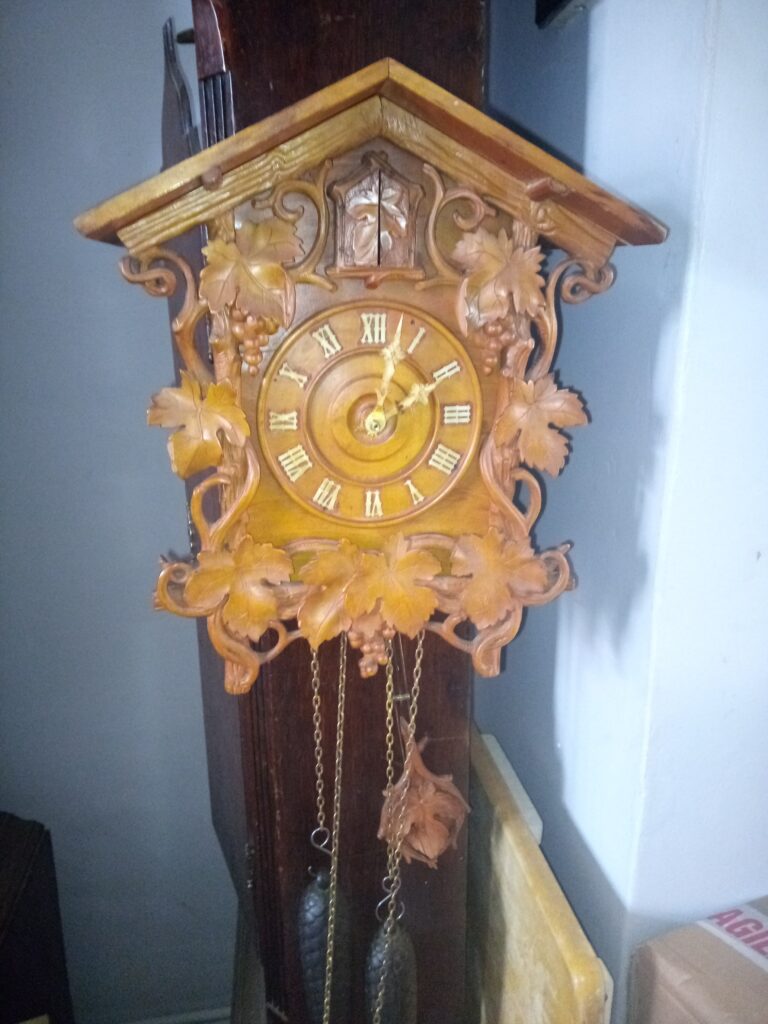
So what we actually have here is a wooden cage movement cuckoo 30 hour clock with a grape vine design for the facia. I suspect it may actually be French or more likely Swiss because of the use of fine wood throughout (probaby fruit tree – pear for the fascia and then the same for the parts of the housing that show).

The movement itself is oak. Im not sure if Ive evangelised about wooden cage movements before but they are actually very good in a “fit for purpose” way. Nobody is going to pretend such a device is going to provide chronometric time keeping but, actually, such machines can be brought witin a minute or two accuracy per day which is amazing considering the basic design.

Have a look a the following picutre.

Lets face it, when you or I or anybody else look at this they see two things. Firstly a wonder of technology an innovation, and secondly something that is unlikely to run for 10 minutes without the wheels flying off.

The fact of the matter is that using wood for the support and strutt contruction of the movement is entirely logical. Its lightweight, can be addressed with carpentry skills in an age where those skill were more common, and if there were any doubts about the longevity of such a solution this clock sets the record straight. This is of couse after a farily comprehensive service that was really more of a rebuild. Oddly, when its a rebuild its usually the metal components a that have worn or warped, not the wood.

As you can see from the picture new bellow tops have been fitted and some of the wiring replaced, but other than that the gearing and suchlike is completely original. This clock was 50 years old when the first model T ford rolled off the production line.

In this job we:

1 Stripped and cleaned and polished all connecting surfaces in the power train of the going and strike gearing.

2. Replaced / resoldered the crutch end which has been joined with glue as a temporary solution

3. Rebushed the necessary collets from the inside of the “plates”.

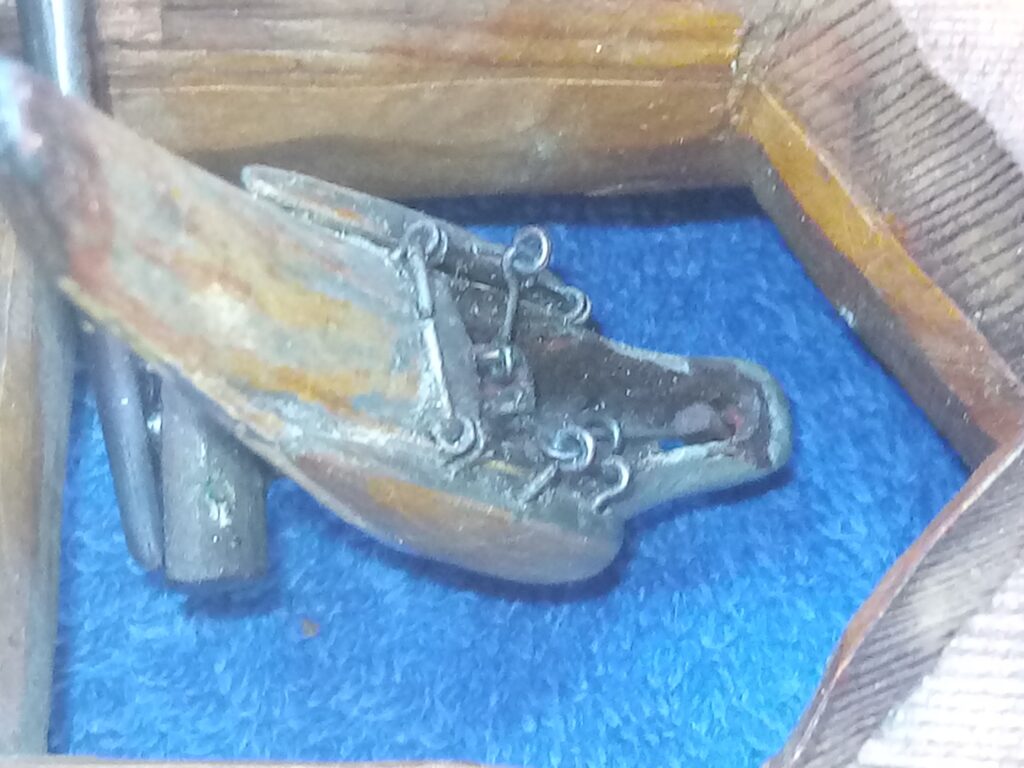
4. Rewired the cuckoo to allow the beak and wings to flare.

5. Set the door latch opening sequence

And all the normal stuff.

Its a great clock and I think I can honestly say that on a damage vs age graph this clock, of all the antique cuckoo clocks we have done, is in the best original condition. It runs brilliantly with a strong tick tock and positive energy pendulum swing. A pleasure to own I expect. Id happilly run this as my main time keeper for the house. Its accurate enough and has a very pleasant bass cuckoo sound achieved with long good quality pipes (the originals).

Junghans P18 b%”*&& problem

Ok so we had a nice c1900 Bracket clock in for a blank cheque resto. When you get an instruction like that, you pay attention. It means its got to be perfect; the money is secondary.

If I said to you “look, I hear you are good and thats what I need. Can you please return this cherished whatever to good working order”, if you are going to say “yes” you have to know you have the required experience to deliver. If you dont deliver then the client will come back again and again with problems. Returning clients with problems are a huge drain on just about every aspect of the business. My business. So, return jobs happen, but one of the key aspects of running a busy clock repair business is to know what a natural unit rate of return is.

1 in 5 is appalling. 1 in 10 is just what you have to deal with if your on a professional journey, and 1 in 20 is background and what to expect if you have machinery, knowledge and experience. Of those 1 in 20, for the vast majority of the time, the problem is a person not understanding how to run a weekly clock and the key “do’s and don’ts”. So basically if your going to do this job you either do it with everything you expect you will need in a worst case scenario, or save yourself a nervous breakdown.

So, on to the close nervous breakdown. That is a bit dramatic but, you know, it bothered me. So I’ve just realised that the point of writing this article has little to do with a P18 movement and Arthurs clock although ill give you and abridged dialog.

Arthur has had two clocks reparied and restored by us. He lives 90 minutes drive away. He gave us a blank cheque order and we did a brilliant job on a difficult movement at half the price of our competitors. Arthur collected the clock and it ran brilliantly, but then one day it made a loud bang when he attempted to wind it.

The clock came back and we did a full strip down diagnostic and found no problem. A week later we found a small fragment of metal in the case. It was clearly recently departed from its parent. We realised we were looking at part of a key. Because the clock had been recently refurbed by us the strength of the springs increased. This meant that an already worn and rattling key fit, finally rounded off internally and failed to provide any purchase on the arbour.

Everyone brings their key when they bring their clock. We only take the clock and not the key. From now on we will test the key fit before declining the key and accepting the clock.

We think we know everything but we don’t. We will…eventually.

From the clients point of view the clock had failed in a major way, when the actuality of the situation was that the problem was not in the clock, but a worn key. We don’t take keys from clients and have our own, so we didn’t have an opportunity to check the fit and chance of it shearing. On this basis we charged the client around 10% of the original bill as it did cover a complete strip down to the heart/spring diagnosis. Had it been bad work on our part there would have been an apology and partial refund of 10%. We get through a lot of clocks and at a 1:20 return rate, a clock every month or two comes back, and in these situations a 10% refund is fair. Its not about the money and all customers end up being someone between friends and acquaintances on a varying balance scale.

Well, an article about fault diagnosis has turned into my own internal process analysis and Ive bored you to sleep probably. Read some of the other articles – they are good. In my opinion. I dont publish boring rubbish!.

Oh. I did. Sod it, pubish and be damned.

A few things we did this week

As a business owner that runs an operation where every single job is different in some way its often quite hard to describe to people what we actually do. “We repair clocks” covers a huge amount of different jobs each with its own associated or individual method. So, its getting to the end of the week and I thought it might be interesting for you to hear the jobs so far and what we did. The following snippets are obviously not the entirety of what has been completed, started, put on the shelf , or picked up again with a new method in mind, but it gives an idea of what we really do. Ok….

Tissot Automatic Mechanical Watch repair

Bob came in with his Tissot. An nice 70’s auto with a gradient fade face in light brown on a gold case with a light leather strap. I wore it for 3 days on test (the only real way which you will have proven in this snippet) and I became quite fond of it.

The reason we were doing this watch is that we had taken on a very strange and exotic movement on for repair, carried that out successfully, and so Bob was coming back with a “no hope” job he had given up on but thought he may now have found somebody up to the job. Actually this sounds rather big headed but its what happened so what am I supposed to write?.

Anyway this watch had been through two high street jewellers and each time had come back unfixed. It ran 20 minutes fast a day. I was confident we could do it so I said “no problem” and got it fixed. The crown gear inside was broken and needed replacing so we sorted that out first. The watch underwent its basic service operations and ran correctly. We charged Bob a very fair price as a returning customer, which he appreciated and ticked it off the list – job done. A week later I got a somewhat annoyed phone call. Now, Bob is a nice guy, and apart from wanting to nuke China, is not in the least confrontational but it was obvious from the tired tone of his report that he felt let down and not entirely by surprise. The watch was running 20 minutes fast.

No. No. No. We have never had a watch back. So I obviously agreed to have it looked at as early as he could get it to me and we did just that. At first we had assumed oil had drifted onto the hair spring through a lubrication error. If oil gets on a hair spring in enough quantity it can form a bridge between concentric passes which has the effect of, from a physics point of view, shortening the spring. A shorter spring will result in a faster oscillation of the balance wheel. The faster the balance wheel cycles the faster the watch will run so it was an obvious assumption to make about the fault.

When the watch was opened there was no oil anywhere it shouldnt have been. We then found that the hair spring was very very slightly warped and close to its platform. If a hiarspring touches its platform mounting while in motion is has exactly the same effect as the oil. It shortens the operating lenght of the spring leadying to a higher BPM (beats per minute). The spring was remounted to be as far as possible from its supporting platform edges and that made the difference. I wore the watch, as I said, for three days. During that time I was half expecting it to run fast for some reason. It didnt and kept perfect time. We also fixed the date wheel advancement which Bob had simply assumed was impossible to fix as the previous repair efforts had not managed that, or possibly even bothered testing it because that part wasn’t a difficult fix.

What was bugging me was “why?”. You see, the watch had been tested the first time and it was running perfectly. It was only when Bob put it on that it started gaining time. At first my thoughts were towards an error in the winding system or gearing but then I had a Eureka moment. Its not that I know this is what was wrong with the watch, its just that its the obvious reason when you think about it, and here it is. HEAT. Bobs body heat when he wore the watch was slighty heating up the carbon steel hair spring. If you deform a hair spring at the beginning of its wind length this warp is exaggerated exponentially by the length of the spring because you are warping along the length of the spring not the diameter of the coil. The spring at room temperature was almost touching the platforms and it was, as sods law dictates, close enough so that any change on its axial level / flatness would bring the end of the spiring in contact with the platform.

Ironically because the connect would have been right at the edge of the coil the watch would still keep running but, for the already stated reason, run slightly fast. If the contact had been in the centre of the coil the watch probably wouldn’t have run and the problem discovered by the other two jewellers, but because I wore the watch I found the problem. Retrospectively of course but that doesnt matter. What is important is that next time it happens we know. Experience like that is money in the bank and better better better. I love better.

Cuckoo Clock previously repaired by a mathematician not an engineer.

Ok so another job this week worthy of mention was a simple two weight cuckoo clock that came in. The owner wanted the clock working but had a limited budget. I explained the pricing policy and range, how we could avoid certain costs, and what may become essential in order to complete the job. On occasions like this I take a bit of a commercial risk. I could see the movement was not standard in many ways, and worse than that there was no obvious reason why the clock should not run. I checked the connecting faces of all the wheel teeth and pinion gears with everything looking in great condition for a 50 year old clock. The bushes were nice and unworn, the gearing mostly clear of fouling, and the pallets in good order. I cleaned the clock on a full disassembly as my thinking was that with such a good condition fit for the bushes it must be oxidation on the inner bush walls. On cleaing and lubrication the clock turned over….but not…right. There is no real way of measuring how much torque an escapement cog is generating, its something you get a feel for after working on a lot of different movements. You recognise a healthy movement in the same way you might an animal. You can just tell, if you know what to look for, that you have a grand national winner or a beach donkey. This one was wearing a red had and carrying a small child jamming an ice cream in its face. So what could the problem be….I had to put this down for a day. I realised during the night what the problem was. The bushes were brilliant. For a 50 year old clock they were immacuate. Too immaculate. Too unworn.

I went in the next day an hour early just because I wanted to check out my theory. I was correct. The clock had been “b*&*^ered about with” by somebody playing “lets try and bush a clock”. It was a bad repair performed years earlier so the patination of the new parts had faded and was undetectable. When you fit a bush for the first time the target is to get a nice snug fit with the current pinion diameter that has worn down on the old bushes. You can overdo this. If you don’t know what sort of torque you should be seeing at the escapement end its going to be very easy to bush a clock so that the fit is a little too snug and doesn’t give the pinion any room for manoeuvre. It needs to have a bit of play in it because you are fitting a bush to a slightly worn pinion gear and wheel. This means the rotation forces are not directly central as when the wheel and pinion gear connect the can move closer and further away from each other during the rotation cycle. This means two things. Tight bushing of this type leads to a cyclic partial seizure in the rotation cycle. In short, the gears are pushed closer and further apart during the cycle. This normally manifests itself as stiffness or partial seizure during each turn at the same point, or at the same frequency depending on the ratio of the gearing. This wasn’t what was happening so I hadn’t spotted it. What had happened was that the pinion gears and wheels were in unworn condition but the clock was simply bushed two tightly on the second wheel. I started at the top and broached the bushes by a fraction of a fraction of a mm and it worked perfectly. Clock repairs are like this a lot of the time. The process of diagnosis is absolutely critical so its important to use methods that explore the configuration, lubrication, and cleaning of components before you create one brass filing. One mistake I made when I first started was that I was too keen and in too much of a hurry generally. I have learned over the years that you have to be focussed and confident with what you are doing. That confidence only comes from success which is the product of method. So before you do anything on a clock work out how you are gong to do it. Allow time for the things you MUST get right first time and if your frustrated with a diagnosis then admit defeat for the day and the high ground will come to you tomorrow. Your brain is working all the time and so if you have a logic problem you will often find the old grey matter will deliver given time and your then running down the street in a towel like Archimedes.

The secret is caring. If you don’t care you wont think about it. Incidentally, care is not the same thing as worry. Its easy to mistake one for the other if its a friends clock you are working on. If you find yourself getting out of your depth and are actually worried then just stop, give the job back, retire and regroup. You cant do that if youve physically changed the shape of any metal in any way which is why its important to understand what a big step it is on a job to make changes you cant come back from or get support on if you need it. Incidentally if you are reading this with your mother in laws clock in 200 bits that somebody “cleared up for you”, rather than divorce, ring me. Its cheaper. Marginally.

(A joke to far – our prices our excellent).

Thats one day of man hours. Quite a few. Clocking is not a fixed hours occupation if your doing other peoples cherished family heirlooms.

Ok. Had enough. Off to bed.

How to build a clock

A lot of the jobs I do rely on two basic things. Firtstly I’m an engineer. I love understanding physics and systems. Secondly I love antiques and history and antiques so every time I see a broken clock I see a broken piece of history. History is history. There isnt old history and new history there is just history. So I fix clocks from any era. This balances well with my love of engineering because clocks encompass history as a constant variable. How we measure time. How we understand time. How we, as innovative human beings, are pressed by a compulsion to improve what we do. Some people believe this is primarily driven by capitalism and the edict of building a better mouse trap, but I believe it is something far more than that. We just like buggering around with things to make them “better” which is an entirely relitavistic word and concept. We promote entropy, the driving forward force of the universe, and just love making things more complicated to improve performance.

But you can over do it.

Clocks really really demonstrate this because in the rush to develop ever more accurate, portable and miniaturised time keeping systems we have made mechanial clocks far more complicated than they need to be in order to do exactly the same job.

So whats the simplist effective way of making a clock?

Its fairly straight forward and you can do it with wood, metal, or reclaimed materials.

A clock comprises of three essentail systems that link in a linear format. These are

  1. Power
  2. Gearing
  3. Regulation

Thats all you need. Its really as simple as that. Lets explore each

  1. Power. Clocks are either driven by springs or weights. Weights are better. This is because they supply a constant force. A hanging weight always weighs the same at the end of a string, not matter how long the string is. So if you base your power source on a weight then you know that the force going through your gearing is going to be constant. That means the rusult will be constant. The results in this case are the rate at which you minute hand goes round 360 degress in an hour. You dont really want that calculation to have variablility within its cycle. So you get a barrel with a cog on the end of it, wrap a string round it, and then hang your weight from the barrel. The turning force of that barrel with the weight hung off it will always be constant. Because you included the cog on the end of the barrel you have a method of transferring that turning power (torque). Torque is measured in foot pounds or newton meters. Imperial and metric. Imagine you have a car wheel. You weld a metal bar that is 1m long to the centre nut so it sticks out like an arm from the centre of the wheel. You then hang a 1kg bag of sugar off the end of the welded rod. You have created a turning force of 10 newton meters. Im not going to bother with an explanation of how newtons are force and KG is mass. Its the same as far as we are concerned in this article. My point is that the force you transmit up a gear train from the source is calculable quite easily. If you hang a 1kg weight from a 1m radius barrel then you are generating 10 newton meters of torque (there are about 10 newtons to a kg). Im probably going to far with the maths here as this is a concept article.
  2. Gearing. The reason you need gearing is to spread out the drop of your weight so your clock doesnt work for 10 minutes before the weight his the floor. Its to slow down the rotation of your barrel with the weight on. Each spindle in a clock has a wheel and a pinion gear. The pinion gear has a set fraction of teeth compared to the wheel mounted on he same spindle. Its a ratio converter for your torque. So you know from “power” what your output is but now you want to divide that up into smaller chunks of power per second. You therefore gear down via connecting pinions and wheels in a sequence until the last cog in your gearing turns quite quickly but with very little force. The last cog in the gearbox is called the “ESCAPEMENT”. This is where the pedal hits the metal and power is transferred to the regulator.
  3. The regulator. The regulator is the part of the clock that actually measures out time into consistent units. The idea is to make one, or an exact division of these units, equal to one second. There are three common types. Quartz crystals that vibrate at a very specific and exact frequency when an electrical current is passed through them, platform escapements where a cartwheel on an axle rotates back and forth because theres a spring attached to it, and a pendulum. A pendulum is the best. A pendulum always swings at the same speed in a vacuum. That means that if you start the pendulum with a big arc or a small arc is will always pass the “down” centre point with the same frequency. Thank Newton (Issac not the unit) and Huygens the astronomer for that. This means that if you put a device on your escapement cog that allows each cog tooth to push the pendulum just enough to account for air resistance then your escapment cog is going to turn at whatver rate the pendulum passes the down centre point. The device that does this is called an anchor escapement. Imagine an upside down anchor hanging over the escapement cog. The pendulum attaches to the shaft of the anchor and the anchor points are set low enough so that when the pendulum is at rest the points sit in-between the escapement cog teeth and prevent it from going round. I wants to go round and is applying force to do so, but not enough to start the heavy pendulum off. If you swing the pendulum then one anchor point goes up and the other goes down. The one that goes down connects with the side of the cog tooth thats trying to turn and the force is transferred to the pendulum. As the pendulum swings to the other side of the anchor comes down in between the escapement teeth and the process of force transmission continues in this repeating cycle.

If you change the length of the pendulum you will find the point at which it swings back and forth at 1 second. If you escapement cog has 60 teeth then bingo (each swing is one second, left or right). That sorts the seconds and minutes out so an hour hand just needs to be put on with an offset cog at a 1:60 ratio. Easy really.

If you have understood this you’ve just made a clock. The actual production is just detail.

Incidentally all this is really down to Newton and Huygens. Every few generations has their greats and if you want to know who ours is its Elon Musk. We are privileged to live in his lifetime and I highly recommend you follow what he is doing, how he does it, and how he thinks. A new type of genius for a new age.

Dual Spring National Time Recorder Clocking in clock – why two springs? Explained.

I teceivef an email asking about the architecture of an easy dual Spring National Time Recorder with an integrated clocking in mechanism. As I was writing the response I thought “thisight interest others….” So. Here is my response.

Dear Malcom,

I think I know the unit you are talking about. Both springs drive the clock and the stamping mech which I found odd but seemed to be the case as there was a single con rod gearing to two wheels either side. I think the springs wind in opposite directions so they can use the same wheel set up to reach this gear that looks like a chuck key end. (they are loop end springs as I remember).I really should be able to recall the name of this conical gear.

At any rate, it’s quite a handy feature as if you disconnect the universal joint on this gear both springs power the clock as the power has to go somewhere and there is no differential joint or slip clutch to stop the power reaching the escapement.

The point here is that main springs on these clocks are massive and hard to source, so the ability to use two half worn springs to drive only the clock means you can get another 20 years of time keeping, albeit without clocking in and out of the house every morning.

You might have a different config as I’ve seen a few and the later ones drive off electric motors, however, if you’ve got the one I think you have, then the above is worth knowing. It’s also quite nice that all your doing is a disconnection as opposed to a modification, so the history of the clock remains intact.

I’ll probabay stick this up as s blog post if you don’t mind; others may find it useful and it saves me explaining it again. These national time recorders are a little bit of our industrial history and I think they shine a light on what it was like to go to work at the silk mills here in Braintree for instance. Pretty much the same as today except now you need tons of planet polluting tech to tell your boss what time you arrived.

Good luck with it and keep on clocking. Apologies for any spelling errors – I’m doing this from my phone watching TV.

Regards,

Justin Holt
Braintree Clock Repairs
07462 269529

Testing the Pendulum on and Electric Clock – fitting a quartz pendulum movement

This is just a quick article to help those people who have a quartz clock with a pendulum.

The way these clocks work is that they have a pulse generator in the electronics that activates a coil based magnet. The switch for this is linked to the pendulum swing (in different ways on different clocks) but all share the same principle. The pendulum bob contains a magnet with north polarity. The electro coil magnet that turn on and off as the pendulum swings has north polarity as well so they repel each other. The coil magnet gets a current at the precise moment the pendulum swings past it and the magnets repel each other pushing the pendulum left or right (depending on which way it is travelling). I have a brilliant Metamec clock that does this on a grand scale and looks like something out of a science experiment from the early 20th century.

The point here is that once you understand what is going on you can test the effectiveness of the coil driving the pendulum. Lets say for instance, your clocks pendulum is siwngs for two minutes and then stops. How do we diagnose the problem?

Well firstly you have to make the assumption that the failed element is either the coil or the fixed magnet, so check the fixed magnet is there and has not fallen off. You have to search with this using another weak magnet or ideally a paper clip. If the paper clip sticks to the pendulum rod at the bottom of its length then you know there is a magnet in there. Once you know the magnet is in the rod then you can check the coil.

Coils rot or break. If you can find the same gauge wire with the same shielding then you can either completely replace the coil wire by re-wrapping it or connect it back up together where it is broken.

A helpful hint on this is to find out just how much power and magnetism the coil is short of in order to drive the pendulum perpetually. You can do this buy running a comparative test. You remove the battery and then swing the pendulum in as near as possible to the original arc you remember it swing back and forth through. This gives you a zero power starting point. You know how long it swings for without any power at all.

You then put the battery in. Get one out of the packet so you are absolutely sure you are not using a dud (Ive done this so many times and it has cost me a lot of confusion time and unnecessary supplier orders). Now swing the pendulum as you did when the battery was not in the unit. Measure how much longer the pendulum swings for. You see in most cases the problem with the coil is a short out. This means only a percentage of the magnetic field is being generated. Because the very low force required of the coil to keep the pendulum swinging you will find that even if the coil is shorted by 90% you will still be able to see this reflected in a longer swinging time than without any power.

This opens up options on what you can do about it because if the coil isn’t getting enough power its highly unlikely this has anything to do with the power source (although there is one thing I will come to later on). It means that the probelm is almost certainly with the coil itself and its electronic joinery. So if the pendulum is at least getting some power you can look at the following options.

  1. Check the solder joints on the end of each wire coil section. On most clocks they are single thread wind so you should only be looking for two contacts. Look carefully at the joints and if they are onto a circuit board then look at the underneath of the circuit board so check of the solder joint has gone on the board as opposed to the end of the wire. If its broken then fix it by re-soldering or establishing a reliable electronic connection in some other way – barrel joining clips can be used on some of he larger coils.
  2. Rewind the coil. You need a micrometer to measure the diameter of the copper wire. There are two diameters to measure – with and without shielding. You then work out the shielding thickness via subtraction and you have a specification for your shielded wire. Go and buy some, rewind the coil with the same length or longer and join it back up to the circuit.
  3. Buy a new movement. This is not as drastic as you might think and should really be the first option for most modern clocks of this type. You just replace the whole thing in the knowledge that your coil or main logic board has failed. Pay attention to dimensions when you buy your integrated movement and pendulum drive unit. The overall depth of your mounted movement is needs to take account of where the pendulum needs to swing. There will only be a certain deviation from is current swinging arc that will work. To explain; lets say the pendulum movement you buy is available with a 21 or 6mm spiggot. On taking your clock apart you find that what you actually need is a 16mm spiggot on the front, otherwise and the glass front wont go back on because the spiggot sticks too far through the clock. At 21mm it was never going to work and at 6mm it was never going to be enough to even get through thickness of your face (you thick face). In this case you need to pad out the mounting on the back and use the 21mm spiggot with only, say, 10mm sticking out of the face . The remaining spiggot length is being taken up by spacers you made up to mount the movement. But heres the problem. By putting he spacers in you have moved the whole movement back by maybe 1cm. If the pendulum hangs down into a glass faced section below the clock you can bet your last quid that it will not fit in this aperture without hitting the back or sides of the clock. The law of sod takes over your project. Your solution is not going to work and never was because you didn’t do your measuring taking pendulum position and length into account. I wont go through what you have to measure; if you understand the principle of what Im saying here you will know what to measure. If you dont then send me the clock to fix and absorb the cost as its not worth you trying and failing and getting terribly frustrated with it. Thats my job, or was a few years ago when I first started doing these. Now I have a method.
  4. If you look at the back of your clock and see that the unit uses two batteries in two separate areas of the clock then you may have an independent pendulum unit with a standard quartz movement in its centre. These are separate components and can be replaced individually. So, if you clock isn’t working but your pendulum is running fine you may just have to replace the clock movement and not the pendulum. This is handy because for a few reasons. Firstly you can buy a new 57mm quartz movement which tend to be standard size for the hand fit. This means you can use your original hands. Secondly the solution is going to be cheaper because there is no need to replace everything. Lastly and most importantly there is an element of standardisation is what these pendulum movements drive and you will probably be able to use your old pendulum with it as they are overpowered in order to drive a wider range of pendulums – completely logical from a design brief and market point of view. Essentially, because its a universal type of product, it is overpowered in my experience which means its more likely to drive whatever pendulum weight or length you have. With the fixed units where you have a truly integrated movement and pendulum driver, you will find that they are only compatible with a range of pendulums. A good bit of advice is to buy a pendulum from the same place at the same time. Its only a few pounds more and allows you a test unit if nothing else. If you get one without buying a guaranteed compatible pendulum how are you going to know if the unit is faulty, badly fitted, or if your pendulum is too heavy. Another area of incompatibility is centre of gravity. The fixings on these units tend to vary from manufacturer to manufacturer so its really easy to get a unit where your existing pendulum cannot be modified to adapt to its new fixing to its armature on the movement. In short, get a back stop position by having a pendulum that you know is compatible before you start work on it. It saves loads of time in the trouble shooting phase.

I do these clocks so if you don’t like the look of all the above give me a ring and I should be able to quote you on the spot after a few questions. Prices vary drastically between £30 and £200 for some of the really really hard fits with only a mm to spare in some areas. There are just not as many types and variants on the integrated pendulum and clock units which means some really imaginative custom fitting on most occasions. While I have my methods, this is one type of job that rarely repeats in exactly the same way and everything is a custom fit in most cases.

Time is money and its never a quick job unless you are lucky to be able to get a exactly the same movement. Even then, through slight design revisions and improvements, the compatible nature of exactly the same movement produced five years apart is far from 100% on most occasions. Its silly things like where they mount the time change button on the back not matching the hole in your clock to gain access to the same. Hanging fixings often change and it means they need to be sawn off. If you saw a quartz movement the vibrations can kill it dead so it means hot wire for cutting and so on and so forth. A lot of work normally and a surprising amount for what should technically be more akin to changing the toner cartridge on a photocopier.

As usual this started as a quick article and has turned into a two hour marathon of cross referencing and developing an understandable narrative. I wouldn’t do it unless I enjoyed it. The other thing is its really quite empowering broadcasting help to such a wide audience. It encourages and motivates me to make what I say understandable. I hope you do.

Guest Blogger Phil Harris – Clock Curator at The Black Country Living Museum. 400 day anniversary clocks..

Phil Harris is the clock curator at the Black Country Living Museum in Dudley (www.bclm.co.uk), which in clock terms, is pretty high kudos. Ive been chatting to Phil via email for maybe a year or more and we often exchange comments on articles and suchlike. Hes really good, and like me, appreciates the antiquity of clocks as much as the engineering.

Ive always said if you want to get into history and you need a thread to follow, clocks make an excellent job of pulling everything together because they are both engineering and interior and exterior design based objects. If you know what a 16th century clock looks like you are pretty close to being able to identify a lot of 16th century furniture or other antique items because design fashion runs in layers through the production of all household goods, rather like the strata you see in geology; different colours and textures in each sequential layer. 

Although phil doesnt repair clocks commercially like me and my associates, he does a museum quality rebuild on the clocks given to his care. That is the top of the game. If you can produce museum quality work you are among the best.

Without people like Phil the world would not be the wonderfully interesting place that it is, and Phil is a testament to what can be achieved if you take time and care over a projects over years and years. A rare breed.

Because he repairs the clocks at a museum the detail is incredibly important, anything less than perfect would be a misrepresentation of our history.

I think Phil thoroughly deserves to be Braintree Clock Repairs first Guest blogger and I can completely endorse him, his work and the people he gives his time to. Brilliant. Anyway, over the Phil…

Hi, I’m Phil Harris and I’ve been following Justin’s fascinating blogs for some time. I am not a professional clock repairer like Justin; I’m a retired Chartered Engineer but merely a self-taught amateur horologist, and I look after the clocks at a local Museum as a volunteer. In correspondence with Justin, I mentioned my interest in 400-day clocks, and Justin very kindly agreed [I begged him – hes brilliant – Justin] that I could write a blog about these intriguing clocks.

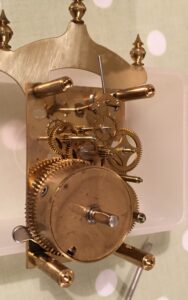
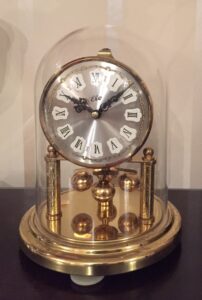
The 400-day or “Anniversary Clock” is a decorative mechanical clock, often covered by a clear glass or acrylic dome, which employs a very slow-turning torsion pendulum. Together with a powerful mainspring and extra arbors in the gear train, which give an overall gear ratio of around 30,000-to-1, these clocks are designed to run for a whole year between windings, hence the name… you wind it up just once a year, on an important anniversary. In contrast, conventional mechanical clocks are usually designed to run for 8 or 14 days.

400DayClockBlog1

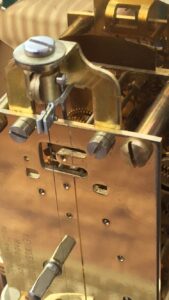
However, such long running – roughly fifty times longer than a conventional 8-day clock – doesn’t come easy. The entire movement is a precision mechanism which needs to be in absolutely pristine condition. The pendulum ‘ticks’ just once every few seconds. Any dirt, old sticky oil or maladjustment is likely to stop the clock. The most delicate part is the thin vertical suspension spring which carries the rotating pendulum bob, and being a mere couple of thousandths of an inch thick, suspensions easily get broken. Fortunately replacements are available, but somewhat awkward to fit unless you have the right tools, dexterity and patience. But, by all means, order a new suspension spring and replace the broken one.

400DayClockBlog2

Sadly, things aren’t always quite that simple. There are about 25 different thicknesses of suspension spring; which one does your clock need? how long should it be? Luckily this information is again readily available, but you’ll need to buy a book – the excellent ‘Horolovar 400-day Clock Repair Guide’ – or ask someone who has a copy, in order to find what you need. And once you’ve fitted the new suspension spring, the likelihood is that the clock won’t run for more than 15 minutes. If you’re lucky, this will be because the suspension simply needs to be put ‘in beat’ which can perhaps take several hours of making tiny adjustments to the upper support block. If you’re unlucky – as seems to happen with four out of every five clocks that I encounter – some other fault is present, and the clock will have to be dismantled and repaired.

Anniversary clocks come in three sizes, standard, miniature and midget, in decreasing order of size and increasing level of difficulty. Many standard-sized clocks are older and more valuable, whereas the miniatures and midgets became increasingly popular from the 1950s onwards and are more likely to appear on the second-hand market. Made mainly in Germany up to the late 1970s, few spare parts are available nowadays other than suspension springs, blocks and forks, main springs and glass or plastic domes. So, what are the likely problems you could encounter?

400DayClockBlog3

I have repaired clocks where a breaking main spring or ratchet wheel has released enough energy to bend a solid steel arbor or gear shaft, and bend or break gearwheel teeth clean off. My most recent clock had been dismantled and reassembled incorrectly by a previous owner, who had bent one of the tiny pin pallets in the process. This had to be replaced, using a 0.3mm diameter piece of hardened and tempered steel wire.

I have also encountered clocks with bent centre shafts – the tiniest amount of inaccuracy here will add enough friction to the motion work that drives the hands to prevent the clock from running – so every component must be cleaned, preferably using clock cleaning fluid in an ultrasonic bath, then carefully inspected under magnification.

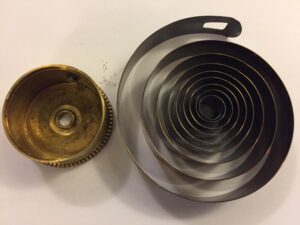
The small pivots at the end of each arbor, together with their matching pivot holes in the plates, must be highly polished in order to reduce friction to the absolute minimum. The closer you look at these small parts, the more you notice the surface roughness of gear and pinion teeth, which often need to be polished away. And the mainspring always needs to be removed, cleaned and lubricated and refitted, or occasionally replaced, a job that definitely requires the right tools. Once all this is done, the gear train can be assembled between the plates and tested for free movement.

400DayClockBlog4

The escapement – the key part of the movement which drives and regulates the swing of the pendulum – comes in two types, Graham dead-beat and pin-pallet, and both have their own nuances and quirks. Sadly it is common to find that some previous owner or ‘repairer’ has twiddled one or all of the possible adjustments in a failed attempt to get the clock to run, when all it really needed was a good clean and service. Many then end up for sale on eBay… Adjusting a 400-day clock escapement can take many hours of further work making tiny changes, then reassembling and testing, and finally adjusted for good timekeeping before the clock can be considered reliable.

Personally, I wouldn’t advise anyone to tackle a 400-day as their first clock to repair. I had restored around 60 ‘conventional’ clocks before I took on my first 400-day clock, and I soon realised how much I still had to learn! 400DayClockBlog5

A lot of 400-day clocks were given as presents or wedding gifts and often have a sentimental value far in excess of their monetary worth, but these clocks are generally well-made and when properly cared-for and serviced, can carry on working literally for generations. Because so much work is involved, however, many professional clock repairers nowadays simply refuse to accept 400-day clocks for servicing or repair. Fortunately, though, Justin at Braintree Clock Repairs still takes these beautiful clocks on, at very reasonable prices, and gives a guarantee on all his work. Why not give him a call?
Phil Harris CEng FCIBSE MIEE

[Thanks for you kind words Phil, but more importantly thanks for sharing your excellent experience and knowledge. I have deep respect for any man who knows the overall gear ratio of a 400 day clock to be 30,000 to 1. I did not know this but it is now burnt into my memory by the shame of being “out-knowledged”.  Thanks again old chap – Justin]