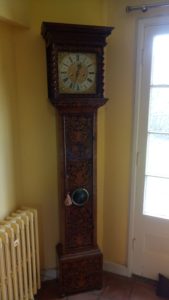
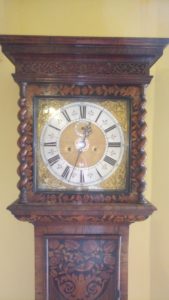
Bracket “Clock” Rude Printing Error

Well. This is what happened. We were doing a mailshot for the Antiques Centre and Braintree Clock Repairs.

I was put in charge of the artwork as I have some experience in computer design, despite despising computers. Incidentally I now despise computers even more, however, back to the point.

We were in a rush to get the mailshot done for one reason or another and so the “proof reading bit”, for which I should have not been made responsible in my view, was my responsibility.

Now as many of you will know, when you read, you do not read the letters. Your brain translates the shape of the word and then you speed on to the next word and so on and so forth.

This makes spelling mistakes that don’t change the SHAPE of the word very hard to see. For instance the word clock, if written in capitals, looks the same shape as the word… well Ill let you find it. Look for the words “Bracket Clock” and then look at it again.

It was a 5000 print run. It is now a heavy box of paper for recycling.

Ill stick to fixing clocks. Advertising doesn’t seem to be my game.

Bracket_Cock_Repair


National Time Recorder Clock Repair

This is a great looking and sounding clock which does what all the best ones do – it tells a bit about when it came from.

National Time Recorder Clock

For those who done recognise this, its the clock used to log employees arrival and leaving time at work. People were paid on the beat and accuracy of this clock which is why its so well made and in a particular way.

The mechanism in the base deals with the advancement of a set of print dials that stamp and date and time on the cards inserted in the front. It operates entirely independently from the clock apart from a single rod interface that revolves once and hour. Thats all you need if you keep maths next to the printing mechanics and it makes a lot of sense.

What is unusual about this clock is that you will notice it has two winding holes. On a normal clock, one winder would drive the chime and the other the clock itself. There is no chime on this clock of course and the purpose of the second winder is to supercharge the clocks power with two springs driving a single drive train. This would completely overpower the clock in normal circumstances but it has been done because the extra power is sent down and torque via the con rod to the printing mechanism below.

This is a brilliant design because it allows both the data about time (one revolution per hour) and the power for the mechanism to be delivered at the same time with the printing. Cleverly, it also means the movement and printing mechanism wont jam up as they may do if they were powered by independent springs that might be at difference stages in their wind.

Good design!.

Heres the “twin turbo” stripped down. The springs on this were the largest loop ends Ive worked with. True respect during handling is necessary with this guage of spring as it really can break bones. I dint have an unwinding tool arbor big enough for the spiggots they were so large.

National_Time_Recorder_RepairUnwinding the springs was a 90 degree rotation at a time with thick safety gloves and thick apron. In the past I’ve taken a big spring in the… well you can imagine as I was working at bench  / waist height. After that you dont worry too much about the extra hassle of protective wear even if its 10 minutes of digging around for tougher protective gear out for a 2 minute job.

I used a particularly large grandfather clock crank key wrapped in a towel to hold the arbor while I released the ratchet. Its a handy trick if you don’t have a winder – put the key on the arbour and then make a “turban” around it with towelling. This stops you having to handle a “hot” key and means if it does slip from your grip, the towel creates huge drag to stop it spinning and flying off / twisting your fingers.


Christopher Gould Grandfather Clock Repair – Fecit Londini c1700

This is a clock I recently provided a mechanical reapair for. Its a particularly nice and rare Gould clock with the all important “Fecit Londini” inscription that means “made in London”. This might not seem much of a credential to have but this inscription was only used on early fine London guild member built clocks.

The face is original and features an early shutter bold mechanism that allows the clock to keep running while the weights are wound up. Bear in mind that it takes about 20 seconds to wind up the clock. Without the shutter bolt, the clock would be running 80 seconds slow over a month. At the time this clock was made such accuracy was thought to be both useful and prestigious.

The other great feature on these early clocks is the glass lenticle which shows the moving pendulum. It doesnt really have a practical purpose but it looks great and gives the cock more movement and life when you look at it.

The case is original and very well produced as well as being in excellent condition.

It had suffered some quite serious wear in the bell stantion. This was always going to happen as once I inspected the component it had a carbon streak fault line in casting. Im surprised this wasnt picked up by the maker during production but it was burried under some anvil work so…forgiveable!.

The more serious problem was the post for the hour wheel gearing had lost its thread and detached which had caused a complete disconnection of the front of face gearing and associated problems. With a bit of careful modification and testing we got there in the end using the original components. Its quite important to use original parts a far as abolutely possible on clocks like this although worn wheels and pinions cant be saved or adjusted for sometimes.

I’m often asked to date and value grandfather clocks. I put this down as 1690-1700 on the date due to the lenticle and face style.

These clocks becoming very rare in good condition, and while values have tumbled in the past few years they are now returning – specially at the top end things where this clock sits firmly. To buy this you would have to pay between 10k and up to 20k but the longer you wait on one like this (at the moment) the better and better the value is going to get.

I don’t care about clock values in the least and will work on whatever is put in front of me of course, but its always nice to get a famous name in the workshop and see what the top of the game was at that time.

DSC_0285DSC_0286DSC_0289


Secticon Clock Repair – electromechanical swiss balance

An old friend of mine, Richard Chamberlain, asked me to repair a secticon clock. Richard is a well known figure and authority on late 20th century design and a lot of his stuff goes out on museum tour. I was therefore reasonably nervous about handling the clock as Id not done a secticon before and wasn’t sure what to expect inside.

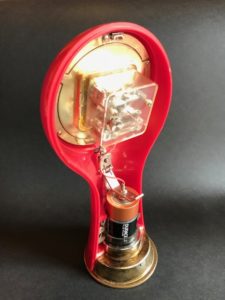
What I found was very pleasing, complicated and generally interesting. It turned out to be a 1.5v electro-mechinical movement with a modified carraige clock escapement driven by a two terminal copper coil motor. Whats hard about about that?.

Well everything really. Not least that the clutch connecting the motor to the escapement drive mounted above it was made from some sort of exotic fibrous material – a cross between hair and rubber is the closest description I can give. Everything is specialised on Swiss mechs. If you look at the comparable German metamec housed 606e from the same period everything in it probably came out of a gas meter or was standard in some way. I could mend the solenoid on it for instance or the coil. There is hope with machines like that but with the Swiss specialist stuff you can give up on any hope of replacement parts or component compatibility. You have to refurb whats left in some way which is why it can be so problematic.

I spent a lot of time examining the movement functioning and understanding exactly how the power from each engine turn translated into hand movement. Its actually too complicated to describe so I wont bother but there were at least 2 methods of power transfer in the gearing types I have not seen before, one involving a screw drive.

On this occasion the problems on the inside of the clock were mechanical as well as battery leak related.

Firstly it was cleaned with the right solvents in the right order to remove very light corrosion from the airborne acid which isn’t that concentrated – you normally get away with it. t was only the fact that the chaps at secticon had isolated the movement in a sealed plastic housing that saved the coil. Normally when a battery leaks in a 60’s electromechanical it destroys the coil insulation and thats really game over. Good design countered this problem and paid off.

The second problem was a relatively minor with a dislocated porprietary design pallet having over shot itself into a jammed position. This just slipped back into place when the balance wheel was over rotated. That took some finding and working out mind you – a very Swiss arrangement i.e. not seen anywhere else.

I didnt get round to finishing it until the night before I was meeting Richard for lunch. Consequently I couldn’t test the final fix as I didn’t have a battery, however, it functioned on a multi power supply at 1.1v just about so I thought it was probably ok.

Well it turned out it was ok and Richard was kind enough to send some of the pictures he has had done of it. It really is a very striking clock and currently values at around £1000 mark. Having worked on it I would say its probably well worth that.

Incidentally if you have one of these secticon clocks and dont know how to get the back off then turn the butterfly nut on the bottom to activate a release cam. This sometimes jams and cant be moved, in which case pull the two halves of the clock apart from the top. There is a spring clip that will release the two halves and no other fixings that will break. Straight forward construction. Don’t use a knife to lever the two halves apart – get a good grip instead and you wont damage it.

IMG_0987

IMG_0999

IMG_1002 (1)