Massive email backlog.

Because I am literally the only free resource of project specific advice online I am unable to use email anymore. As an example 40% of my time is now unpaid advice via email.

I still enjoy helping people with basic questions and quotes but doing this via email is not economically viable.

From hereon I will only be available on the phone (07462 269 529).

This is not a decision I have taken lightly – it’s just common sense. Why are we emailing each other all the time when a phone call is far more pleasant, efficient and gives you the estimate / conversation you would have wanted in the first place.

ill be removing my email address from the website shortly and expect a %20 increase in customer service.

All the very best,

Justin

For the heroes of clockery who are at their wits end.

I get enough email from amatieur clockists asking for advice. Every clock is different and thats the challenge. I can only offer general advice and that annoys me. Its your fight and you have to persist. If you dont you fail (which is allowed) Its about something else. Its a passion and drive to defeat the gods by knowing their game. It comes with time and hard work. It takes dedication.

Email from Phil Harris – Black Country Living Museum

Ok so this is not actually a blog by Phil but he sent me an email asking why I had not published much recently and if I was OK. Firstly, how bloody nice!. You know if we were all the men that Phil is the world would be a much happier place. Luckily we do have people like Phil and you (hey, why would you be reading this otherwise – its not exactly a summer blockbuster). Incidentally, the reason I dont post as much as I used to is that I now have more responsibities as the business grows. I still love blogging and I will try to make more time for it. At the moment, every second I spend on the keyboard as opposed to the tools ends up costing people who rely on my money or time.

Anyway, back to the point of this post,

You know, people think Curators are some sort of security force or official at a Museum. This article will change your mind about that. Bear in mind that Phil looks after a limited classification of items. I dont think hes into everything, for instance weaving technologies / spinning jenny although to be absolutely honest I dont know and he may be the words foremost expert on 19th century weaving machinery – It really would not surprise me.

The reason Im publishing this is as a doff of the old cap to those brilliant individuals who keep our industrial, engineering heritage alive with their own efforts (as a vollunteer as you will find most curators are). This is important because there is no difference between Elon Musk and the early road builders like Macaddam. You have heard of Macaddam and you think probably think its a brand to do with tarmac (which probably is a brand), but Maccadam was not a brand (I dont think – dont sue me!). He invented a process for laying roads using smaller stones than paving stones. This homogenation of the particulates in road surfaces (all the same sized smallish stones) uncovered what is essentailly a fluid dynamics principle that locks particles within a varying tollerance into what is best considered as an alloy matrix. If you put a load of grapefruit sized stones with a load of walnut sized stones and then lay that down as a foundation of a road, it will cause rutting. You can even see this on modern roads where there are two distinct tracks on the road infront that follow the tracking of everyones wheels.

Macaddam must have spent some time working with different stone sized mixtures to work out the best mix to avoid ruttting. You know that because his tennet was, I believe, “if you can fit the stone in your mouth, its too big for the road”.

That implies measurement and testing. It also means this bloke understood fluid dynamics, even if those principles had not been named centuries later. I mean you have to love it. We were still in the stone age until the mid 18th Century….. or were we?. DId the architechts of Stone Henge lay thier surrounding roads and discover the same thing via repeatable experimentation (the scientific method – formalised by Galileo Galilee in 1650 or so). Who knows. There is always more to do in archaeology

Its all facinating and very intyeresting to find out what you could be if you just do something like work out how to make a better road, even if you dont really understand how its better.

This is the sort of information curators have. People who go to Museums and dont ask curators (available) for information are wasting a huge opportunity. Its lilke buying a blook and then ripping out all the pages that dont have a picture on them.

Anyway, here is Phils emial (very lightly edited for publication but all his own words). There are a some gems in this email……..

Hi Justin, I hope you are keeping well.

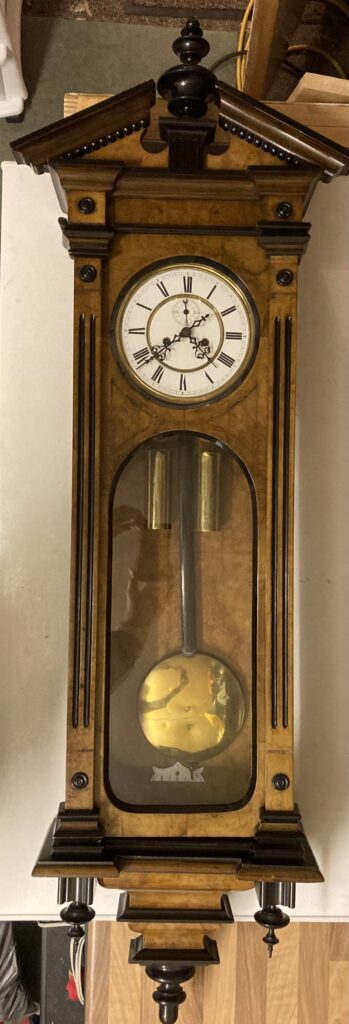
I haven’t been in touch for a while, basically because I was a bit worried about you as you hadn’t been posting on your brilliant blog since last March. However today I found your most recent blogs plus your latest piece on Vienna Regulators, and it has prompted me to write to you because I have just been given one! A rather nice Concordia twin-weight Vienna Regulator from about 1883 in a large handsome walnut case. It had been dropped and the pendulum rod was broken. I haven’t stripped it down yet, so I found your latest blog post very helpful. Although I’ve restored several “Vienna-style” spring-driven clocks before, I’ve never had a proper weight-driven regulator and your advice is very sound. To me, it looks in engineering terms a bit like an over-sized and fast-running 400-day clock; the pivots are tiny, the weights aren’t heavy at all, and the pendulum is massive. Apparently the Concordia factory was set up in Germany by ex-Gustav Becker employees, and although the movement is unsigned it is almost identical to a GB. I will take a great deal of care whilst restoring it. Picture attached.

While I’m writing, I hope you don’t mind my sharing the two latest clocks I’ve overhauled for the Black Country Living Museum. The first was an old (1860-ish) Anglo-American clock that they found in semi-derelict and filthy condition under a bed in a disused room. To cut a long story short, this clock was so worn-out it should really have been scrapped, and it took me months to get it going. Someone previously had stripped out the entire strike train, which is why you’ll notice there’s only one winding hole… Almost every pivot hole needed bushing; every trundle in every lantern pinion needed replacing; every wheel tooth needed filing back to a sensible profile; the mainspring needed replacing; the click and rivet were replaced; the dial needed replacing and so did the pendulum bob. Having done all that and more, and cleaned up and French polished the case, it looks good in its new home, the public bar of the recently-opened Elephant & Castle pub. Photos attached.

The second one was a 12″ English Dial fusee timepiece with a short pendulum. The pendulum was missing completely, and it took me some time to source a replacement and get it running to time, but again it looks just the job in the pub’s Smoke Room. I’d never tackled a fusee movement before. This one had no maker’s name on it, but it was a good quality movement, the fusee cable was perfect and the mainspring was smooth, so I chickened out of removing the spring as I didn’t trust my spring winder to hold the power. The other repair demands a confession, which I’ll happily admit to you. The escape wheel had one tooth about half the length of the others. The clock runs for a whole week and keeps perfect time throughout, so I’m happy and so are the Museum! Photo attached.

With my very best wishes,
Phil

[Justin – These are NOT easy clocks – specially the Regulator / Tall Clock. Maximum respect. Even the fusee is a right….]

Ive been busy. Apogies to those who follow this blog. Vienna regulators.

Ok so Ive been rather busy for ages and Ive not pubished to this blog for some time. I enjoy writing it and I know it helps people who want to get into clock mechanics. Education within my community has always been a fundemental from the beginning and I have neglected you. I apologise.

So I feel obliged to pubilish something useful to somebody. That somebody is the person who owns what is known as a regulator, Vienna or otherwise.

These clocks are the devil incarnate. They operate on a very low power consumption and will refuse to work if you speak to them innapropriately (we all talk to our clocks….dont we?. Ok forget I said that).

The longcase clock was developed for accuracy. To cut a long story short the pendulum as a regulatory device spawned the long case clock, however, the prinicple of a long pendulum delivering increasing levels of accuracy comesurate with its length, then began to exetend to other types of clock. Furthermore, with the increase in engineering precision it was possible to not only have a long pendulum providing accurate beat consistency, but it did not really matter what type of clock had that long pendulum. It could be a wall clock for instance. Or a tower clock with the vertical space available.

Because clocks were the top tech of their time, at least that available to the public buyer, there was an almost unstopable market force towards convenience, price and refinement. That is where Vienna regulators come from. Those simple design propositions driven by knowledge and experience. With the development of the regulator you no longer had to have the granfather clock which was essentially a large wooden butler standing in your hallway hicupping every second. You could have a wall mounted piece of techno beauty on your study wall, quietly advising you of the EXACT time.

What a lot of Vienna Regulator owners these days dont appreaciate is why these clock were practical, accurate, and advanced. They were the Tesla Phone of their time. Ill qualify that. A Tesla phone works from a sattelite. Not through wires in the ground. This means it is a step change in the engineering of communication. It doesnt suffer from terrestrial problems of physical “connection” or the frailty of borders or law. It sends your words to the sky and returns them to your desired destination without the majority of connection predjudice (wars, power outages, idiots, profit) and is worthy becuase it is indescrimate. It provides the same simple connection architechture that seems to define successful modern communications.

In the same way the regulator took the basic priniciples of the pendulums newtonian regularity in oscillation to the wall, not the floor. You have to remember that at the time these were produced the only reliable accurate time could be obtained by clumsy floor standing devices or a church. Or a very expensive pocket watch.

To take this accuracy out of the chapel or hallway some adjustments to the ratio of things were required. Firstly, you cant hang 25kg of weights onto the wall withou the whole clock ripping itself from its fixings and becoming modern art on the floor. To achieve the same, or better accuracy, from a wall clock would mean a long pendulum interfaced to a movement that required far less power (think KG) to work. So the regulator was born.

These devices are accurate. They are also particularly low power consumption per tick and tock. Compare the shaving foam cannister sized weights on a regulator with the massive 12kg plus weights on a long case clock. There is a massive degree of difference. So to make what is effectively a wall mounted grandfather clock, something had to be changed. This was the refinement of the mechanics to provide a low friction and energy consumption device.

As a clock repairer this presents problems. With a Gradfather clock you have a huge amount of grunt available to drive the gearing. This means that the cogs dont have to mesh exactly, the friction generated within the mechanism is almost incidental and of no great importance because there is so much power. With a regulator this is turned on its head. The machines are designed to almost conserve power. They operate as accurately as a long case clock but at 20% of the power on roughly the same dial size (all things considered).

Fundementally Vienna regulators use loads of refinement and vectors and spectors/indian shamam spirits and angles to achieve the same thing as a long case. The cost is complexity and low wear tollerances.

I probably get one call a week from someone asking me (as a last resort because they have attempted a home fix),”why does it only run for 3 hours, all it did was change the cables”. The answer is that the clock is so accurately balanced between perpetual motion with a tiny power input, and a clock that consumes more potentail and kinetic energy than the drive (weights) provide.

You may well have taken your regulator apart. You found a relatively low quantity of gears and simplistic engineering design overall. You probably didnt notice just how thin or small the connecting components connection points are. You wont have noticed that the pallets are two bits of carbon steel with screw down variable settings so that you can adjust very precisely how much pallet connects with how much escape wheel tooth. You probably thought it was just another variant of standard clock gearing and functional modules (power, gearing, regulation).

It is hard to overstate the importance of these physical ratios in a regulator. It really is beyond mathematics. With a regulator everything is pushed to the edge of its performance within the power available from two relatively small weights that run the clock for EIGHT sodding days.

Repairing these clocks or servicing them is an absolute nightmare. Its near impossible to quote for these jobs because, potentailly, it could involve re-refining all the gear train components as well as setting the pallets to the right level above the escapement to within thousands of an inch. All of which has to be done by test. There are no manuals. There is no other knowledge on the engineering settings of your clock other than that contained in your service partners brain.

So, if you want your 4ft regulator fixed there are a few things worth considering.

Fistly, if youve already tried yourself because your reckon you know what you are doing and you worked in engineering, but are now retired, you probably quadrupled your repair bill. Your service partner will have no indication of “what was” because youve changed settings, and effecively erased the original settings, by buggering around with it. This means the repair will be based on a first pass of replacing wear, and a much longer phase of working out how all the forces in the gearing deliver a result.

Secondly, do not let anyone touch your precious clock who does not have considerable experience in working with these machines. When I started I lost a shed load of money spending rediculous hours working out what worked and where the likely weaknesses in an machine were. What will probably happen if you give one of these clock to anyone that is less than “advanced”, is that you will not seee your clock for at least a year at which point you will eventually have the “errr.. we cant do it” discussion.

I love all clocks but there is special place in my heart for these time keepers. It is a black bit. Yes you read it right, I dont like these machines simply because its just so easy to underplay the potentail costs and problems.

Thats the negative view of a stressed out clock repairer. My view is that they are beautiful fantastic machines that will keep better time than your Rolex. I know that for a fact. BUT you have to respect the design and principles of these incredible machines before owning one or you will not budget for maintenance at the correct level and end up with a clock you can not bear to lose but cannot afford to fix. Like a hanging corpse.

I may need to go back and redo that “making your business attractive to potential clients” course.

1930’s Long case – Deco. Pendulum Adjustment.

This is a quick one to thank my peers in the craft. Its how to adjust the pendum settings on a domed top, arabic with brass bezel, long case clock. If you are reading this you already know what Im talking about. That said this is for my more advanced readers as well so Ill publish with that in mind.

The pendulum leader has a turning wheel on it. This is there to allow for horizontal alignment of the beat/balance settting process. This hower has a larger guage balance setter in the form of a pallet arbour clutch.

If you get a situation where the wheel doesnt achieve the desired horzontal offset you can remove the pendulum and while holding the suspension spring, force the whole leader left of right beyond its point of natural resistance. I had one of these as a job, and I did this without removing the face or taking the whole shelf and movement out. This is why Im pulishing it; it took half the time and money discovering this “blind”, so I know it can be done by others.

Also these clocks are absolute nightmares to repair generally. The chime control system is under-specified, for the size and of forces the the massive wheights they have can take. Basically, in my opinion the things are a large mantle clock movements in a long cases…….

With massive torque and revolutions per operation. The top level flys clutch sytem fails, then top pinions on it spiin too fast and its rattling or so badly bush worn it take the whole gear train torque transfer down by about 50%. If this was a car (an analogy I ofter use), it would be an Alfa Romeo. Absolutely beautiful, exquisite lightly specified components, and a lot of power in comparison to other long case, and generally much older, clocks. Im not sure if the people who get to own these clocks, often inherited, understand that have been handed a financial bomb with a lit fuse.

Still, intersting clocks when they are completely mechanically restored as they normally have epic chimes.