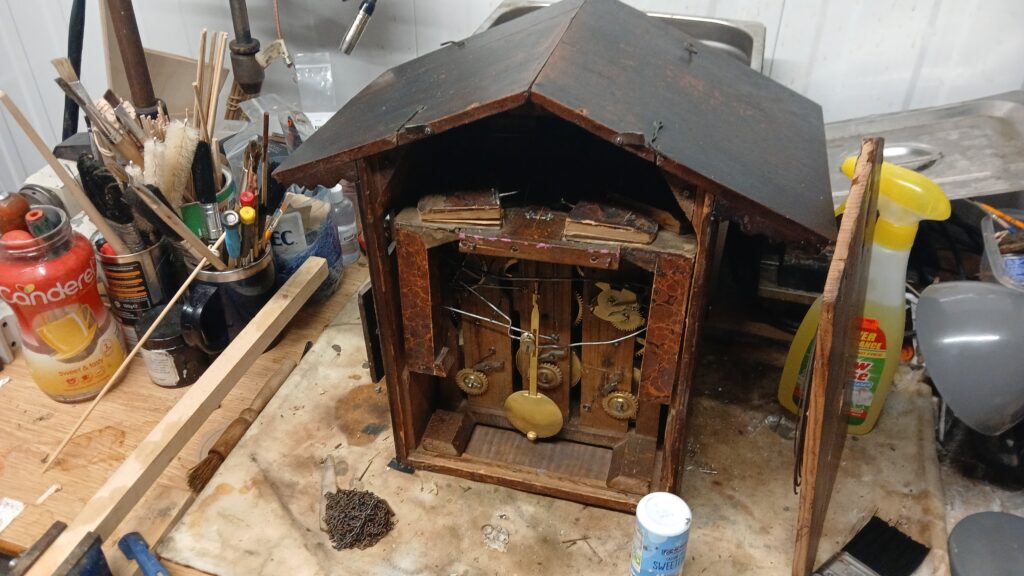
We do more cuckoo clocks than anything else – modern or old. We got into it about 15 years ago, and because it became a specialisation, work pours in. Anything from a 1980’s 2 weight mechine to this “best ever” Tripple fusee black forest victorian cuckoo.
It was a very difficult job but we did it and we were the only people who would take it on. This is hardly surprising as the clock is almost a “one off”. I imagine there are other machines out there with the same feature set (and finely carved/produced) but this is the first one I have seen in almost 20 years. I thought I had bragging rights with my 1860 Dresden table standing cuckoo clock, but this is a country mile ahead of it. Im not going to publish a shot from the front because I have not yet asked the owners permission, however, and rather anonymous shot of the mechanics should be fine and tell the story.
There are 3 gear trains and 3 bellows. This drives two cuckoos on independent synchronised chiming for both the quarter and full hours. This is not something Ive seen on a wooden cage movement before and for good reason. Its complicated!. Cuckoo clocks tend towards simplicity in what they do but this one is as much of a computer as anything Tompion made in my opinion.
You dont really need to understand how it works to appreciate its early complex engineering so I will leave you with a picture to drool over.
Thats the preparation and laquer bench by the way – not the work station!.
I have done more gravel driveway miles than Macadam (1756 – 1836). Expensive clocks are often in larger houses and this is a typical call out…
I recieve a call, the normal thing.
“My clock has stopped”
“ok no problem – give me some details on what and where and Ill tell you if we can help”.
“its on the wall and it loses 15 minutes a day and stops sometimes. The clock cant be moved so we can come and pick you up and take you to it”
“No problem, see you on Monday”.
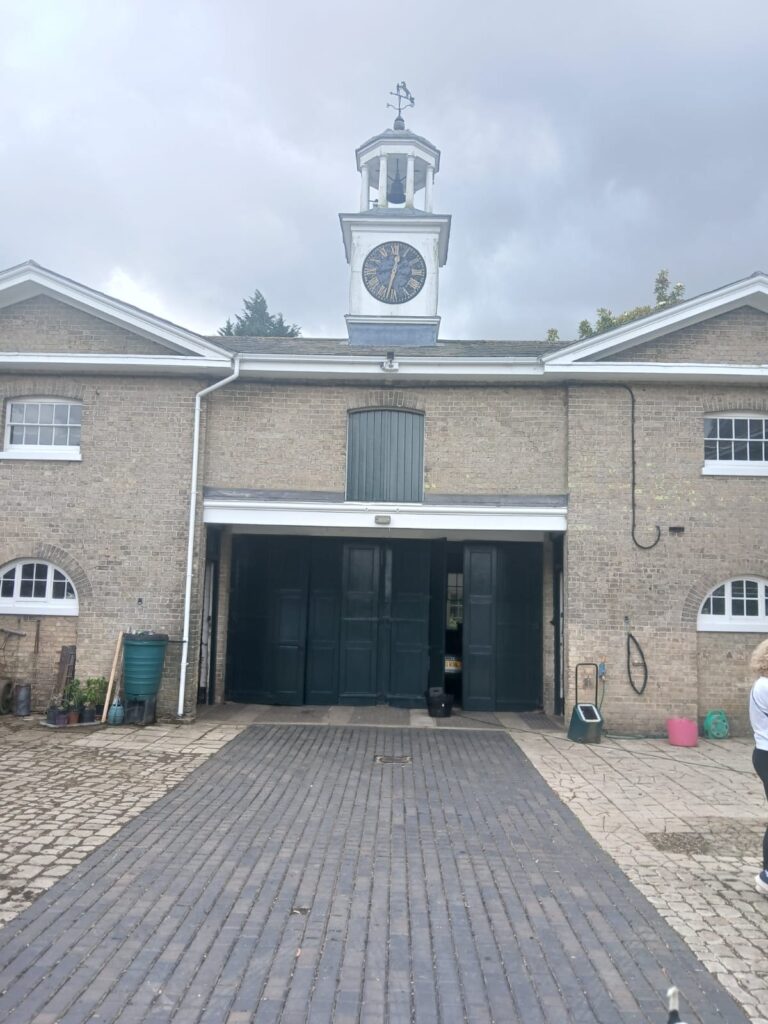
Monday came and so did the client. I was driven to what I can only assume is Batmans house. It featured more land than a reservoir, an impressive black iron gate, a drive so long you could not see the house at the end of it and some stables. We arrived a the house after the safari down the drive and arrived at the mansion. I unpacked and asked where the clock was. The customer looked up and so did I. The “clock” was a tower clock – a full on church washing machine sized movement. I wasnt really surprised to be fair but had expected something indoors that looked like a church organ.
I got on with the inspection and assessment but needed to pay a visit. The customer showed me the smallest room and I went through.
Now, on my bathroom wall I have a bronze swimming certificate and picture. On his bathroom wall he had a massive poster with period script… an MBE. It turns out the clock owner did 20 years of particularly worthy charity work.
Tomorrow someone is coming in with a 30 year old wall clock. There is no telling what is next.
Firstly, Thanks to Phil you have another really good article by and experienced museum restorer. I can tell you for a fact that these Viennas are always ALWAYS troublesome. They feature a low power deadbeat escapment on a simple but fine movement in most instances. As an amateur is just a bridge to far but if you are going in with a scredriver in your mouth like a commandos dagger then pay attention to clock SAS phil who will lead your four man patrol. So cam up and prepare for your mission briefing. Your sanity will be sent back to your family covered in a flag should you fall. Probably. Or the loony bin. Over to Phil..
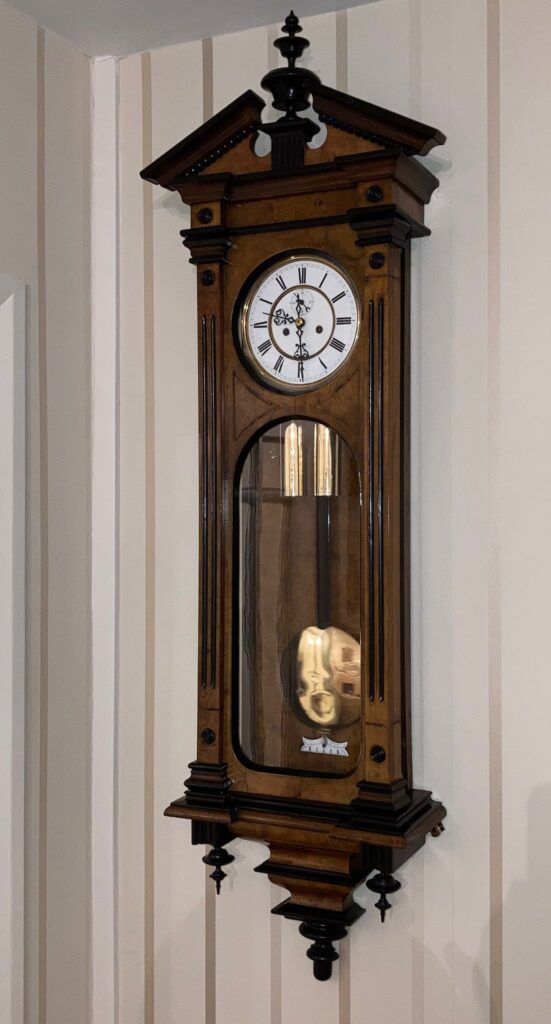
Hi again, it’s Phil here. Justin very kindly lets me submit an occasional “guest blog”, and this summer I took a few days off from my voluntary work as Volunteer Horologist at the Black Country Living Museum to devote some time to restoring a lovely clock I was given a while ago – an 1885 Concordia twin-weight Vienna Regulator.
In February 2023, Justin posted a really descriptive blog about Vienna Regulators, how he loathes them and how they are very difficult to service – at a predictable and profitable cost – and I don’t propose to repeat any of that. As a result of reading Justin’s blog, however, I was pre-warned, so I approached this clock of mine with some trepidation. Justin’s conclusion that you need a degree of horological expertise before owning a Vienna is absolutely correct!
I was given the clock in March 2023 by a generous Repair Cafe customer, because it had fallen off the wall, a fate seemingly quite common with these big heavy wall clocks, and the owner felt the cost of a professional repair would be prohibitive. The wooden pendulum rod was snapped in two right across the crutch slot, the base of the case had snapped clean off, several mouldings and small pieces of trim were missing, most of the finials were loose and a number of joints in the case structure had split apart. Remarkably, the glass panels and the decorative crown were still intact. Hoping for a quick fix (one will come to me some day, eventually, but this wasn’t it) I repaired the pendulum rod with epoxy resin, and when it had eventually cured I set the clock up and tried it. Nothing… it ran sluggishly for barely one revolution of the escape wheel, ticking feebly, then stopped, suggesting a lot of dirt and friction in the pivots.
[Justin: If I had that description for a job quotation I would have to differenciate between my contact telephone number and the price. Phil is clearly a maniac. Love it – fantastic]
Fast forward a couple of years and I recently got round to looking at the clock. I spent some time studying the operation of the strike release and locking mechanism, as it’s quite different from conventional rack striking. Rather than falling onto the snail by gravity, the rack tail is pressed upwards by a spring and contacts the snail from below. I took some photos of the way the components were planted. I also spent a lot of time storing and labelling all the tiny pins, screws and other parts from the front plate in the sequence I’d removed them. Then it was time to split the plates, which I did very gingerly – no surprises, thankfully – and systematically removed the train wheels and other components, taking a photo after each step. I used to do this every time when I started out on clocks nearly ten years ago, but let it lapse as I gained experience. However this was my first-ever Vienna, and I wanted a clear record of the order and placing of all the arbors.
As Justin said, with the front plate removed the two-train movement looks deceptively uncomplicated, but the pivots are hardened and tiny at 0.5mm diameter. The going side has maintaining power, so I dismantled both great wheel and winding drum assemblies to clean and service the click springs and ratchets, as well as to replace the gut lines. The dead-beat Vulliamy escapement had been “messed-with”, something all clock repairers dread, as the double-ended pallets had been reversed due to wear, and one of the pallet clamping screws had been inserted cross-threaded. I managed to re-insert this screw properly and clamp the pallet tight, fortunately without disturbing its position. Adjusting Vulliamy pallets is never easy – I’ve had to do it only once, on a 400-day clock, and I’d prefer to avoid doing it again if at all possible. The whole movement was very dirty and oily, so the plates went into clock cleaning fluid, and the wheels and arbors went into my small domestic ultrasonic. Part-way through the process I gave everything a careful rub with 0000-grade wire wool. After finally rinsing in hot water and drying, the brass parts were gleaming, and I had no excuse to delay reassembly… starting by fitting new 0.8mm gut lines, which on this movement can only be done when the plates are apart.
I polished the pallets and pivots and pegged out the pivot holes, not easy as they’re so small, and refitted the train wheels. On the strike side, it’s essential to place the wheels as they would be positioned at the end of a run, with the hammer tail having just dropped off a lifting pin and with the warning wheel pin having over half a turn to run. I’ve struggled with these issues on some American clocks in the past, but luck and good fortune were on my side this time, as once the plates were back together – being very careful with those tiny pivots – the strike train worked perfectly first time. Planting the cannon pinion and intermediate wheel gave me more difficulty. The cannon pinion carries a pin that advances the snail, via a star wheel with a spring-loaded detent, as the hour approaches. The intermediate wheel sits above and meshes with the cannon pinion, and carries two pins on its front, one to release the strike for the half-hour positioned nearer the wheel’s centre, and the second for the hour 180 degrees apart nearer the wheel’s rim. The pins lift and release the lifting lever to initiate the warning and the strike on the hour. Plus the square for the minute hand needed to hold the hand at 12 when the hour strike releases… Getting all these into the right places took me some time, as the hour wheel has to be in place on the cannon pipe before the cock holding the intermediate wheel’s front pivot can be fitted. Fiddly and awkward, but ultimately completed successfully.
I spent some time adjusting the pendulum, which wanted to swing in an ellipse. Obviously the clock’s fall from the wall had stressed the pendulum and its hanging components. On and off, this took most of a day till I was satisfied that the pendulum hung plumb and swung in a single plane.
The clock ran perfectly once I’d reassembled it and lubricated everything. I was a bit concerned about the small amplitude of swing, but that is apparently normal for many Viennas as the pallets span 11 or 12 EW teeth. The overswing is plentiful, which is my criterion for a good working escapement. I use the ‘slow-motion’ video feature on my iPhone (other smartphones are available) to see the overswing clearly.
A lot of thought must have gone into the design of the Vienna Regulator. One thing I didn’t realise was that the weights descend at exactly the same rate; some careful calculations involving drum diameters and gear ratios must have been done to achieve this nice feature. One odd thing common to many Viennas is that the subsidiary “seconds hand” is no such thing! Although the dial is marked from 0 to 60, this dial is actually counting ticks, not seconds, as the hand rotates once every ~45 seconds driven by its 30-tooth escape wheel. All Viennas (the weight-driven ones) also seem to have a very subdued tone to the strike, the spiral gong not being strident but still quite audible.
With the movement on the test stand and being regulated, I started on the case. The structural issues and split joints were rectified one-by-one using woodworking adhesive and clamps. The original seven missing pieces of trim looked like they were made of round-nosed hardwood either just over 8mm or just under 10mm thick, and I could find nothing like it in my favourite DIY store, so it was a case of making them from scratch. I had some lengths of ex-bed base beech slats which I was able to plane down to the right thickness, then sand to profile, cut using a mitre saw and glue into place. This alone took a whole day! I used black enamel brush-applied paint to colour in the new pieces. At a quick glance, these are indistinguishable from the originals.
The clock now has pride of place in our living room. The important point to note is just how long this work took me, probably devoting three or four hours a day over the best part of a fortnight. As an amateur, much of this time is spent in studying and learning as I go along. I can only work as fast as my skills allow, and I can of course afford to take my time, whereas Justin as a professional not only has to work a lot more quickly, he is good as well, because it’s how he makes his living. This expertise comes from decades of experience which few amateurs can possess. And Justin was quite right when he said these clocks will refuse to work if you don’t speak to them nicely. After running perfectly for a whole week on the test stand, when I put the movement back into the case and hung it on the wall, it ran apparently fine, but inexplicably stopped during the night. Was it something I said, or the way I said it? Perhaps I should have wished it “gute Nacht” in German… but I restarted it the following day and it’s still going!
OK I just read that again and all things condired this is VC territory. Bang on with the process and the steps with good respect for the rattlesnake bite a clock like this gives you if you do all the right things in the wrong order. Perfect execution by Phil on a comprehensive mechanical resto. Some people may comment on the state of the pendulum bob. If yours is like this do not replace it. Firstly the new weight will mess up the power ratios and seconldy, authenticity is as important as condition with clocks. If you fit a new key component which looks the part (but isnt) a lot of the charm and the value of the clock evaporates.
I am delighted that Phil chooses to share his experience with us. If you have a similar story and love clocks please put it forward to me as a possible blog entry. I cant publish everyone without sort of ruining my site by turning into a magazine, however, I have always helped and encouraged other clock repairers who are getting a hold on things. The blog features mainly interest and, more importantly, self help articles. If you think you have something to contribute please let my know on whatsapp 07462 269529.
I despise computers. Its not that I dont understand them, its the reliability. This is as function of huge changes happening over identity and verification in all corners of the internet.
My mother passed on a few years ago and I changed part of my name to honour her. It felt great and the right thing to do. It came at an enormous and enlightening cost and that was time (ironically).
Just at the moment EVERYONE online wants to nail you to a plank with your straw man. Identity checks on owners of online assets such as websites, review engines, banks, are rampant. ANYONE who trades a quid on the internet is now subject to a full financial enema colonic. They really do look right up there – it feels like it and it is not pleasant.
For these reasons my website had to be down for 11 days and I didnt have any idea of a definite “if or when” things would be resolved. It just has been.
I owe you all another particularly good article from Phil at the Black Country Museum which will be up shortly..

Recent Comments