
Phil keeps me up to date on his restos. Hes a pro philanthropic restorer and I actually learn a thing or two from his submissions. If your doing one of these in your man cave this article is a must. I like Phil because he just bloody keeps on going until hes happy which is an almost utopian ideal as opposed to a realistic objective for a perfectionist. He is also a fantastic example of what you can do if you apply yourself while not losing your mind and converting an uncooprative machine over the rugby posts. Many people think the marks on old clock cases are spillage. Its tears.
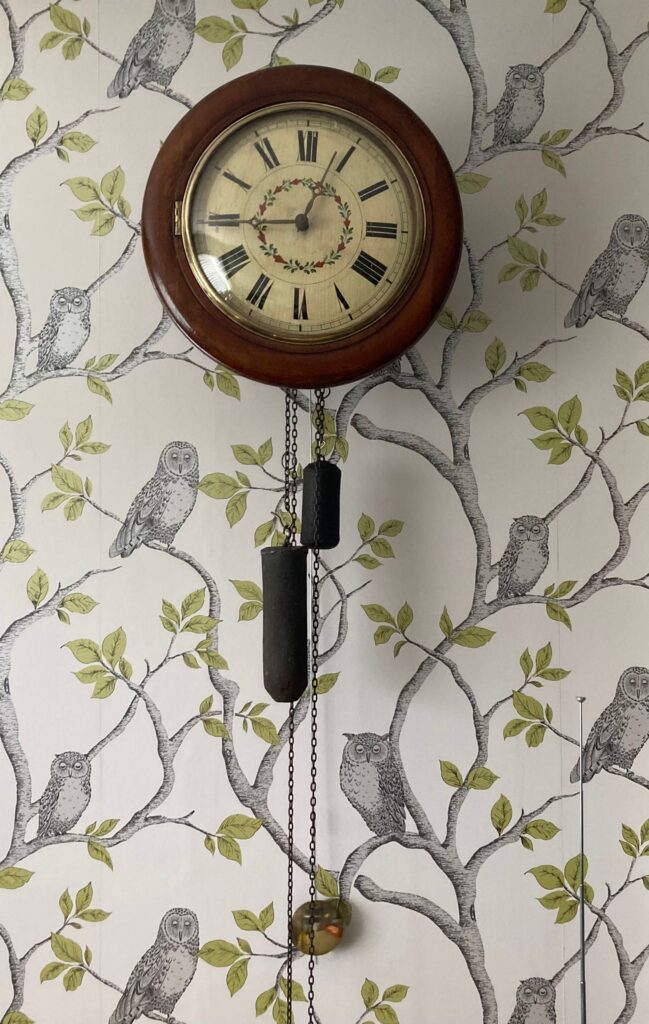
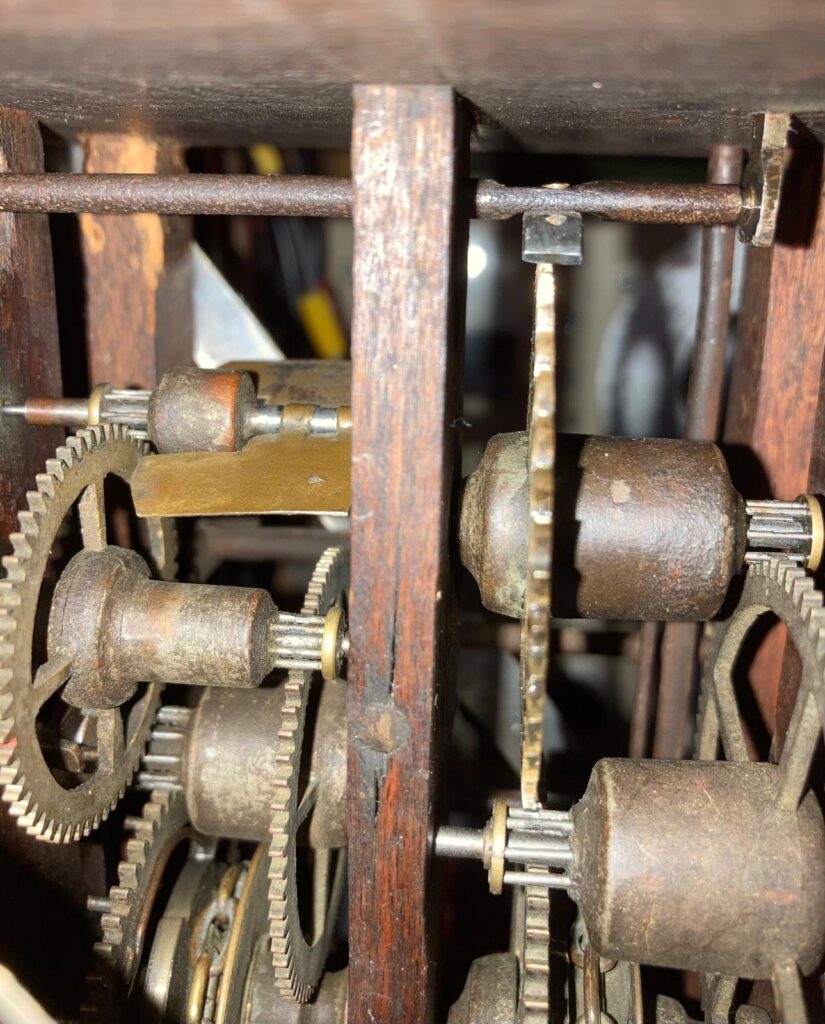
Phil here again, and thanks to Justin for kindly letting me post another blog describing one of my own projects that I’ve recently completed during my summer break away from my voluntary duties at the Black Country Living Museum. This one is a c.1840 weight-driven Black Forest 30-hour striking wood-movement clock, which I’ve been restoring on-and-off since I bought it for £40 from an antique shop in Wales several years ago. The main problems were woodworm, a butchered escapement, a badly-waisted pivot on the going great wheel, a too-short pendulum and a warped dial. The bent-strip pallets needed replacing, as did the bushings for the pallet arbor. There are several non-original parts in this clock, but I decided to keep most of these as they are functional and not seen. I bet Justin has repaired dozens of clocks like this! I took a liking to it when I saw it languishing in a Welsh antique shop four years ago. I did a bit of research and discovered it was a Black Forest “Schwartzwälder Stollenuhr” and made around 1840-1850, judging from the brass wheels on wooden arbors. When I got it home, I found it had once been well-inhabited by woodworm, so following Museum practice I applied the usual liquid Rentokil treatment, then wrapped the whole thing in a plastic bag and bunged it into the deep freeze for a month! Once satisfied that there was no active worm present, I filled most of the visible flight holes using coloured furniture repair wax sticks. I tried the clock, and whilst the strike side worked, the going train wouldn’t run for more than a few ticks before stopping. At this point I realised that this wasn’t really a clock; it was someone else’s abandoned restoration project. The bent-strip pallets had clearly been replaced, but looked nothing like a Black Forest escapement and gave no impulse. The pallet arbor pivots had been roughly filed and were closer to square than round, the crutch was loose on the arbor and the back pivot “bridge” had been replaced by a bit of thin steel plate with a hole crudely drilled through it. Much time was spent turning the pallet arbor pivots true and bushing the front and back pivot holes, to at least get the pallet arbor rotating in a proper manner. Dismantling a wood-movement clock needs care, and it helps to know the sequence – I found out by trial and error. Essentially this movement comprises a solid timber frame made up of a top and bottom plate and seven vertical pillars. The four corner pillars and the middle one – think of the number 5 on a dice when viewed from above – are permanently fixed in place and give the frame its rigidity, but the front and back centre pillars – which contain all the pivot holes – are removable, once you’ve pulled out the nails which hold them in place through the top plate. The precision fit of these old wooden parts is actually quite remarkable. I researched and found a drawing of the traditional Black Forest escapement, a small bent-strip pallet not unlike that of a cuckoo clock, spanning just three-and-a-half teeth of the escape wheel, and hence narrow enough to pass through the small aperture in the fixed centre pillar of the wood movement frame. I started with a new American bent-strip pallet, which I hacksawed down to size and bent into shape as best as I could. I temporarily soft-soldered the pallet to the arbor and adjusted the angles by trial-and-error till I got reliable running, then drilled through the strip ready for rivetting. I polished the pallet working faces to a mirror finish, hardened them by heating to red heat then quenching in water, polished again, tempered to a light straw colour, quenched and polished again. Finally I rivetted the pallet to the arbor using a brass rivet, turned down on the lathe to the correct diameter. Happily the escapement still ran, although not very well, going in and out of beat as the escape wheel rotated, and occasionally stopping due to one tooth failing to release. The escape wheel contains 42 teeth. Watching the escapement in action, it became clear that two groups of teeth were very slightly shorter than the rest. Using thin duck-billed pliers, I carefully ‘drew-out’ the short teeth, then placed the escape wheel in the lathe and very lightly ‘topped’ the teeth to the same length, using 3,000-grit abrasive paper on a wooden backing pad rather than a file. This process was completely successful, and the escapement now ran reliably. The means of setting the depth of the pallets’ engagement with the escape wheel is incredibly crude. The front pallet arbor pivot is like a flattened nail, held by friction alone through a hole in the top plate; adjustments are made by tapping it down with a hammer, or pulling it up with pliers. The back pivot runs in a bridge with slotted mounting holes, offering a degree of ‘fine’ adjustment. The two trains on these clocks sit in tandem, front to back, with the going train in front of the strike train. The back pivot of the going train’s great wheel was badly waisted. Rather than re-pivoting in the normal way, which I considered impossible due to the small diameter of the arbor itself, I decided to make a sleeve by turning down a piece of steel rod to fit the pivot hole, then drilling down the centre of the rod to create a sleeve to slide over the waisted pivot, finally soft-soldering it into place over the old waisted pivot. Purists may recoil in horror at the use of soft solder in clock repair; as an electrical engineer by profession, but an amateur horologist, I am reasonably skilled in soldering and it can form an effective – and invisible – repair in certain cases such as this. It’s worth mentioning the pivot holes, which in most wood-movement clocks are actually formed from thin brass strip coiled into a slotted tube (shaped a bit like a Mills pin or clevis pin) and fixed firmly into the wood. These are difficult to assess for wear by the usual means. Suffice it to say that excessive side-shake does not seem to be too much of an issue with these movements. I polished all the arbor pivots and, as they still seemed to run smoothly after the best part of 180 years, I otherwise left well alone. You’ll also note that I have made no attempt to brighten the brass wheels; I didn’t want to damage or stain the wooden arbors, so they got a gentle brushing with a soft brass brush and I left it at that. The motion work differs from that in a conventional clock in that the chain-driven great wheel rotates anti-clockwise once every two hours, driving a ‘two-hour wheel’ and linked lantern pinion via a hand-setting friction washer pinned to the great wheel arbor’s extended front shaft. The ‘two-hour wheel’ engages with the cannon pinion and minute pipe, which rotate on a peg fixed to the centre front vertical wooden member, and drives it clockwise at a 2:1 ratio, whilst the lantern pinion drives the hour wheel and hour pipe clockwise at a 1:6 ratio. The ‘two-hour wheel’ also carries two pins 180 degrees apart, which lift the strike release lever once each hour. The friction washer was missing on my clock so I had to fabricate a suitable alternative. The strike train uses countwheel striking and needed little attention other than cleaning, polishing the pivots and lubrication. The strike great wheel carries pins which lift the hammer mechanism via two levers and rods. The train ‘warns’ at about 10 minutes to the hour, and it took me several attempts to get the wheels into the correct starting positions to enable the train to run up to speed prior to the hammer being lifted. Incidentally, the cast-iron weights are different, weighing around 850 grams and 1.5 kilograms, with the heavier weight driving the going train, according to my research. The clock arrived with a pendulum comprising a small light brass bob, on a rusty thin rod which appeared to have been made from an old bicycle wheel spoke. This turned out to be around 4” too short as the clock ran fast, so I made a new rod from two straightened-out wire coathangers, joined with a short polished brass sleeve. A clamp was made out of a piece of old clock spring to hold the bob in place and permit a sliding fit on the rod for regulation. Once I had the movement running, I discovered that the painted wooden dial centre was quite badly warped, to the extent that it had broken past two of the nails securing it into the escutcheon. I soaked the back of the dial with warm water and allowed it to penetrate for half an hour, then – very gingerly and carefully – clamped the dial flat and left it overnight to dry. The result was perfect! I made a couple of new pins to secure the dial into the escutcheon. The cast brass bezel responded well to Brasso wadding followed by Renaissance Wax, and I applied four coats of French polish to the wooden escutcheon. The dials on these clocks were originally secured to the movement by nails and wire hoops; these had fallen out and been lost long ago, and two small metal L-brackets and screws now hold the dial in place. With the domed glass cleaned, the end result is quite pleasing. One feature of these clocks is their noisy operation and loud tick – I think the wood movement acts as a sounding-board, amplifying the sound of the escapement. Another notable feature is the wide swing of the pendulum, due to the narrow span of the pallets, leading to the common name of “wag-on-the-wall clocks”. The bell is particularly strident! The clock now resides in my workshop rather than the house, but it’s a good timekeeper. It’s been an interesting restoration and makes an unusual addition to my collection.
Recent Comments