James Webb Data Inconsistencies explanation – New discovery by Justin Hammarstrom / Braintree Clock Repairs. Theory with impirically matching data and proof. Peer Review Publication.

Summary: The James Webb Empirical Proof for Gravitational Data Latency

This summary outlines the specific observational evidence from the James Webb Space Telescope (JWST) that supports the model of black holes as “data buffers” using the Centrifugal Data Handover and Inverse Square Law.

The Primary Evidence: “Little Red Dots” (LRDs)JWST has identified a novel population of compact, extremely red objects known as “Little Red Dots.” These provide the empirical “smoking gun” for the theory of information latency.

* The V-Shaped Spectral Energy Distribution (SED): These objects exhibit a unique spectral shape—blue in the ultraviolet and extremely red in the optical. In my theory, this “V-shape” is not caused by dust, but by the Flickering Neon Bulb effect. The cycle of this flickering is equivalent to the latency variable of the light ee are seeing from these “impossibly old” red dots.

* Connection Failure at the Horizon: The spectral “break” represents a phase-shift. As data circles the event horizon, it experiences extreme latency. The “V-shape” is the physical signature of a data packet being re-assembled and prepared for centrifugal expulsion.

Rotational Asymmetry & Redshift VarianceStandard models view redshift as a simple measure of distance. This theory, supported by JWST’s high-resolution imaging of early spiral galaxies, suggests redshift is a rotational variable.

* The Observation: JWST data (such as the JADES survey) has revealed a significant statistical asymmetry in galaxy spin directions and morphologies at high redshifts (z > 5).

* The Theory’s Proof: I posit that the “Age” (redshift) of a galaxy is higher on the side rotating away and lower on the side rotating toward us. This proves the galaxy is a Re-assembled Data Packet. The discrepancy in age across the same object confirms that time dilation is tied to the Black Hole’s rotation, not just its distance from Earth.

The Centrifugal Handover Mechanism: The distribution of matter across the universe follows a mechanical handover rather than a purely gravitational collapse.

* Buffer Phase: Information circles the black hole (Latency).

* Expulsion Phase: Centrifugal forces fling the “notifications” (galaxies) outward.

* Inverse Square Distribution: Once expelled, the density and signal strength of these data packets dissipate according to the Inverse Square Law. This explains why galaxies maintain a specific structural integrity (as “packets”) before eventually spreading out as they move further from the central gravitational “well.”

Conclusion: Space as a Changing VariableThe JWST observations of “overmassive” black holes in the early universe—which exist before their host galaxies have fully formed—support the “handover” model. These black holes aren’t just eating matter; they are processing the variables of space and handing them over to the next Planck definition of the particle.> Key takeaway: The JWST data confirms that the “Age” of the universe is a localized processing speed, governed by the rotational latency of central black hole buffers.

Technical Addendum: Flux Ratio Anomalies & The Inverse Square LawThis section outlines the application of the Centrifugal Data Handover to quadruple-lensed systems (Einstein Crosses). It provides a measurable test for the theory using existing deep-space observations.

Flux Ratio Anomalies as Data Signal LossStandard gravitational lensing theory often fails to explain why the four images of a distant quasar do not match predicted brightness ratios. In this model, this is not caused by “dark matter,” but by mechanical signal loss during the data handover.

* Asymmetric Wavelength Shift: Observations of lensed systems show wavelength shifts that vary between the four images.

* Centrifugal Expulsion: These shifts occur because each “data packet” (image) is flung from the central gravity well at a different rotational phase. The “Age” of the data in each image differs because it circled the “buffer” (the lensing galaxy’s central black hole) for a different duration.

Applying the Inverse Square Law to Data Packets: The intensity and spread of this expelled data follow the Inverse Square Law. This defines the “Signal Strength” (I) of the data packet as it is handed over from the black hole’s centrifugal influence to the observer.

The Distribution Formula:I = P / (4 * pi * r^2) * I (Information Density)

The observed brightness and spectral integrity of the galaxy/quasar.

* P (Processing Power): The rotational energy or velocity of the central black hole buffer. * r (Handover Distance): The distance from the event horizon where centrifugal force overcomes the horizon’s pull. As the data moves further (r) from the central processing “well,” the information density (I) drops. This explains the “flickering” seen in high-redshift objects—they lose signal coherence as they transition between the variables of space.

JWST Proof: The “Processor” Precedes the “Packet”James Webb data (specifically observations of UHZ1 and GHZ2) reveals “overmassive” black holes in the early universe that exist before their host galaxies are fully formed.

* Theoretical Fit: This confirms the Black Hole Buffer comes first. It is the “Clock” or “Processor” that must exist to begin the centrifugal handover.

* Re-assembled Data: The galaxy (the data packet) is only assembled after the black hole has begun processing the surrounding variables of space and flinging them outward.Summary of Empirical Evidence:

* Latency: Caused by information circling the event horizon. * V-Shape SED: Evidence of connection failure during re-assembly.

* Redshift Asymmetry: Evidence of rotational time dilation.

* Flux Anomalies: Evidence of centrifugal distribution following the Inverse Square Law.

The above a summary of my unique and new theory. Its miles ahead of anything else being suggedted becayse it has syructural integrity and follows all known telatavistic and Newtonian laws of astrophysics. It has profound impilcations.

Not bad for a clock technician 😉
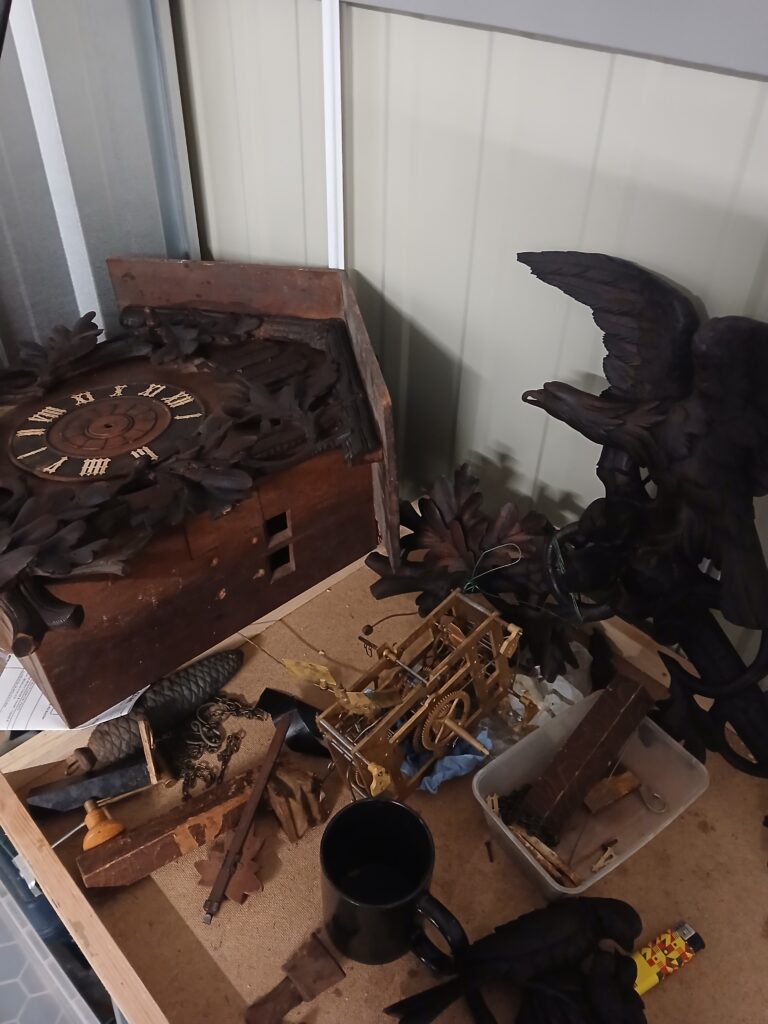
Victorian Cuckoo Clock Repairs atm.

Just a quick post to show whats going on in the Braintree workshop. We do pretty much any cuckoo clock modern or old.

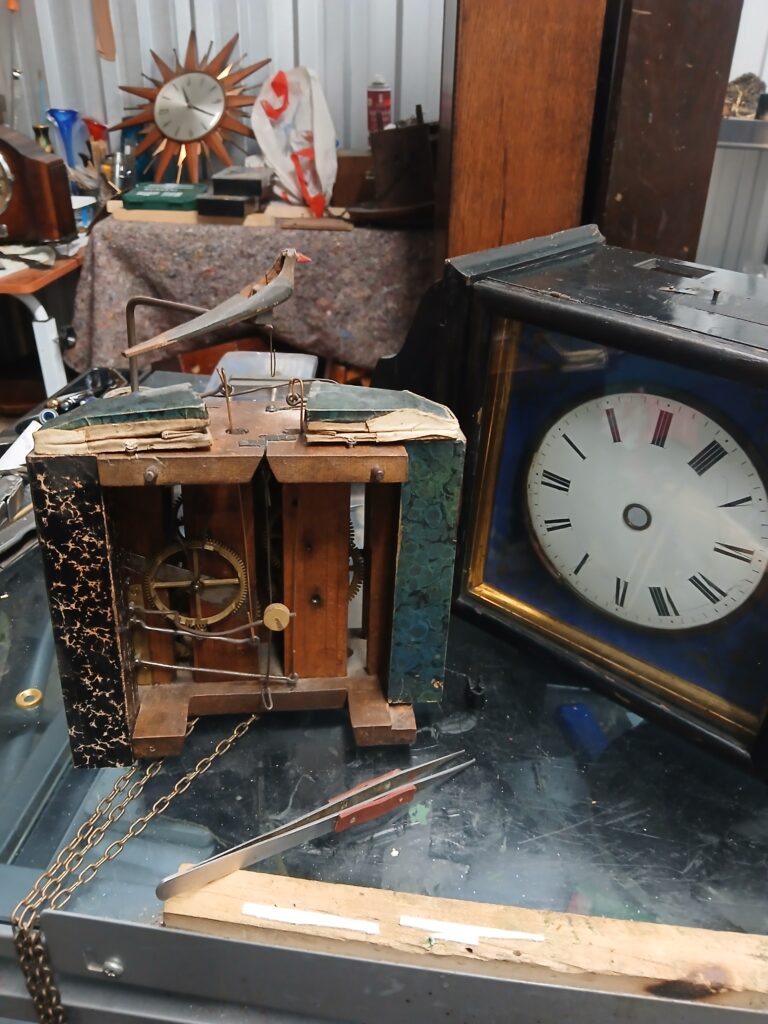
These two are crackers. One is huge with a 1000+ music box in a hunting lodge game clock. The eagle crown is a work of art in its own right.

The second is pucture frame cuckoo with a wooden countwheel movement. Im surprised wood was not used more in movements. With brass bushes its just as good as brass plate units although it is a bit space heavy in a small case like this.

Both really nice clocks and I thought others may be intetested in seeing these miracles in the process of service snd restoration.

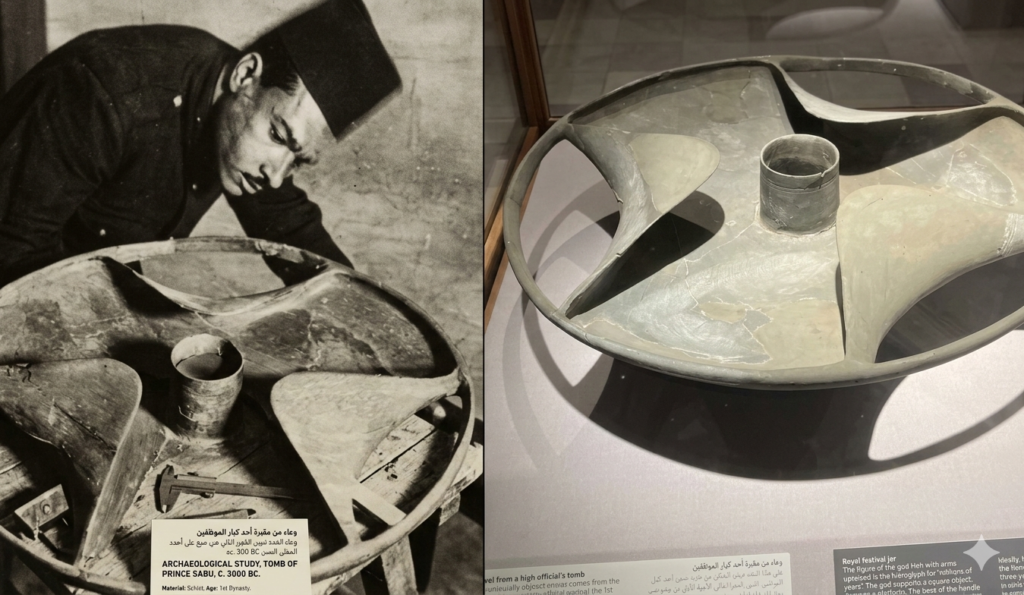
The Appalling Sabu disk bushing.

This is an Alien disk found in Sakkara Egypt in an ancient burrial context. Godaliens was probably involved in its manufacture and its obviously an impleller or propeller. A certain rotary function is implied. Men in lab coats are currently using lasers to measure it and calculate its micrometrics. Is it atom perfect on the surface? That could mean..well, better aliens made it than the ones who made the pyramids. Tom Cruise needs to know about this. Books need to be written.

B#%%£cks, it’s a candle stick.

Heres why.

If its a rotary wheel, its been bushed with a wooden spoon and put in by an idiot whoes last job was on a solid cartwheel. In the material used, that bush needs to be around…probably the square of the diameter with a multiplier/modifier for overall object mass. That would be a fair engineering guess. With an alien computer brain you could get the bush dimensioms and tensile matrial stress exactly bang on for your proposed rpm. If I can come up with a prototype test piece in my head, aliens should be able to do a better job. Also the internal bush is asymentric, I checked. Its not a drilled hole, its formed, almost certainly by abrassion.

The reason its almost certainly a candlestick is down to Fabergè. The best pieces are unique and represent almost impossible levels of contemporary technical brilliance. Its a really flash candlestick. Probably the chief pooh-bahs.

My theory is somewhat supported by candle dynamics. Common knowledge but Ill just remind you. Due to the matarial constrains of naturally produced candle wax, a tall pillar candle burns badly or falls over if it has a diameter over 11cm. Temple pillar candles are still produced today ay 11cm diameter. The sabu disk “bush” is 11cm.

This, for me, rather dossapointingly, debunks the Sabu disk. I want to believe.

Its my own theory by the way and I have only circummstancial evidence but I ve worked with rotary clock mechanics for so long I can just see whats going on with this. Bigfoot? well I love bigfoot. Hes juuuuust about a feasible possibilty, however, there is more chance of him turning up riding a unicorn than that candle stick serving and kind of force exchange function. AND..If anyone even suggests its a clock part because it has 120⁰ degree design bias I will personally assault them with a 3d printed minature model inserted into them to test its impeller function.

As an aside. Never trust men in lab coats with anything. They are wearing them because they are expecting a mistake or cock up. They are clean because they put them on new every day. Trust the scientist who is more than comfortable working in his underwear.

Postmans Alarm Style Resto – Phil Black Country Museum.

Phil keeps me up to date on his restos. Hes a pro philanthropic restorer and I actually learn a thing or two from his submissions. If your doing one of these in your man cave this article is a must. I like Phil because he just bloody keeps on going until hes happy which is an almost utopian ideal as opposed to a realistic objective for a perfectionist. He is also a fantastic example of what you can do if you apply yourself while not losing your mind and converting an uncooprative machine over the rugby posts. Many people think the marks on old clock cases are spillage. Its tears.

Phil here again, and thanks to Justin for kindly letting me post another blog describing one of my own projects that I’ve recently completed during my summer break away from my voluntary duties at the Black Country Living Museum. This one is a c.1840 weight-driven Black Forest 30-hour striking wood-movement clock, which I’ve been restoring on-and-off since I bought it for £40 from an antique shop in Wales several years ago. The main problems were woodworm, a butchered escapement, a badly-waisted pivot on the going great wheel, a too-short pendulum and a warped dial. The bent-strip pallets needed replacing, as did the bushings for the pallet arbor. There are several non-original parts in this clock, but I decided to keep most of these as they are functional and not seen. I bet Justin has repaired dozens of clocks like this! I took a liking to it when I saw it languishing in a Welsh antique shop four years ago. I did a bit of research and discovered it was a Black Forest “Schwartzwälder Stollenuhr” and made around 1840-1850, judging from the brass wheels on wooden arbors. When I got it home, I found it had once been well-inhabited by woodworm, so following Museum practice I applied the usual liquid Rentokil treatment, then wrapped the whole thing in a plastic bag and bunged it into the deep freeze for a month! Once satisfied that there was no active worm present, I filled most of the visible flight holes using coloured furniture repair wax sticks. I tried the clock, and whilst the strike side worked, the going train wouldn’t run for more than a few ticks before stopping. At this point I realised that this wasn’t really a clock; it was someone else’s abandoned restoration project. The bent-strip pallets had clearly been replaced, but looked nothing like a Black Forest escapement and gave no impulse. The pallet arbor pivots had been roughly filed and were closer to square than round, the crutch was loose on the arbor and the back pivot “bridge” had been replaced by a bit of thin steel plate with a hole crudely drilled through it. Much time was spent turning the pallet arbor pivots true and bushing the front and back pivot holes, to at least get the pallet arbor rotating in a proper manner. Dismantling a wood-movement clock needs care, and it helps to know the sequence – I found out by trial and error. Essentially this movement comprises a solid timber frame made up of a top and bottom plate and seven vertical pillars. The four corner pillars and the middle one – think of the number 5 on a dice when viewed from above – are permanently fixed in place and give the frame its rigidity, but the front and back centre pillars – which contain all the pivot holes – are removable, once you’ve pulled out the nails which hold them in place through the top plate. The precision fit of these old wooden parts is actually quite remarkable. I researched and found a drawing of the traditional Black Forest escapement, a small bent-strip pallet not unlike that of a cuckoo clock, spanning just three-and-a-half teeth of the escape wheel, and hence narrow enough to pass through the small aperture in the fixed centre pillar of the wood movement frame. I started with a new American bent-strip pallet, which I hacksawed down to size and bent into shape as best as I could. I temporarily soft-soldered the pallet to the arbor and adjusted the angles by trial-and-error till I got reliable running, then drilled through the strip ready for rivetting. I polished the pallet working faces to a mirror finish, hardened them by heating to red heat then quenching in water, polished again, tempered to a light straw colour, quenched and polished again. Finally I rivetted the pallet to the arbor using a brass rivet, turned down on the lathe to the correct diameter. Happily the escapement still ran, although not very well, going in and out of beat as the escape wheel rotated, and occasionally stopping due to one tooth failing to release. The escape wheel contains 42 teeth. Watching the escapement in action, it became clear that two groups of teeth were very slightly shorter than the rest. Using thin duck-billed pliers, I carefully ‘drew-out’ the short teeth, then placed the escape wheel in the lathe and very lightly ‘topped’ the teeth to the same length, using 3,000-grit abrasive paper on a wooden backing pad rather than a file. This process was completely successful, and the escapement now ran reliably. The means of setting the depth of the pallets’ engagement with the escape wheel is incredibly crude. The front pallet arbor pivot is like a flattened nail, held by friction alone through a hole in the top plate; adjustments are made by tapping it down with a hammer, or pulling it up with pliers. The back pivot runs in a bridge with slotted mounting holes, offering a degree of ‘fine’ adjustment. The two trains on these clocks sit in tandem, front to back, with the going train in front of the strike train. The back pivot of the going train’s great wheel was badly waisted. Rather than re-pivoting in the normal way, which I considered impossible due to the small diameter of the arbor itself, I decided to make a sleeve by turning down a piece of steel rod to fit the pivot hole, then drilling down the centre of the rod to create a sleeve to slide over the waisted pivot, finally soft-soldering it into place over the old waisted pivot. Purists may recoil in horror at the use of soft solder in clock repair; as an electrical engineer by profession, but an amateur horologist, I am reasonably skilled in soldering and it can form an effective – and invisible – repair in certain cases such as this. It’s worth mentioning the pivot holes, which in most wood-movement clocks are actually formed from thin brass strip coiled into a slotted tube (shaped a bit like a Mills pin or clevis pin) and fixed firmly into the wood. These are difficult to assess for wear by the usual means. Suffice it to say that excessive side-shake does not seem to be too much of an issue with these movements. I polished all the arbor pivots and, as they still seemed to run smoothly after the best part of 180 years, I otherwise left well alone. You’ll also note that I have made no attempt to brighten the brass wheels; I didn’t want to damage or stain the wooden arbors, so they got a gentle brushing with a soft brass brush and I left it at that. The motion work differs from that in a conventional clock in that the chain-driven great wheel rotates anti-clockwise once every two hours, driving a ‘two-hour wheel’ and linked lantern pinion via a hand-setting friction washer pinned to the great wheel arbor’s extended front shaft. The ‘two-hour wheel’ engages with the cannon pinion and minute pipe, which rotate on a peg fixed to the centre front vertical wooden member, and drives it clockwise at a 2:1 ratio, whilst the lantern pinion drives the hour wheel and hour pipe clockwise at a 1:6 ratio. The ‘two-hour wheel’ also carries two pins 180 degrees apart, which lift the strike release lever once each hour. The friction washer was missing on my clock so I had to fabricate a suitable alternative. The strike train uses countwheel striking and needed little attention other than cleaning, polishing the pivots and lubrication. The strike great wheel carries pins which lift the hammer mechanism via two levers and rods. The train ‘warns’ at about 10 minutes to the hour, and it took me several attempts to get the wheels into the correct starting positions to enable the train to run up to speed prior to the hammer being lifted. Incidentally, the cast-iron weights are different, weighing around 850 grams and 1.5 kilograms, with the heavier weight driving the going train, according to my research. The clock arrived with a pendulum comprising a small light brass bob, on a rusty thin rod which appeared to have been made from an old bicycle wheel spoke. This turned out to be around 4” too short as the clock ran fast, so I made a new rod from two straightened-out wire coathangers, joined with a short polished brass sleeve. A clamp was made out of a piece of old clock spring to hold the bob in place and permit a sliding fit on the rod for regulation. Once I had the movement running, I discovered that the painted wooden dial centre was quite badly warped, to the extent that it had broken past two of the nails securing it into the escutcheon. I soaked the back of the dial with warm water and allowed it to penetrate for half an hour, then – very gingerly and carefully – clamped the dial flat and left it overnight to dry. The result was perfect! I made a couple of new pins to secure the dial into the escutcheon. The cast brass bezel responded well to Brasso wadding followed by Renaissance Wax, and I applied four coats of French polish to the wooden escutcheon. The dials on these clocks were originally secured to the movement by nails and wire hoops; these had fallen out and been lost long ago, and two small metal L-brackets and screws now hold the dial in place. With the domed glass cleaned, the end result is quite pleasing. One feature of these clocks is their noisy operation and loud tick – I think the wood movement acts as a sounding-board, amplifying the sound of the escapement. Another notable feature is the wide swing of the pendulum, due to the narrow span of the pallets, leading to the common name of “wag-on-the-wall clocks”. The bell is particularly strident! The clock now resides in my workshop rather than the house, but it’s a good timekeeper. It’s been an interesting restoration and makes an unusual addition to my collection.

Metamec Mystery Mason

We get a lot of Metamecs in because they are relatively difficult quartz conversions or mechanical repairs.

My first clock repair was a Metamec and Ive always liked their style. They are set apart from other contemporaries because they are themed with Icons or suggestions of Freemasonary. They just are. The pillars of the Temple Of Soloman, and that pillar symetry look, is all over the 50’s and 60’s models. Then theres the eye shaped geometry in many clocks. Always a single focal point. Often intersected by symetical lines suggesting the set square or compass or both. The damn things almost look at you in the eye from a dollar bill.

Ive read the Metamec book. Ive spent time with Wallace King who was sales manager for them in the 60’s. Hes a Mason. That sort of made sense with the clock design. I took it as a given that masonry must have been in the company DNA. But heres the thing…Wallace said that the guy responsible for the pioneering modernist design, Captain Smart I think his name was, was not a Mason. Wallace said the designs were not masonic as far as he was aware. What?. How?. Wallace, it IS masonic design. No. Give up. Odd.

I believe the was a masonic deep cover mole at Metamec. Massive conspiracy. Possibly. You heard it here first.

Victorian Tripple Fusee Cuckoo Clock Repair and Resto

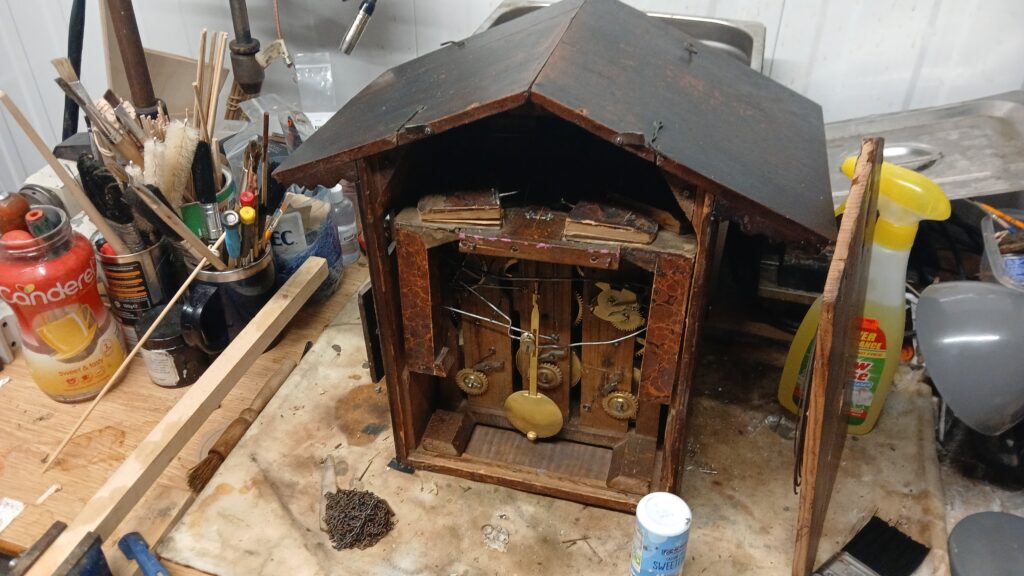
We do more cuckoo clocks than anything else – modern or old. We got into it about 15 years ago, and because it became a specialisation, work pours in. Anything from a 1980’s 2 weight mechine to this “best ever” Tripple fusee black forest victorian cuckoo.

It was a very difficult job but we did it and we were the only people who would take it on. This is hardly surprising as the clock is almost a “one off”. I imagine there are other machines out there with the same feature set (and finely carved/produced) but this is the first one I have seen in almost 20 years. I thought I had bragging rights with my 1860 Dresden table standing cuckoo clock, but this is a country mile ahead of it. Im not going to publish a shot from the front because I have not yet asked the owners permission, however, and rather anonymous shot of the mechanics should be fine and tell the story.

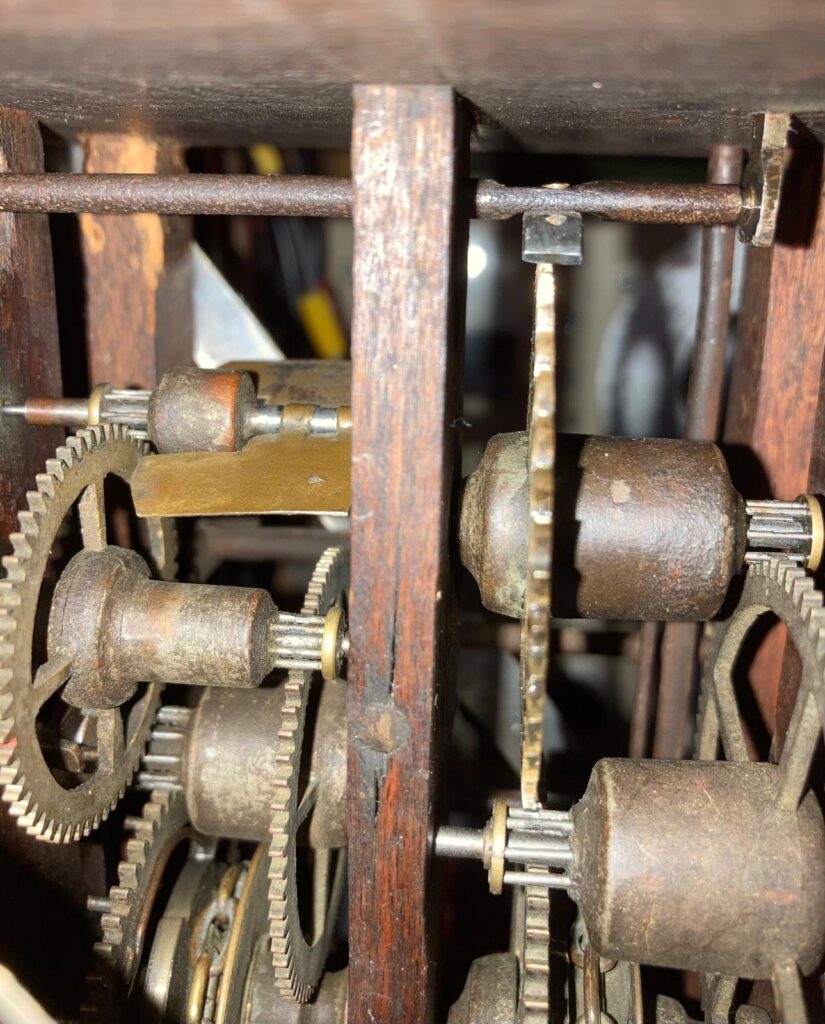
There are 3 gear trains and 3 bellows. This drives two cuckoos on independent synchronised chiming for both the quarter and full hours. This is not something Ive seen on a wooden cage movement before and for good reason. Its complicated!. Cuckoo clocks tend towards simplicity in what they do but this one is as much of a computer as anything Tompion made in my opinion.

You dont really need to understand how it works to appreciate its early complex engineering so I will leave you with a picture to drool over.

Thats the preparation and laquer bench by the way – not the work station!.

Tower Clock Service.

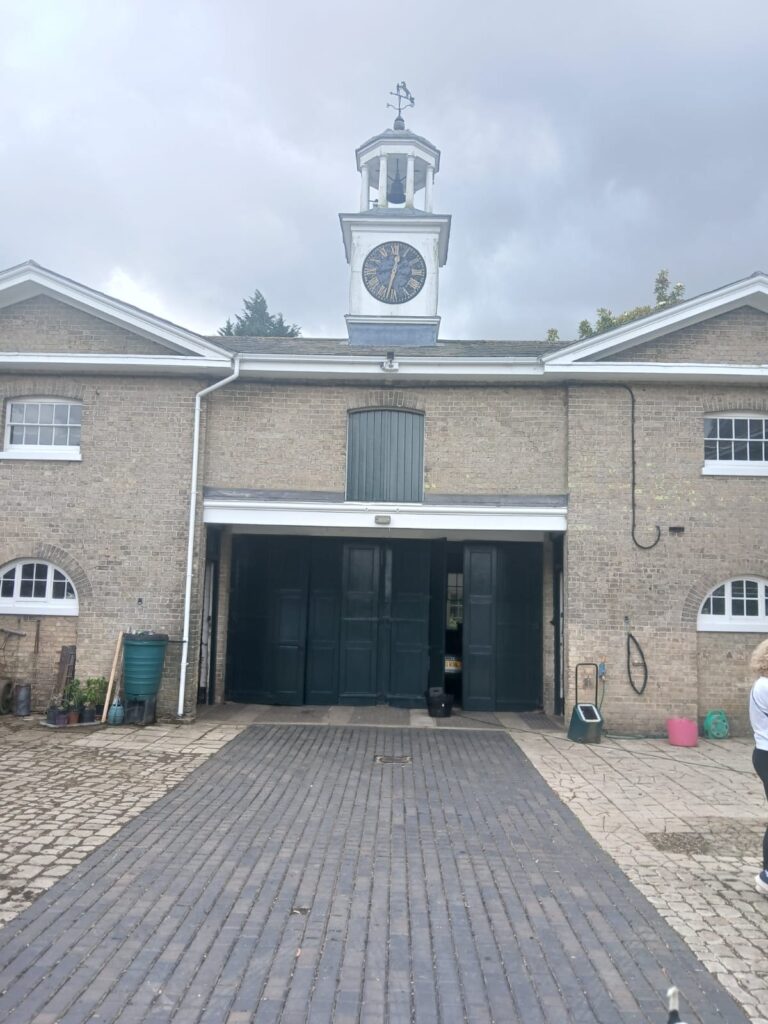
I have done more gravel driveway miles than Macadam (1756 – 1836). Expensive clocks are often in larger houses and this is a typical call out…

I recieve a call, the normal thing.

“My clock has stopped”

“ok no problem – give me some details on what and where and Ill tell you if we can help”.

“its on the wall and it loses 15 minutes a day and stops sometimes. The clock cant be moved so we can come and pick you up and take you to it”

“No problem, see you on Monday”.

Monday came and so did the client. I was driven to what I can only assume is Batmans house. It featured more land than a reservoir, an impressive black iron gate, a drive so long you could not see the house at the end of it and some stables. We arrived a the house after the safari down the drive and arrived at the mansion. I unpacked and asked where the clock was. The customer looked up and so did I. The “clock” was a tower clock – a full on church washing machine sized movement. I wasnt really surprised to be fair but had expected something indoors that looked like a church organ.

I got on with the inspection and assessment but needed to pay a visit. The customer showed me the smallest room and I went through.

Now, on my bathroom wall I have a bronze swimming certificate and picture. On his bathroom wall he had a massive poster with period script… an MBE. It turns out the clock owner did 20 years of particularly worthy charity work.

Tomorrow someone is coming in with a 30 year old wall clock. There is no telling what is next.

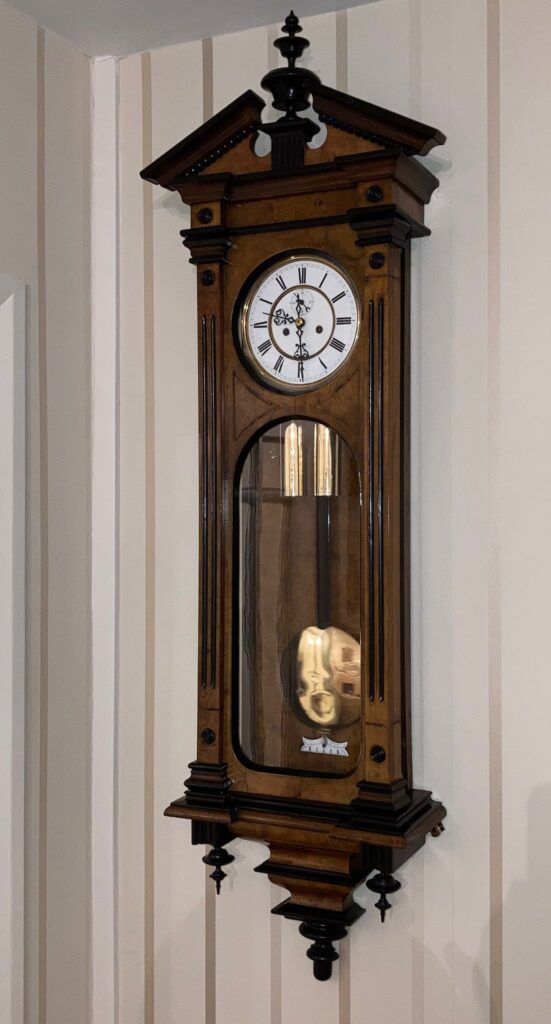
Vienna Regulator Restoration – Phil Black Country Museum

Firstly, Thanks to Phil you have another really good article by and experienced museum restorer. I can tell you for a fact that these Viennas are always ALWAYS troublesome. They feature a low power deadbeat escapment on a simple but fine movement in most instances. As an amateur is just a bridge to far but if you are going in with a scredriver in your mouth like a commandos dagger then pay attention to clock SAS phil who will lead your four man patrol. So cam up and prepare for your mission briefing. Your sanity will be sent back to your family covered in a flag should you fall. Probably. Or the loony bin. Over to Phil..

Hi again, it’s Phil here. Justin very kindly lets me submit an occasional “guest blog”, and this summer I took a few days off from my voluntary work as Volunteer Horologist at the Black Country Living Museum to devote some time to restoring a lovely clock I was given a while ago – an 1885 Concordia twin-weight Vienna Regulator. 

In February 2023, Justin posted a really descriptive blog about Vienna Regulators, how he loathes them and how they are very difficult to service – at a predictable and profitable cost – and I don’t propose to repeat any of that. As a result of reading Justin’s blog, however, I was pre-warned, so I approached this clock of mine with some trepidation. Justin’s conclusion that you need a degree of horological expertise before owning a Vienna is absolutely correct!

I was given the clock in March 2023 by a generous Repair Cafe customer, because it had fallen off the wall, a fate seemingly quite common with these big heavy wall clocks, and the owner felt the cost of a professional repair would be prohibitive. The wooden pendulum rod was snapped in two right across the crutch slot, the base of the case had snapped clean off, several mouldings and small pieces of trim were missing, most of the finials were loose and a number of joints in the case structure had split apart. Remarkably, the glass panels and the decorative crown were still intact. Hoping for a quick fix (one will come to me some day, eventually, but this wasn’t it) I repaired the pendulum rod with epoxy resin, and when it had eventually cured I set the clock up and tried it. Nothing… it ran sluggishly for barely one revolution of the escape wheel, ticking feebly, then stopped, suggesting a lot of dirt and friction in the pivots. 

[Justin: If I had that description for a job quotation I would have to differenciate between my contact telephone number and the price. Phil is clearly a maniac. Love it – fantastic]

Fast forward a couple of years and I recently got round to looking at the clock. I spent some time studying the operation of the strike release and locking mechanism, as it’s quite different from conventional rack striking. Rather than falling onto the snail by gravity, the rack tail is pressed upwards by a spring and contacts the snail from below. I took some photos of the way the components were planted. I also spent a lot of time storing and labelling all the tiny pins, screws and other parts from the front plate in the sequence I’d removed them. Then it was time to split the plates, which I did very gingerly – no surprises, thankfully – and systematically removed the train wheels and other components, taking a photo after each step. I used to do this every time when I started out on clocks nearly ten years ago, but let it lapse as I gained experience. However this was my first-ever Vienna, and I wanted a clear record of the order and placing of all the arbors. 

As Justin said, with the front plate removed the two-train movement looks deceptively uncomplicated, but the pivots are hardened and tiny at 0.5mm diameter. The going side has maintaining power, so I dismantled both great wheel and winding drum assemblies to clean and service the click springs and ratchets, as well as to replace the gut lines. The dead-beat Vulliamy escapement had been “messed-with”, something all clock repairers dread, as the double-ended pallets had been reversed due to wear, and one of the pallet clamping screws had been inserted cross-threaded. I managed to re-insert this screw properly and clamp the pallet tight, fortunately without disturbing its position. Adjusting Vulliamy pallets is never easy – I’ve had to do it only once, on a 400-day clock, and I’d prefer to avoid doing it again if at all possible. The whole movement was very dirty and oily, so the plates went into clock cleaning fluid, and the wheels and arbors went into my small domestic ultrasonic. Part-way through the process I gave everything a careful rub with 0000-grade wire wool. After finally rinsing in hot water and drying, the brass parts were gleaming, and I had no excuse to delay reassembly… starting by fitting new 0.8mm gut lines, which on this movement can only be done when the plates are apart. 

I polished the pallets and pivots and pegged out the pivot holes, not easy as they’re so small, and refitted the train wheels. On the strike side, it’s essential to place the wheels as they would be positioned at the end of a run, with the hammer tail having just dropped off a lifting pin and with the warning wheel pin having over half a turn to run. I’ve struggled with these issues on some American clocks in the past, but luck and good fortune were on my side this time, as once the plates were back together – being very careful with those tiny pivots – the strike train worked perfectly first time. Planting the cannon pinion and intermediate wheel gave me more difficulty. The cannon pinion carries a pin that advances the snail, via a star wheel with a spring-loaded detent, as the hour approaches. The intermediate wheel sits above and meshes with the cannon pinion, and carries two pins on its front, one to release the strike for the half-hour positioned nearer the wheel’s centre, and the second for the hour 180 degrees apart nearer the wheel’s rim. The pins lift and release the lifting lever to initiate the warning and the strike on the hour. Plus the square for the minute hand needed to hold the hand at 12 when the hour strike releases… Getting all these into the right places took me some time, as the hour wheel has to be in place on the cannon pipe before the cock holding the intermediate wheel’s front pivot can be fitted. Fiddly and awkward, but ultimately completed successfully. 

I spent some time adjusting the pendulum, which wanted to swing in an ellipse. Obviously the clock’s fall from the wall had stressed the pendulum and its hanging components. On and off, this took most of a day till I was satisfied that the pendulum hung plumb and swung in a single plane. 

The clock ran perfectly once I’d reassembled it and lubricated everything. I was a bit concerned about the small amplitude of swing, but that is apparently normal for many Viennas as the pallets span 11 or 12 EW teeth. The overswing is plentiful, which is my criterion for a good working escapement. I use the ‘slow-motion’ video feature on my iPhone (other smartphones are available) to see the overswing clearly. 

A lot of thought must have gone into the design of the Vienna Regulator. One thing I didn’t realise was that the weights descend at exactly the same rate; some careful calculations involving drum diameters and gear ratios must have been done to achieve this nice feature. One odd thing common to many Viennas is that the subsidiary “seconds hand” is no such thing! Although the dial is marked from 0 to 60, this dial is actually counting ticks, not seconds, as the hand rotates once every ~45 seconds driven by its 30-tooth escape wheel. All Viennas (the weight-driven ones) also seem to have a very subdued tone to the strike, the spiral gong not being strident but still quite audible. 

With the movement on the test stand and being regulated, I started on the case. The structural issues and split joints were rectified one-by-one using woodworking adhesive and clamps. The original seven missing pieces of trim looked like they were made of round-nosed hardwood either just over 8mm or just under 10mm thick, and I could find nothing like it in my favourite DIY store, so it was a case of making them from scratch. I had some lengths of ex-bed base beech slats which I was able to plane down to the right thickness, then sand to profile, cut using a mitre saw and glue into place. This alone took a whole day! I used black enamel brush-applied paint to colour in the new pieces. At a quick glance, these are indistinguishable from the originals. 

The clock now has pride of place in our living room. The important point to note is just how long this work took me, probably devoting three or four hours a day over the best part of a fortnight. As an amateur, much of this time is spent in studying and learning as I go along. I can only work as fast as my skills allow, and I can of course afford to take my time, whereas Justin as a professional not only has to work a lot more quickly, he is good as well, because it’s how he makes his living. This expertise comes from decades of experience which few amateurs can possess. And Justin was quite right when he said these clocks will refuse to work if you don’t speak to them nicely. After running perfectly for a whole week on the test stand, when I put the movement back into the case and hung it on the wall, it ran apparently fine, but inexplicably stopped during the night. Was it something I said, or the way I said it? Perhaps I should have wished it “gute Nacht” in German… but I restarted it the following day and it’s still going!

OK I just read that again and all things condired this is VC territory. Bang on with the process and the steps with good respect for the rattlesnake bite a clock like this gives you if you do all the right things in the wrong order. Perfect execution by Phil on a comprehensive mechanical resto. Some people may comment on the state of the pendulum bob. If yours is like this do not replace it. Firstly the new weight will mess up the power ratios and seconldy, authenticity is as important as condition with clocks. If you fit a new key component which looks the part (but isnt) a lot of the charm and the value of the clock evaporates.

I am delighted that Phil chooses to share his experience with us. If you have a similar story and love clocks please put it forward to me as a possible blog entry. I cant publish everyone without sort of ruining my site by turning into a magazine, however, I have always helped and encouraged other clock repairers who are getting a hold on things. The blog features mainly interest and, more importantly, self help articles. If you think you have something to contribute please let my know on whatsapp 07462 269529.

Website Horror

I despise computers. Its not that I dont understand them, its the reliability. This is as function of huge changes happening over identity and verification in all corners of the internet.

My mother passed on a few years ago and I changed part of my name to honour her. It felt great and the right thing to do. It came at an enormous and enlightening cost and that was time (ironically).

Just at the moment EVERYONE online wants to nail you to a plank with your straw man. Identity checks on owners of online assets such as websites, review engines, banks, are rampant. ANYONE who trades a quid on the internet is now subject to a full financial enema colonic. They really do look right up there – it feels like it and it is not pleasant.

For these reasons my website had to be down for 11 days and I didnt have any idea of a definite “if or when” things would be resolved. It just has been.

I owe you all another particularly good article from Phil at the Black Country Museum which will be up shortly..

Guest Blogger Phil from the Black Country Museum

Phil has been busy. I like his stuff and he’s one of those tenacious people who have what ot takes to do it right. Over to Phil..

Blog attached! Took me hardly any time at all…!

It’s been a while since I offered you anything in the way of a ‘blog’ for your excellent website. The truth is, most of my recent activities as Volunteer Horologist at the Black Country Living Museum have been relatively routine, involving repairs to conventional clocks which you cover in far more detail than I ever can. 

However over the past few months – one day per week – I’ve slowly been restoring a large and unusual three-dial electric turret clock dating from the very early 1930s. The clock once hung at the entrance to the Victoria Square tram and trolleybus terminus in Wolverhampton, where it acquired the nickname of “the three-faced liar” due to its tendency to indicate different times on all three dials. The clock was relocated to the Museum in the 1970s and apparently worked – sporadically – till around ten years ago. 

I’d been keen to get my hands on this turret clock for some time, as it’s quite an imposing showpiece and the only public clock on the site, but it was only earlier in 2025 that I persuaded the Museum to hoist me aloft in their ‘cherry picker’ to gain safe access to the clock and see if I could do anything with it. 

Behind each of the three two-feet-diameter backlit dials is a high-torque mains synchronous movement, which my research identified as the manually-started Gents C272 from around 1932. I picked the south-facing movement to service first as this is not in view to the majority of visitors, so I removed the hands, unbolted the movement and took it down to the workshop. 

Mechanically, the movement is a fine, strongly-built design with thick plates (and, incidentally, involute profile wheel and pinion teeth rather than cycloidal) which responded well to conventional dismantling and clock cleaning techniques. However, once reassembled, the 200 RPM synchronous motor proved difficult to start and tended to stop at the slightest provocation. I suspected that the magnetic field wasn’t strong enough. Measuring the DC resistance of the motor’s single coil showed a ominously low value of around 400 ohms, which suggested the coil may have had shorted turns. A second trip up in the ‘cherry picker’ was then necessary to measure the other two motor coils in-situ. Both measured 850 ohms, which at least confirmed my suspicions, and indicated that the remaining two motors were electrically okay at least. 

The faulty coil was sent away to be re-wound by a specialist, who reported back that the coil had been repaired previously, and that the inner half of the winding showed signs of burning. Sure enough, the re-wound coil measured around 750 ohms and, when fitted, the motor ran perfectly. A new earth wire was fitted and the motor was successfully PAT tested. 

At my third visit in the ‘cherry picker’ I removed the north-facing movement and replaced it with the one I’d just finished. The hands were re-sprayed in satin black to match the existing, refitted to the movement and the clock re-started. That was back in June, and it’s still going two months later…!

The second movement was now on the bench. As well as being filthy dirty, the rotor shaft was very loose in its ball bearings – it appeared that the shaft had been spinning inside the inner races, and its diameter had worn down – and rattled about so badly that apart from the loud buzzing noise, the drive end (where the rotor laminations spin between the pole pieces) was jumping about, causing greatly reduced torque. I obtained some new ball bearings (tiny, Imperial measurements 1/8” ID by 9/16” OD by 1/4” deep) which thankfully are still available from UK bearing suppliers, but was then faced with obtaining a tight sliding fit between the rotor shaft and the bearing. I was reluctant to use Loctite or similar, as the shaft has to be pushed through the bearing during assembly and I feared the locking compound would contaminate the ball race itself. In the end, I very carefully centre-punched the shaft at 90 degree intervals, forming tiny craters with raised edges which gripped the bearing perfectly. On reassembly, the motor ran smoothly and quietly and generated plenty of torque. It again passed a PAT test. 

Last week was my fourth trip up in the ‘cherry picker’ to reinstall the second overhauled movement, refit its newly-painted hands, and bring down the third and final movement for attention. The work involved should be a repeat of what I did to the second. We now have two of the three dials, both the ones visible to visitors, working and telling the correct time for the first time in over a decade!

Power cuts are mercifully rare, but despite these motors having resiliently-coupled flywheels which keep the rotors spinning at synchronous speed during very short outages, any power loss of more than about half a second will stop the clocks. Being hand-started, a journey up in the ‘cherry picker’ would then be needed to re-start the motors. Experiments with an inexpensive 650VA UPS of the type used with computers showed that this will keep the rotors turning at the correct speed, even during a longer power cut, so once the third motor is overhauled and refitted, I’ll do the work of rearranging the wiring within the turret to incorporate the UPS. This should reduce the need for site visits to twice per year for the GMT/BST time changes, as well as keeping the three dials in synchronism. The clock’s days of being a “three-faced liar” will hopefully be over!

Thanks Phil.