Clocks and Astronomy – How to buy, setup and use a reflecting astronomical telescope

Clocks and astronomy go hand in hand. This blog is about clock help and info and interesting things about clocks.

This is one of the help articles but with a bit of a twist in that its about the largest clock – the universe. This needs observing obviously. So this is for anyone skirting round the idea of getting a telescope who wants good impartial experience based advice on getting started. I have no commercial interests here or loyalties or even preference. Its all nuts and bolts to me really and its just about quality.

In not going to bang on about the history and science and suchlike – its advice and answers on the important basic things around getting a telescope. the fun stuff and the quick wins on what to do.

Ill try and cover the basics of what everything does, why it does it, how and what to buy and what you can expect to see.

The first telescope I got sucked rather severely and it took several buys to really understand the relative merits of the equipment and what is possible at reasonable cost. If somebody had given me a quick introduction and pointers on what to expect it would have saved me a lot of time, so here it is.

Firstly what to buy.

There are two types of telescope generally speaking. Reflectors that use a big curved mirror like a lens, and then there are refractors that use a lens as a lens. Nautical telescopes and everyday binoculars work on the refactor principle with a lens at each end. This is not what you need.

Get a reflecting telescope because they collect more light.

The 4″ mirror  in the telescope has a much bigger surface area than the retina in your eye so everything “it looks at” appears much brighter to “it”. The bigger eye can collect more light per square cm in view which translates as a brighter image. Imagine your eye with a 4 inch diameter, and how bright everything would be. It wouldnt be a magnified view either – you would see what you see right now, just much more brightly, probably blindingly so.

This is what a reflecting telescope is – a big light collector. The bigger the better, and the brighter your view of feint sky objects like galaxies will be.

There is an important thing to understand at this point. Everyone is used to nautical telescopes and binoculars that zoom in and are used to MAGNIFY things. That increases RESOLUTION. Astronomers don’t care about resolution as much as they do being able to see whats going on in a massive dark room with appalling lighting trying to open the Thermos with gloves on and spilling it all over the eye peices. A reflecting telescope therefore increases the INTENSITY of the light you can see because it collects more light per unit of area in front of it.

Imagine a water mark on a bank note. If you want to see the water mark you hold it up to the light because its too feint if you don’t. The same thing applies  reversed in astronomy. You can only see the object if you get more light from it. The way to collect more light is to have a larger surface area collecting it. If you do that you see things that you cant see at lower light collection levels. This is the basis for astronomical observation generally in visible light wavelengths.

So, there are big objects in the sky you cant see with the naked eye because they are very feint water mark types of objects like galaxies and star clusters. A reflecting telescope reveals them. The Andromeda galaxy is as big as the moon in the sky yet most people have never seen it. It can be seen as a very feint object on a very dark night but it hardly sticks out in the sky.

The same area of sky viewed through a 4″ reflecting telescope reveals the galaxy entirely as if somebody had shone a light on it from all angles. It looks like a smudge of smoke.

It is in fact billions and billions of stars too small to see individually, but that generate light collectively. Smoke is, after all, just groups of little particles but we don’t see, what we actually see the effect of their collective light reflection.

Its the same with galaxies. Remember the stars are separated by light years and are only a few hundred thousand miles diameter – as in our galaxy. Thats probably equivalent to one smoke particle per square mile or something ridiculous like that. The quantities are unimportant; its principle that a a large enough group of widely distributed objects, if viewed from far enough away, take on a shape and thats what many deep sky “objects” are. Consequently they are feint and hard to see.

A 10″ telescope does not have twice the collecting power of a 5″. It has Pi x R squared which roughly equates to 78.5 sq inches to 19.4 sq inches –  four times the value. This for only doubling the diameter. One of the reasons its hard to select a starting scope is that you know for every jump in price bracket (based on telescope mirror diameter) there is a disproportionate gain in the key performance statistic – light collection.

You will seriously consider a 6″ and frankly…. I would, but Id be doing knowing it was too much money for too little performance gain. Id go in at 8 if not 10 as you may as well go straight to the top if you know thats where your heading anyway…….but that advice is for you maniacs out there, not us stable value for money sorts who do our homework reading a blog like this and get the best deal.

Also a big scope needs mounting and its expensive. You have to look after it. I will keep my cheap one in a corner of the garden with a cover and not worry too much about it. Ill probably use it once a month and special events – you can see the ISS with it for instance and some people say you can resolve the shape although I’m not sure I believe it.

A 4″ reflector is by far the best starting size and there is no real reason to go above that as it will keep you busy for some time as a casual observer of planets, lunar and cometary stuff.

When you outgrow it sell it and upgrade two steps by which time you will know exactly what sort of setup you want in terms of tech and targets. Some people just do planets and gear up to optimise on that, while others like wide field / meteor spotting setups with custom shape shifting seating and supported equipment – effortless comfort based observing.

Some of its heated I believe and there is a binocular format setup. Imagine a comfortable outsized swivel  chair with two traffic cones mounted pointing skyward in a polymer pod and you get the overall idea. Having handed all this advice out on getting a modest 4″, the super comfort setup with huge supported binoculars is what I would go for in an ideal world.

Its is not mentioned much when you buy a telescope, but Patrick Moores eye looked like that for a reason. You get single eye strain and muscle cramps in your brow and cheek occasionally. Eventually you look permanently indignantly surprised. So its binoculars at some point if I get back into it seriously.

Only some galaxies can be seen in a 4″. If you want galaxies jump straight to an 8 or a 10″ but prices start get a bit hairy. One galaxy is much the same as another so 4″ wins the value argument hands down. You can only see Saturn once for the first time and seeing it 4x the size is nice, rather than life changing. As long as you can reslove it to some degree its the same experience for the most part. Awe.

So how does the zoom work – there must be one?…All that collected light needs to be channeled and focused into your eye.

Because of the way these telescopes are designed there is no true “zoom” function. Instead, if you want to look in more detail at a section of what you see, you use a higher magnification eye piece. The eye peices are a standard size and come in various magnifications quoted in mm e.g. 20mm, 12mm, 5mm in increasing magnification.

From memory, the moon fully fills the view with a 10mm eye peice and then a 5mm might let you look at 10% of the moons surface in high detail. Im a bit off on specifics as Ive only just got my latest scope after a break of a few years.

Dont bother with a GPS based system as they are expensive and ruin the fun of learning sky coordinates and getting stuck in a bit more generally. Its the sort of thing you buy later on and get a derivative that suits your needs.

So thats what they do generally on the light collecting front but the other thing they are really good for is looking at planets.

You have seen Jupiter many times even if you don’t realise it. Its a very bright star in the spring / summer sky. When you look at it through a 4″ reflecting telescope you see a disc, not a twinkling star. On a clear night, if you focus you can see the red stripes across it.

Its humbling but none more so than Saturn. This is seen in the winter months. Whats astonishing about this is that you can see it in 3 dimensions. With Jupiter, its a disc. With Saturn you can see the rings offset at an angle. Your seeing perspective on another planet. You will not forget the first time you see it.

Its all well worth getting into for a couple of hundred pounds which gets you the sort of setup you can see below. I actually got this for £30 from a second hand store and repaired the tripod as you might imagine being repair obsessed. Its in perfect condition although I have to get the eye peices separately at some cost.
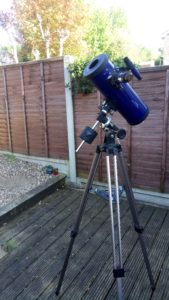
DSC_0048In terms of setting up the scope its straight forward. First learn the Equitorial Coordinate system which divides up the sky into two axis. I said straight forward, not quick, however all you have to learn is where the axis run from and how the divisions of units work up and down in the N/S E/W rotations. Its fully explained here:

to https://en.wikipedia.org/wiki/Equatorial_coordinate_system

The scope unpacks and assembles easily usually. They are designed for home garden use. There are no hair spring or ultra sensitive adjustments to make.

Because its generally designed to look at quite a large arc of sky most scopes are only really looking to be accurate to 1 degree from and engineering perspective on the dials. Its worth going for a Meade or Celestron or better rather than a brown label Chinese machine simply because of the precision engineering standards on the adjusters.

As you start to look for feinter smaller things you have to work at higher magnifications so each movement of the scope is a huge movement in the field of view at high magnification. Precision adjustment becomes necessary and not having it is annoying if your struggling to see something rare.

Also, be warned, the earths rotation is noticeable at 300x times mag. You have to turn the fine adjustment to keep up with the moving object.

Some scopes come with the option of an electrically driven tracker that proceeds to turn the scope to match the rotation speed of the planet. You may as well save your money and go manual until you decide if you want a gps based system that does both tracking and automatic pointing / location for you.

The field of view (how big the circular view you can see is) in a typical small scope is 2 – 5 degrees I believe (of 360 degress / a circle). The moon is about half a degree in the sky. On this basis aiming the telescope isn’t going be that hard for bright objects and most scopes feature a wider angle side mini sighting scope for general aiming.

However, for feint ones you need to use the settings on the scope….

These work by first setting your azimuth by pointing the telescope mount (which is sloped) north and setting your latitude on the base mount (easy). This means its lined parallel with the central axis of the earth from which the equatorial coordinate system works. Thats why its essential to learn the equatorial system. If you don’t want to learn then the machine is going to be next to useless to you on anything but the moon.

So, all you then have to do is set the vertical and horizontal dials on each axis of the telescope to the coordinate values of he objects you want to see (widely available information).  The telescope will then be pointing at exactly what you want to see give or take a degree or so. Fine positioning of the image in the centre of the view is then done via two easily accessible screw handles designed for the purpose.

And thats it. How to buy and get a telescope up and running so you can see what is really going on in the night sky.

Lastly, some temptation….. you can fit your phones camera to the eye piece hole and take long exposure photos. This is good because you get the colour. To explain, in darkness your eyes adjust to heighten contrast and increases the aperture of your iris to let more light in your eye. What a lot of people are not aware of is that it also turns off your ability to see as much colour while increasing your ability to discern black and white. This means what you see in the sky with the naked eye is actually the black and white version of what is up there to some degree. The camera, however, doesnt lie. It picks up the colour so you get to see whats really there.

Theres also a cheat available with electronic imaging. You can increase the exposure time which simulates using a bigger mirror and getting more light. Your tracking has to be right to do this and its a slippery slope to investing in a purpose built CCD camera eyepiece and adaptor with all sorts of exotic software filters and suchlike. Great fun for tech heads and it also opens up computer aided observation where……you dont have to actually be there. Heresy of course, but it is the future.

Well its been an interesting change from clocks but to be fair it was clocks really. Everything can be explained by clocks in one way or another. Key stones of civilization, blah blah, fundements of technology yawn zzzzz…

Back to repairing clocks.

 

Bracket “Clock” Rude Printing Error

Well. This is what happened. We were doing a mailshot for the Antiques Centre and Braintree Clock Repairs.

I was put in charge of the artwork as I have some experience in computer design, despite despising computers. Incidentally I now despise computers even more, however, back to the point.

We were in a rush to get the mailshot done for one reason or another and so the “proof reading bit”, for which I should have not been made responsible in my view, was my responsibility.

Now as many of you will know, when you read, you do not read the letters. Your brain translates the shape of the word and then you speed on to the next word and so on and so forth.

This makes spelling mistakes that don’t change the SHAPE of the word very hard to see. For instance the word clock, if written in capitals, looks the same shape as the word… well Ill let you find it. Look for the words “Bracket Clock” and then look at it again.

It was a 5000 print run. It is now a heavy box of paper for recycling.

Ill stick to fixing clocks. Advertising doesn’t seem to be my game.

Bracket_Cock_Repair


National Time Recorder Clock Repair

This is a great looking and sounding clock which does what all the best ones do – it tells a bit about when it came from.

National Time Recorder Clock

For those who done recognise this, its the clock used to log employees arrival and leaving time at work. People were paid on the beat and accuracy of this clock which is why its so well made and in a particular way.

The mechanism in the base deals with the advancement of a set of print dials that stamp and date and time on the cards inserted in the front. It operates entirely independently from the clock apart from a single rod interface that revolves once and hour. Thats all you need if you keep maths next to the printing mechanics and it makes a lot of sense.

What is unusual about this clock is that you will notice it has two winding holes. On a normal clock, one winder would drive the chime and the other the clock itself. There is no chime on this clock of course and the purpose of the second winder is to supercharge the clocks power with two springs driving a single drive train. This would completely overpower the clock in normal circumstances but it has been done because the extra power is sent down and torque via the con rod to the printing mechanism below.

This is a brilliant design because it allows both the data about time (one revolution per hour) and the power for the mechanism to be delivered at the same time with the printing. Cleverly, it also means the movement and printing mechanism wont jam up as they may do if they were powered by independent springs that might be at difference stages in their wind.

Good design!.

Heres the “twin turbo” stripped down. The springs on this were the largest loop ends Ive worked with. True respect during handling is necessary with this guage of spring as it really can break bones. I dint have an unwinding tool arbor big enough for the spiggots they were so large.

National_Time_Recorder_RepairUnwinding the springs was a 90 degree rotation at a time with thick safety gloves and thick apron. In the past I’ve taken a big spring in the… well you can imagine as I was working at bench  / waist height. After that you dont worry too much about the extra hassle of protective wear even if its 10 minutes of digging around for tougher protective gear out for a 2 minute job.
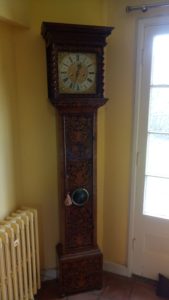
I used a particularly large grandfather clock crank key wrapped in a towel to hold the arbor while I released the ratchet. Its a handy trick if you don’t have a winder – put the key on the arbour and then make a “turban” around it with towelling. This stops you having to handle a “hot” key and means if it does slip from your grip, the towel creates huge drag to stop it spinning and flying off / twisting your fingers.


Christopher Gould Grandfather Clock Repair – Fecit Londini c1700

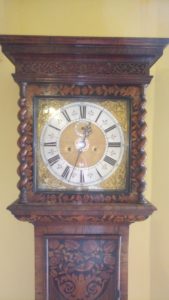
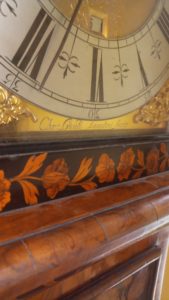
This is a clock I recently provided a mechanical reapair for. Its a particularly nice and rare Gould clock with the all important “Fecit Londini” inscription that means “made in London”. This might not seem much of a credential to have but this inscription was only used on early fine London guild member built clocks.

The face is original and features an early shutter bold mechanism that allows the clock to keep running while the weights are wound up. Bear in mind that it takes about 20 seconds to wind up the clock. Without the shutter bolt, the clock would be running 80 seconds slow over a month. At the time this clock was made such accuracy was thought to be both useful and prestigious.

The other great feature on these early clocks is the glass lenticle which shows the moving pendulum. It doesnt really have a practical purpose but it looks great and gives the cock more movement and life when you look at it.

The case is original and very well produced as well as being in excellent condition.

It had suffered some quite serious wear in the bell stantion. This was always going to happen as once I inspected the component it had a carbon streak fault line in casting. Im surprised this wasnt picked up by the maker during production but it was burried under some anvil work so…forgiveable!.

The more serious problem was the post for the hour wheel gearing had lost its thread and detached which had caused a complete disconnection of the front of face gearing and associated problems. With a bit of careful modification and testing we got there in the end using the original components. Its quite important to use original parts a far as abolutely possible on clocks like this although worn wheels and pinions cant be saved or adjusted for sometimes.

I’m often asked to date and value grandfather clocks. I put this down as 1690-1700 on the date due to the lenticle and face style.

These clocks becoming very rare in good condition, and while values have tumbled in the past few years they are now returning – specially at the top end things where this clock sits firmly. To buy this you would have to pay between 10k and up to 20k but the longer you wait on one like this (at the moment) the better and better the value is going to get.

I don’t care about clock values in the least and will work on whatever is put in front of me of course, but its always nice to get a famous name in the workshop and see what the top of the game was at that time.

DSC_0285DSC_0286DSC_0289


Secticon Clock Repair – electromechanical swiss balance

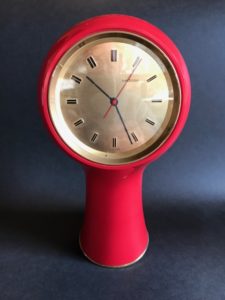
An old friend of mine, Richard Chamberlain, asked me to repair a secticon clock. Richard is a well known figure and authority on late 20th century design and a lot of his stuff goes out on museum tour. I was therefore reasonably nervous about handling the clock as Id not done a secticon before and wasn’t sure what to expect inside.

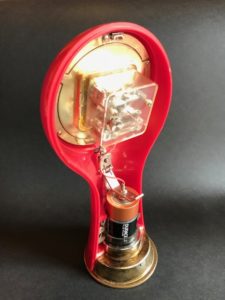
What I found was very pleasing, complicated and generally interesting. It turned out to be a 1.5v electro-mechinical movement with a modified carraige clock escapement driven by a two terminal copper coil motor. Whats hard about about that?.

Well everything really. Not least that the clutch connecting the motor to the escapement drive mounted above it was made from some sort of exotic fibrous material – a cross between hair and rubber is the closest description I can give. Everything is specialised on Swiss mechs. If you look at the comparable German metamec housed 606e from the same period everything in it probably came out of a gas meter or was standard in some way. I could mend the solenoid on it for instance or the coil. There is hope with machines like that but with the Swiss specialist stuff you can give up on any hope of replacement parts or component compatibility. You have to refurb whats left in some way which is why it can be so problematic.

I spent a lot of time examining the movement functioning and understanding exactly how the power from each engine turn translated into hand movement. Its actually too complicated to describe so I wont bother but there were at least 2 methods of power transfer in the gearing types I have not seen before, one involving a screw drive.

On this occasion the problems on the inside of the clock were mechanical as well as battery leak related.

Firstly it was cleaned with the right solvents in the right order to remove very light corrosion from the airborne acid which isn’t that concentrated – you normally get away with it. t was only the fact that the chaps at secticon had isolated the movement in a sealed plastic housing that saved the coil. Normally when a battery leaks in a 60’s electromechanical it destroys the coil insulation and thats really game over. Good design countered this problem and paid off.

The second problem was a relatively minor with a dislocated porprietary design pallet having over shot itself into a jammed position. This just slipped back into place when the balance wheel was over rotated. That took some finding and working out mind you – a very Swiss arrangement i.e. not seen anywhere else.

I didnt get round to finishing it until the night before I was meeting Richard for lunch. Consequently I couldn’t test the final fix as I didn’t have a battery, however, it functioned on a multi power supply at 1.1v just about so I thought it was probably ok.

Well it turned out it was ok and Richard was kind enough to send some of the pictures he has had done of it. It really is a very striking clock and currently values at around £1000 mark. Having worked on it I would say its probably well worth that.

Incidentally if you have one of these secticon clocks and dont know how to get the back off then turn the butterfly nut on the bottom to activate a release cam. This sometimes jams and cant be moved, in which case pull the two halves of the clock apart from the top. There is a spring clip that will release the two halves and no other fixings that will break. Straight forward construction. Don’t use a knife to lever the two halves apart – get a good grip instead and you wont damage it.

IMG_0987

IMG_0999

IMG_1002 (1)


Tony Gilbert Hermle Clock Repair

When customers come to see me on Saturdays at the Antiques Centre its always fun to see what turns up. It can be anything from a 17th Century £15,000 bracket clock to a Smiths Car clock.

It can be quite challenging to make a diagnosis and offer options and costs in a 10 minute window but 90% of the time I am able to do this accurately and very much so when it comes to Franz Hermle movements. Spares for these are still made and parts are often generic accross the range so everything is fairly easy to estimate and get a price on.

Labour costs are lower, but at the end of the day its still a significant cost compared to replacing the mechanical movement with a quartz or cabled synchronous movement. For this reason, if people just like the look of the clock and want an more affordable repair, I am happy to convert clocks between movement types that achieve this objective.

The main issue cosmetically on a quartz or sychronous swap outs is matching the hands. I often have to craft hands both in terms of fit and shape to replicate originals. It can be quite a job to do properly. Then there is the job of fitting the movement securely and in a fashion that does not stress the face of the clock around the collet causing “face warp”. Fundamentally, the clock has to look the way it did or the whole point of the job has been missed.

DSC_0197

Ive not come accross a clock from Tony Guilbert of Dersingham and when I first saw it I wasnt particularly over awed. It looked like a repro styled 1940’s school or station clock.

I see a lot of the originals and its really hard to compare the new ones favourably with the originals. Its about character and the hand crafted element of the older clocks. Im not a clock snob at all but good is good which means it has to be better than something!. Part of the fun of clocks is the variety and mixture of crafts required so theres a large playing field.

Making clocks with modern manufacturing techniques is fine but the clocks have an anonymity as a a result. I know the same manufacturing methods were used on the old clocks but there was less machine automation in the assembly and construction process. For instance, the tolerances in panel size could be looser in the good old days of full employment because there was a man or woman on the production line who did the final fitting by hand. You can see that in the clocks. Even clocks by Smiths of this genre, the same Smiths of “Smiths Enfield” rifle production / armourers, have this hand finished feel.

Older examples back to the Victorian era are genuinely hand made panel by panel, with individually hand cut fixing dowells. These act as securing pegs for the back “box” of the case which can be removed by pulling the pegs out via their hand carved ball ends. Very nice. Each clock is different and I have recognised clocks Ive worked on before when they have changed ownership

Anyway, the point is I wasnt expecting much from this clock and happily accepted instruction for the cheaper electric conversion.

Having measured up the movement cavity in its various critical demensions, I opted for a high torque movement.They have better gearing for larger hands and I will use them, despite the extra cost, on anything over 4″ hands if I can. The standard movements, and even some of the high torque variants for sale, have problems with play in the minute hand. The hand wobbles around laterally meaning the time is out by a minute each side of the hour. Annoying.

So, selecting the right quality of movement and weighted hand match is important on larger faces. On this occasion I sourced hands that were a close match and then shaved them down where required to the correct proportions.

At this point I was ready to fit it all together, which providing you have done the groundwork, is a ten minute job.

Then I noticed this…

DSC_0203

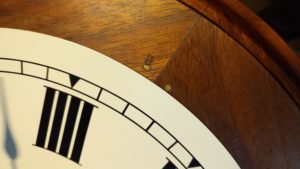
This is whats called “a good job in the first place”. Its been pinned with brass spiggots in the traditional four sections of the Victorian clocks. It could have easily been done with two panels and some glue. You wouldn’t really know, as the owner or potential buyer.

Shaving hand pinned brass flat over wood is not something I would trust a machine to do. And if a machine had done it, then why are the pins in varying position on each panel…..because a this is a hand made clock.

I had a look at the rest of the case and started to notice other things.

The joinery was perfect and delicately finished without any frills. Basically this looked like a lesson in craft joinery. Then I noticed the quality and weight of the wood. Its a heavy clock and the little Hermle wasnt contributing much weight so its probably light oak. Its hard to tell on the varnish finish but its good timber with offset grain in each section as in the originals.

This clock has a floating balance wheel regulating it. Normally, this type of clock is traditionally pendulum driven and quite frankly hard work. It was the cost of accuracy before decent floating balance wheel movements came along  because pendulums are accurate. They are however sensitive to positioning. A lot of these clocks were positioned high up on wall and hung by a single point. Winding them can stop them because you tend to move the clock a little when you do so, as any owner will tell you.

Because people and processes were measured by the beat of these clocks, in schools and factories, they had to be as accurate as possible so the pendulum was the regulator of choice often with a fusee drive to even out the power delivery over a 7 day cycle (old basic clocks gain and lose at the top and bottom of their winds to some degree).

The floating balance movement in this clock is the right choice for what it does. As a nice touch, the maker has used a two hook mounting that maintains the convenience of a hanger while securing the clock horizontally for perfect tension on the balance wheel. So many clocks with Hermle movements are badly thought out and suffer medium term wear or fragility because of it. Not this one.

It has a twin note chime that mimics the gong function of the original clocks It is a nice reference, and, actually its a nicer sound on two small bells. Consider that the norm on the older clocks is a rather dour chime bar or clang once the hammer  leather is worn.

In short, its really well designed and thought out as well as being well constructed from good materials.

So what to do?

The problem with the movement in this clock is that its running fast, even with the regulation set to account for this at maximum. This means that a few things could be wrong.

When a clock with a balance wheel runs fast it means theres may be problem with the main spring losing power, counter intuitive as that may sound. The power may also be leaking somewhere in the gear (going) train through partial obstruction or fouling. Or, on top of this, the balance wheel coil spring may have faded. Or the pinions worn. Or any or all of those.

Where modern replacement movements are available it is common sense to pay for a replacement movement to be fitted, rather than repair one with so many potential faults that are complex and therefore costly to address and even diagnose.

From the clients point of view, a new mechanical movement is clearly going to be a more expensive and less practical solution than a quartz, hence the instruction by the client to “go quartz”. Common sense and great value.

We do what we are told. We really do. Ask us to repair you clock and that is what will happen. Unfortunately due to various superstitions and implausible beliefs I have concerning clocks it is impossible for me to murder one that has been hand crafted in the way this one appears to have been. If your into the Shinto belief system, everything made by man has a soul. I dont want to meet this clock on the other side if I’ve cut its movement off in a previous life.

Consequently we are going to revive or replace the Hermle at our expense and simply charge the client the quartz replacement cost.

Its that or end up as a pair of smoking boots outside the Antiques Centre having been struck down by lightning while trying to beat off a swarm of locusts.

Another reason we are doing this is because I’m not sure that this clock isn’t made by a small independent maker and it just seems a bit more personal.

A quick search of the internet produced nothing and the label on the front of the clock is a laser printed clear sticker. I bet this chap only made a few clocks very well, and no others. Nice work.


Google+ Online Grandfather and Mantle Clock Worshops in 2018

Ok so I hate computers. I really do with a venom. So, in perverse fashion, I’m going to use the tech for a bit of fun and education in order to expand the average brain size on the planet. And because I love talking about clocks.

I like showing people how clocks work. I just do. It gives me great pleasure to introduce people to mechanical science and talk to those who already understand it. So, clock workshops it is!.

No doubt it will be a complete technical disaster and flop with 2 people logging in trying to get me to fix thier clocks for free online. Thats NOT what this is about, we are going to go about this a different way. Each meeting is going to focus on a topic. So, here are some suggestions Ive come up with but I would welcome plenty of suggestions so I can come up with popular content that will get a good look from a reasonably decent audience.

My firs workshop will probably be “Setting up a mantle clock” thats stopped and diagnosing what the problem is with it. I get a lot of this and I do over the counter fixes for it at the centre for a small fee. Lots of people all (over the world now – this is a well read blog!) cant get to the centre and a bit of tweaking on a mantle clock can usually get it going or get a fix plan in place. So what we will do in this sessions is set up a “knackered” clock and get it going. Ill have a few examples on hand to show so we cover a few variants and it should be a really useful session for getting grannies old mantle clock thats been stuck in the attic going with a home clock repair!.

The second workshop (or maybe the first – I dont know) will be “Understanding your grandfather clock”. Right. This is a bit of a bug bear to me. It gets my blood up (a tiny bit). PEOPLE HAVE NO IDEA HOW TO OWN A GRANDFATHER CLOCK. Its like people nowdays not knowing how to own a car. They would have no idea where the oil went, would clean it with paint thinners, and leave it in the drive for six months before replacing a faulty windscreen wiper blade. Knowledge out there about grandfather clocks is that bad and its leading to good clocks being undervalued, scrapped and abused. Our mission at Braintree Clock Repairs is to stop this appalling grandfather abuse. Some of these clocks are only turned once every seven years. Weve got to stop this so log onto my grandfather clock talk and Ill explain how your clock works, what all the bits do, and how to date your clock. I will do this with a few movements in different states of deconstruction rather than a live strip down as I dont want to break my John Mason 1730 London Brass face which we may as well use as the demo dolly.  This knowledge will help you extend the life of your clock for the next generation and you will love your clock even more once you know how it works – its almost devine in its simplicity and accuracy and its no cooincidence that its pendululm design was by one of histories greatest astronomers and atrophsisysts – Christian Huygens (wikki link to him).

If you would like to attend either of these events Ill let you know when I have enought people interested – say 20 people, assuming 5-10 can make it live. That should mean we can really make it two way like a consultation along a common theme.

This is a contribution to our clock friends and community so don’t hold your breath on either of them as its probably going to be late January are the earliest.

To sign up to the events just email me at admin@braintreeclockrepairs.co.uk with the subject of your email as “EVENT MANTLE” or “EVENT GRANDFATHER. Dont bother with a message as I wont read them – Ill just put them in a a folder until its time to group email you all instructions with how to attend the Google+ meeting. To prepare you will need the following

  1. A gmail email address e.g. john6787876@gmail.com If you dont have one its very easy – you can just go here and it will take you through it. I assure you its perfectly safe and secure and gmail is one of the best systems out there and I find it much easier to use than hotmail and outlook which seem completely {legal department deletion}
  2. Once you have a gmail email address then you will be able to get on google+. If your signed into your gmail account it just lets you onto the google+ page. This is a bit like facebook without all the Facebook. Its a basic service that allows you to leave posts, see others posts and join video chats. You can join without a camera at your end so you can see me but I cant see you, or, if you want to show me your clock and ask questions you can turn your camera on. In either case you will be able to see me live and I will just see you as an icon or, if you choose, see and/or hear you. If your already a gmail user, are signed in, and have not looked at google+ then the main page is https://plus.google.com/ – as I say, its basicly google facebook but its not as family centric or enclosed. Its a great way to meet people from other nations Ive noticed; facebook works on locality with a lot of its services whereas google+ is more global. The google+ system I am going to use is called “Hangouts” if you want to familiarise yourself with what a “Hangout” is and what it looks like on the screen etc.

So – please send in your emails and we can get this off the ground at some point in 2018. I hope.

Happy new year to all my customers and the people Ive met along the path of clocks this year. It has been inspiring. Thank you.

BBC Celebrity Antiques Road Trip Appearance

As you know, if you read this blog, or you’ve read the main page of the  site, I manage an antiques centre as well a the clock business with my son, Edward. Im only on site there on Saturdays now and Tom will be happy to help you in my abscence, however, to get to the point, the BBC pitched up to film Celebrity Antiques Road Trip.

I probably work a 50 or 60 hour week and enjoy my work. Consequently, I don’t watch much TV and when they rang (the day before they wanted to come along) I didnt really know the show or when it was on, what it was about, who was in it. Nothing. I just said “yes” as soon as they said “BBC”. Anyway I made an appearance in the haggling and paying bit . Yes I did fund the £45 discount myself if you wonder about that. Quite frankly I would have paid them to take the stuff and filled up their petrol tanks just for the advertising so it was an easy discount to give.

Overall I didnt rate the experience and wouldn’t recommend it to any but the most confident. The effect of some BBC boffin pointing a huge nose lens thing right into your face is astonishing. You cant get words out and because of all the adrenaline its really hard to concentrate on what you are supposed to be saying and in what order. Basicly the camera may as well be a slow burn death ray. I think I would have been fine had they got me on clocks but they bought a pipe. Damn.

The director was a really nice chap and gave me a fantastic edit, but the reality is that there is far more film on the edit room floor of me looking like Im having a stroke while waffling rubbish backwards.

They shoot the whole show with a crew of 7 which I found surprising, and no lighting and just one camera. You could have made the whole thing on an iphone from the way they used the kit and shoot progression – very clever actually. The other thing worthy of mention is that there are multiple shots of the same “scene”. What I mean is that that make you do it again if they don’t like the way you did it. This happened so much with me I think there must have been some sort of camera fault. That will be it – camera fault. Anyway I think a few of my clocks are in shot and you can see where I work from and take in clocks  on Saturdays at least.

Heres a link to the episode if you want to see me look about 1000 years old and tight fisted for 10 seconds of screen time. My 15 minutes of fame.

If they ring up again Im only doing it if they agree to do a clock repair bit and I want a script and some notice. And a dressing room. And a limo. And Im not working with Jim Carey or Costner. Imbeciles.

https://www.bbc.co.uk/iplayer/episode/b09j0lrj/celebrity-antiques-road-trip-series-7-episode-13

CelebRoadTrip


Loetscher Swiss Cuckoo Clock Repairs – The UK Authorised Service Centre

Loetcher_Logo

This is just a short post by way of a NEWSFLASH!. I don’t do newsflashes but this is probably worth mentioning.

Due to our extensive experience in repairing all types of antique and modern cuckoo clocks we are shortly to appointed Loetscher UK service centre for the UK. This will cover warranty repairs, out of warranty repairs and means we will be carrying and extensive parts stock with a view to offering a 5 days service (plus postage times) for warranty work.

We will of course to continue to provide repair services for all modern and antique cuckoo clocks so if yours inst a Lothcher then we can still repair any fault.


5* Review for the Clockmakers Museum London – Inspiration for clock repairs, science and history

Today I visited the Clock Makers Museum in the Science Museum London. It was pretty much a religious experience. I saw clocks by makers I had only seen 2D without getting to know a clock when you can see right into it and uderstand… lots of things.

The first thing that is absolutely shocking is just how good the early clock are, 16th century specially so. Theres art and passion and science in these devices, and despite being the preserve of the wealthy, it shows that there was a very real commercial and skills based Britain at that time. It wasnt all tax and farming, walloping iron with hammers and building galleons. Fine engineering and mathematics was going on. This is less surprising in the 17th century really I suppose as munitions manufacture was advancing with its own driving force and many of the crafting skills, at least, would have grown as well as the opportunities to learn them.

Point in fact..

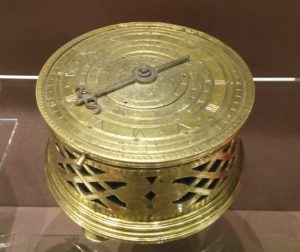
This clock was made by a Cap called Kratzner who was the kings clock supplier to Henry the VIII. Thats 50 years before Blackadder the 2nd to put it into context for those without a date lined knowledge of the monarchy.

DSC_0083-1

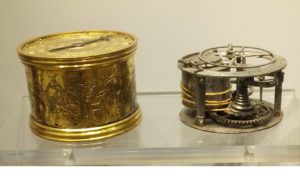
They handn’t opened it up so I couldn’t see the movement but they had another example by another maker who, more than likely produced lower quality work than Kratzner because of his Royal appointment which was based on work quality. He was the big noise in astronomy at the time and a leading mathematician and lecturer at Oxford. Theres every possibility he might have pointed and laugh at the clock innards below.

tableclock

Theres a lot of precision metalworking and maths in there whatever Kratzners imagined view. Note the early use of a cone shaped cone fusee barrel which is essentially a variable ratio gearbox that evens out the surge of strength a rough steel spring has when fully wound. The stiff curve on this can be seen in the ratio of the top to the bottom of the cone. Improvements in steel generally and springs generally meant that over time fusees were not needed as spring power delivery was smooth enough over the run and new methods of regulation using balance wheels and lever escapments means the regulation would function accurately in a wider power band. Having said that, taller springs on much later clocks still use this method of power distribution over runtime and its always been widely used in pocket watches where fine accuracy defined quality. Despite its limitations and lack of technical refinement the maths and the knowledge is all in this little table clock and its shows the desire to miniaturise technology and make it portable that continues to this day.

Me and my son repair clocks and Ive seen most now up close. The exception is of course the majority of the clocks I saw today which you can only see in museums or if you know a multi-millionaire or two. The he clocks I have seen, however, are  simply a technical improvement on this clock with refinements in regulation, gearing and power. This is basicly where it started for British clocks if you dont count turret clocks.

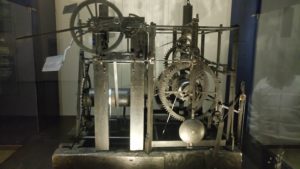
Heres one from about 1350 or so out of Winchester cathederal and while you might not recognise the architechtural similarities I assure you they are there. these things were not that accurate either and read in quarter hours. Time didnt become that much of an issue to any more than 15 minutes. This was until Christian Huygens invented the pendulum as a regulator in 1558  and got it down to three minutes a week for the masses whos households could now afford the cheap and simple pendulum clock (comparatively). Thank Christian for having to get to work at exactly 9 or whatever but bear in mind that before it was “get up as soon as it is light, work, get beaten with a knobbly stick on principle, return to hovel when dark. , sleep, repeat” unless you were a clock maker or similar.

Anyway, its a big table clock. You cant really tell how big it is so I did a second shot…

DSC_0185

Thanks the the random woman who was kind enough to pose for scale.

I should have asked her name really but I was in clock frenzy research mode and she was just a tool to a means. So sorry and thank you mystery woman. Also she was off less than average height so it doesn’t really do the scale thing justice bearing in mind shes a good 2 feet away from the glass case and I was using a wide angle depth distorting lens. If this was to scale this woman would be the size of bigfoot considering the unit is mounted on a 1ft plinth.

A better guide might be that you could just fit a fiat 500 in the perspex case.

DSC_0187

Once clock makers started trying to make them more accurate thats when modern mechanical evolution really started in earnest. It spread like wildfire with the development of materials technology including of course the silicon chip which is now what tells us the time. If it wasnt for the innate curiosity we have for technology and a desire to prove we can master it, then we would still be in the middle ages and this little clock is one of the quick steps we started taking which soon turned into leaps and nuisance telephone calls from robots.

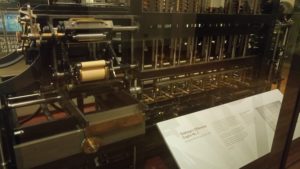
Technology advanced automation which created wealth and the two became linked in an upward spiral at an accelerating exponential rate to the bloody iphone and computer fraud. Look heres the Turing machine (2). I found it at the end of the clock exhibition not surprisingly. QED.

DSC_0175

Clocks didnt start in 150 however. It was a process of miniaturisation (sound familiar?) as the turret to table clock shows.


Overall I can thoroughly recommend a visit to the clock museum in the science museum, London, Exhibition Row.

As a general review heres the low down.

Theres a couple of Tompions there and the best work of the 17th and 18th century makers. Its mainly about that and for good reason as its when the biggest leaps in craftsmanship really happened. By 1800 things were getting mechanised but all the stuff you see at the museum is hand made and quite incredible because its all the best golden age clobber!. Theres a ton of pocket watches if thats your thing and some really impressive engraving although you want to reach through the glass an pick one up for a closer look!. Its not for kids and dare I say wives. Skive off to it after work if you can get out early as it closes at about 6 I think – check the link at the end for the google listing.

Well done and thank you to the http://www.clockmakers.org/ for making this happen and organising such a well date lined example of clocks with some good internal views that give you all the engineering buzz and appreciation of the beauty of some of these things up close. The grandfathers – seriously valuable ones, are there without glass cases although the Tompions are an understandable exception. Still, you really get to see the best grandfathers in the condition they were sold in. For an enthusiast its a 45 minute tour, for the interested about 20 minutes but theres plenty more steampunk tech to see in the rest of the museum and it was two hours of selfish pleasure. Nearest tube South Kensington + 5 minute covered walk to entrance.

Heres a google business listing link to how to get there and all that stuff . If you know London its just off the staircase on the second floor of the science museum if you use the Exhibition row entrance go to the lifts and stairs at the end of the entrance corridoor.

https://www.google.co.uk/search?rlz=1C2CHBF_en-GBGB734GB734&source=hp&ei=DkIbWv_CB9D9kwXx9rnYAw&q=london%20clock%20museum&oq=london+clock+museum&gs_l=psy-ab.3..0j0i22i30k1l4.877.7346.0.7674.32.21.5.2.2.0.432.3789.0j15j2j2j1.20.0….0…1c.1.64.psy-ab..5.23.3638.0..35i39k1j0i131k1j0i10k1j0i10i30k1j0i13k1.0.LCUFluisJgU&npsic=0&rflfq=1&rlha=0&rllag=51506889,-131303,3313&tbm=lcl&rldimm=2736474298214855188&ved=0ahUKEwiQu-Xppt3XAhVRyKQKHWO1D8sQvS4IRjAA&rldoc=1&tbs=lrf:!2m1!1e2!2m1!1e3!3sIAE,lf:1,lf_ui:2#rlfi=hd:;si:2736474298214855188;mv:!1m3!1d10554.215149663847!2d-0.13130329999999998!3d51.5068897!2m3!1f0!2f0!3f0!3m2!1i592!2i204!4f13.1;tbs:lrf:!2m1!1e2!2m1!1e3!3sIAE,lf:1,lf_ui:2