We are now the service arm of CuckooCloolections.co.uk

I am please to announce that Braintree Clock Repairs is now taken on repairs for the very popluar cuckoo clock website, www.cuckoocollections.co.uk.

This is a good business partnership as Braintree Clock Repairs has somewhat of a speciality in cuckoo clocks and holds vintage and modern spares for service work. Cuckoo Collections, however, are on the other side of thing sourcing and selling the best contemporary clocks around so this partnership should work well.

Just to stress at this juncture…this is ADDITIONAL work to Braintree Clock Repairs other types of clock, we fix ANY clock and are quite proud of that. We have a 98% fix rate and if we cant fix it….we dont charge. A no fix no fee service in clock repair is unheard of for good reason. Its about being good and knowing it by proving it on every job. Crikey – Ive strarted bragging – I do apologise but it is true and its worth knowing if your a potential customer reading this.

The same goes for Ryan at Cuckoocollections. He is a swithced on chap with good product knowledge and will be able to give you excellent advice if you have any queries on stock or options on a modern clock or some of the repro classics (email is best to get hold of him).

As part of this service partnership Braintree Clock Repairs is now going to gradually add a more extensive range of services for the modern electronic clocks. Not too much of a change from normal operations, however, it will allow us to continue to enjoy the genre through all its eras, be it a fantastic Victorian automater with a superb music box, or the simple every day later cocks from the 20th century that get passed down as family heirlooms, and now, the contemporary clocks you will see on Ryans site as well.

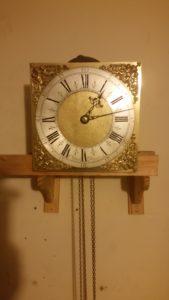
Thanks to Ryan at CuckooCollections.co.uk for coming up with this idea – the more cuckoo clocks I get to work the happier I am. As long as I get all the normal  1710 London Grandfather and 1950;s Smiths Bakelite in as well of course!.

In all honestly doubt I soley do cuckoos….serious risk of mental meltdown. Some of the old clock were build by dyslexic maniacs with reverse finger joints and you can only absorb so much of this insanity before you want to track the guy down and say “but why this way? you could have mounted this part so it was as least accessible”. Cant afford the air fares so Ill try and keep my cuckoo addiction manageable and my engineering critique to my blog.

Interclock Grandfather Clock Repair

Ok… Interclock. How to describe them…

I often find the best way of communicating where a clock sits in the clock landscape of things by comparing them to a car. So, for instance, and smiths 1930s mantle is a Vauxhall Vectra. It was made with the same principles of value for money, good styling (subjective obviously), and built to do the basic job well for a long time. A Small Mathew Norman carriage clock is a BMW 318. Its well made, has mid range brand kudos,  has classic straight line design styling and you cant get one at a knock down price.

This brings me to Interclock. They are generally 1985 Bentleys.

The first one of these I saw was as at a large country house. Lord whover phoned and told me he would like me to come out as his Interclock grandfather clock was not chiming. Id not heard of the maker and just booked it into the call out diary on the basis.  Seven out of ten times I can repair in one visit on a callout, and with grandfathers, there are rarely surprises in terms of design or function – I’ve seen pretty much everything.

I’m not saying I can complete any job on site, but most call outs tend to be for clocks that have been moved recently or stopped working suddenly and most of those can just be fixed with a quick partial disassembly.

Anyway, back to the Inerclock Bently. Info on Interclock is hard to find. I was unable to track anything useful down on the internet. Luckily the owner had kept the original sales brochures and spec in the base of the clock. I should have really taken a copy but from memory, Interclock were based somewhere like Kingston Upon Thames. I may be wrong on this but it was quite a good London address but not central. The clock was a top of the range job and it looked, literrally, like a pipe organ. Interclock designed and made clocks in the 1980’s and they are very grand and over the top. Styling could be described as “New Edwardian” but the glamour of the clocks is more in keep with regency design values. At any rate they tend to be huge. The pedulums are outrageous – huge affairs the size and shape of a full sized banjo.

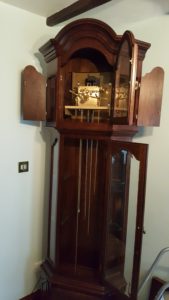
Now, for a repairer like myself, they may as well have been made on Mars as far as any trade or guildy type design rules or principles. The construction of the cabinet is closer to that of a display case as opposed to a clock case. The one I did today (photo) that has internal lighting and glass shelves so you can stick your favourite objet d’art it there to enhance the look of the thing further. I think if you had attempted that at a London Maker between 1680 and 1860 you would have been assassinated by your guild which gives you some idea of the tradition of form and build in grandfather clocks generally.

Im going to commit and say I like them but I had to see a few before I “got it”. There is something so over the top about the way they crazily mix design style and function and still pull it off in the end result. I wouldn’t own one as you need a big room or it will completely dominate. Having said this, because they sort of look like furniture as opposed to a clock it is possible to fit them aesthetically into a smaller room than you might imagine. If your room can take a large display dresser style piece of furniture then you might like to have a look for a second hand one of these because I have a feeling they might become rare and more popular then they are. Servicing costs are high and they can be broken down for spares – specifically the movement which retails at several hundred pounds if you need to replace it – I know because I buy and recondition them from time to time. I’m after a 1930’s version at the moment which is proving really hard to source and may mean building a working movement from two broken ones as nobody has any working for sale – only broken or failed project remnants. This means that most of these clocks will end up frankenstiened into other cases and the Interclock cases will be either broken for spares or disposed of. Terrible I know, but thats what is going to happen because of the high service bills and many of them now being inherited items (or will be soon ehem!). Your average Grandfather clock buyer is in his late 30s to mid 50’s in my experience – this means that the original owners of these 80’s clocks are probably making every day count, as it were. I do apologise if your reading this as an owner in their autumn years but to be frank its a common subject that comes up on house visits, normally at the part where investment in service costs is reached, and cost justification, and it always turns to humour.

In terns of maintenance, ff your thinking of having a go yourself, think again. The head/hood of the clock does not come off. This means figuring out out the order in which you have to unscrew panels and loosen things to get the movement out. If you get it wrong it can fall apart like a Chinese puzzle and you are committed to a complete dissasembly . Because its a one part chasis you only have the side panels to see in and how its put together. Invariably this isnt enough and you have to move the clock forward. I have rocked one or two back from a wall on my own but really its a two person job. Added to this, if you dont put the clock back EXACTLY where it was it wont run again.

This brings me to the movement. Kienigner (German) and very nice too. The problem on them is that Pendulum setting on them is very precise and easily knocked out of position if the pendulum is pushed too far right or left. Even if you remove the pendulum and are careful as you remove poke around the back of the movement, its easy to accidentally make an adjustment. Again its all down to accessibility and case design.

If you need a hand on yours email me a picture of the top section and if Ive done that model before Ill email back a few bullet points on a suggested disassembly approach. If your within 30 miles of Braintree Essex, give me a call to book a service visit rather than have a go yourself – well worth it.

The clock below is the one I did today. As you can see I managed to get it apart and found that the quarter chime trigger had jammed in the up position. The clock had not been run for several years chiming so this jam happened some time ago. I worked out that somebody had really rammed down the “silent” switch on the front and this had catapulted the trigger right back 180 degress lying on its back where it had been for 4 years.

I’m quite surprised it did this as movements are usually designed with stop pegs to avoid precisely this type of malfunction but it had got over it somehow. It had to be firmly handled to set back in place so its hard to work out where the considerable force came from to flip the trigger in this way. This sort of things happens a lot if you let a clock run down on its chime as opposed to stopping the mechanism properly with the silent switch. The problem is that the chime runs down half way through a sequence and leaves lever and suchlike inside the clock between positions. This results in a seize up of the whole clock because components assume positions they are not supposed to be in and block sequential triggers and functions.

Its sort of important to understand “why” and well as “what” the problem is you find yourself revisiting clocks when problems that apparently have been completely cured mysteriously re-occur. Its a learing curve with a real business cost so you soon learn to take the time to understand “why” you have a problem if possible.

Interclock_grandfather_clock_repair

This is a corner clock by the way and relatively modest compared to the vast 8 hollow bar chime model I first saw. Ive sorted the first problem out but the clock is currently on test with a second service visit booked tentatively for next week as there are further known problems that need a week of running to diagnose properly. The Kieninger movements are very fine in comparison to, say, Hermle, however the cost of this engineering beauty is complex servicing – like and ’85 Bentley in for a 200,000 mile service.

Tutorial – How to break down move or transport and pack a grandfather clock

This is the inside line on how to move a grandfather clock with lots of good clear advice and a step based tutorial approach. I do this from time to time to……keep clocks going and keep people involved with their clocks. Moving your own grandfather clock gets you into the clock a bit more. You will see some of how it works and it might even lead to you attempting some of your own service jobs – a bit like owning a classic car. This article tells you how to move your clock safely and professionally. Thanks for visiting my site and taking and interest.

If you clock is worth a great deal you should probably get somebody like me to move it. Its an odd thing to open with in terms of a DIY tutorial but the process does have some risk, which while I tell you exactly how to avoid, is still present.

If your clock is a mid-range two weight affair (and very nice too!) then you can move it yourself because it comes apart easily and fairly robust. Its the more expensive clocks that tend to have the more fragile key components. Grandfather clocks are almost modular in design and tradition of manufacture has meant this modularity is consistent through grandfather clocks manufcaturing history. This is partialy because all the parts were manufactured by guilds specilising in each area. Cases were produced and sold to clock movement makers who in turn were buying face plates and dials from engravers and sheet metal producers. This even applies to the face components like spandrels and hands, but dont worry, you wont be removing those. In fact there are only five elements to the breakdown for transport. Head, case, movement and face assembly, weights and pendulum (and key!)

So this is a step by step guide on moving a 1700 – 1860 clock. Broadly speaking they share identical overall construction.

Before you do anything to the clock record the angle of the clock on two horizonal axis. You are going to need to set the clock up at exactly the same lean and yaw as it is currently set to or it wont work when you put it in place at the new location.

So, you need to measure the lean and yaw from the hood of the clock .The hood is the box head of the clock with the glass door. It slides off as a separate assembly, but we will come to that, firstly you need to measure. To do this get two small spirit levels and a whiteboard marker. Put one on the side ledge of the clock hood and the other on the front ledge. Mark the edges of the spirit level bubbles and mark each level with its identity / side / front.

Remove the hood. What you are dealing with is a box with an open bottom, back and of course a glass door. It slides forward so just get a hold of each side with the flat of your hand and pull it forward. If the clock has not been taken apart for a few years you might need to lightly jiggle it. You will see some movement on the edges and you can than work that into a slide with a bit of perseverance. But stop…..

Before you do this secure the glass door catch because the clock head will likely lean forward in the last stages of sliding free. At this point the door, if not locked, will open and hit you directly in the face. The higher the clock the worse this is. I was working on a 1900 8 bell that was 7.5ft high the other day and if that had opened I would have been wearing the whole head door like a jagged glass necklace. So worth mentioning.

Ok so the hood is off. Now you remove the pendulum. Look behind the movement and see whats going on.

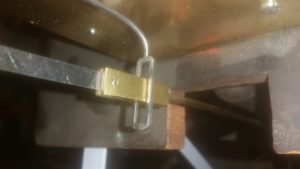
What you will see is the pendulum rod become a leaf suspension spring in its top 6″. At the top of this leaf spring, if you look carefully, you will see that the leaf spring is sitting suspended from a slit cut into a support. It isn’t slipping through because there is a brass stopper at the end of the leaf spring so the whole pendulum is hanging from this brass stopper.

The next thing you will notice at the bottom of the leaf spring is that there is a dog leg shaped wire protruding from the movement which appears to cross the leaf spring. This is usually at the junction between the pendulum rod and the brass block that joins the rod to the leaf spring. That dog leg is a lever that moves back and forth with the pedulum because it has a fork or loop in it that surrounds the brass block. You cant see this loop / fork arangement easily form a side view so you have to know what your looking for beforehand if its the first time youve had the head off. Rest assured what you are looking at is a leaf spring running through a fork or loop attached to a dog leg lever that leads into the clock movement.

To remove the pendulum you need to reach inside the clock and get a grip on the pendulum rod as far up as is comfortable. It must be comfortable because you may need to support the pendulum for a few minutes and a tricky job is badly effected by discomfort. If this bit goes wrong it starts to cost money. Dont unscrew the pendulum weight off to make things easier. It needs to be exactly where it is for the clock to keep the same level of accuracy as it currently does. If you replace the pendulum weight even a few MM down the thread when you reassemble it the clock will gain or loose time significantly and need regulation which is a time consuming week long process of change, measure, change, measure etc. to find the precise bob position that results in perfect time. Grandfather clocks are designed and valued for their accuracy so messing up the timing on one is a cardinal sin! Certainly to the owner.

You should be looking directly into the back of the clock so you can see the leaf spring, its brass block, and the crutch (dog leg wire), while at the same time holding the pendulum rod as described.
20171012_233218

Lift the pendulum slowly. The stopper at the top of the spring should lift but if its sticky the spring will flex to account for your lift. If you bend the spring to much its had it, so take it easy on the lift and – 1cm should shift it. If it doesnt get your spare hand on the stopper and pull it up while SUPPORTING but NOT PUSHING UP the pendulum with your other hand. If you push and pull at the same time you can snap the crutch / fork join.

If, as I hope, the spring comes free without event, then get your free hand on the stopper and push it back to release the spring from it slit. Once thats free of the slit then slowly lower the rod, BUT….
20171012_233229

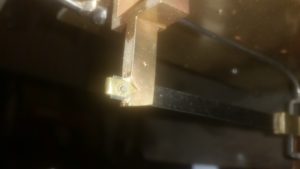
This is the tricky bit. The crutch or loop round the block is a tight fit and the blocks are square. If lifting the pendulum to detach the leaf spring from the slit has pushed the brass block right up through the crutch then it can be really trick to pull it back through because the fit can be very tight.

This is why I recommended a comfortable position which you should test with a measure of how heavy the pendulum is before you go for it. You cant hurry this bit or force it because the crutch is and expensive component to get fitted and the join on the dog leg is often 100 years or more old. The crutch will break easily under any kind of strong force. Its about as fragile as plastic to give you an idea. If its a bad one then soft plastic thats already perished is the norm – an accident waiting to happen.

Im not saying your clumsy, the fact of the matter is that you will be supporting a kilo or two on a thin rod in a stress position which encourages you to hurry. If you loose your grip on the often thin an smooth pendulum rod and it drops, then the block will catch on the fork and the weight of the pendulum accelerating downwards will break the crutch at the solder point.

You will either be fine or swearing a lot or probably both about halfway through.

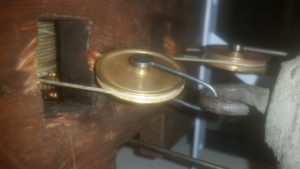
Once you’ve done the pendulum wind the weights right up. When I say right up I mean until you feel the very first hint of extra resistance caused by the weights locking at the top. Go really slow at the end of the wind to find this sweet spot.
20171012_233133

Now take the weights off. Wrap both in a single towel and tape it. If you wrap them individually they roll and bang into things unless you pack them in packing in a box. If you bubble wrap and tape them they invariably break loose and you have the same problem. Towel.

If you look up into the clock you will see the weight wheels bunched up against the supporting plank. Wrap a few layers of packing tape loosely around them to maintain their position. You want to be able to easily cut off the tape at the other end so that the wheels are sitting there with the cable in their grooves ready for the weights. Don’t worry if the cable falls out of the grooves during transit too much and better lightly tape them and have them come lose than fight a tape ball in low light near easily cut weight cable. If they do fall out, because you wound them to the sweet spot you can just sort of clip the wheels back to the cable – its not hard. If you overwind it however you will have no end of trouble so go light on the initial wind up and try and wind the wheels so they are just lightly clamped against the board by the wound in cable.

Your now ready to remove the movement assembly. The face is attached to the movement by three pins. That in turn is attached to the wooden base plate via two bolts. If you look up into the clock you will see these. The face, the movement, and the board are therefore a discreet unit for transport. You will be able to lift it off as such. Dont do this until you have read the rest of this article by the way – guaranteed fail if you do.

If you cant lift it off then its screwed or nailed on where the board meets the side support it sits on. For some reason there are normally four screws or nails, I suppose because this creates the best flat and even connection between parallel supports without risk of distortion. Anyway, remove the screws or in the case of nails lever the board up with a chisel so the nails detach. Do not use a hammer fork or nail remover from the top of the board. A 2″ chisel used judiciously is the path of least destruction. Expect some damage here and if you’ve got a brass face 1700 london clock in walnut phone Pickfords or me at this point. Move the whole clock rather than damage a rare and good one. Condition is everything at the top of the market.

The movement assembly is the the riskiest part to transport. Pay attention to the back and the front specially. While it looks like the sides are vulnerable with the exposed cogs, its actually the hands face and the fragile crutch at the back that are going to get you if anything does.

The movement assembly is unstable by nature. Its just the wrong shape and will fall forward or backwards if you put it down on a flat surface or lean it up against a wall – it has a deceptive centre of gravity. Even if yours seems to be fine at about 25 degress off vertical I guarantee you it will topple easily backwards and that invariably snaps the crutch at its weak point.  It will happen if you trust your luck when you need at third hand. Its one of the reasons l come well prepared or with my son if we need to collect, deliver or install a whole clock

The highest risk period of this whole job is from the moment you lift the movement assembly to the point where it is placed in prepared packaging. If you digress from the direct transfer from clock to packaging it all goes pear shaped quickly. You will place or rest the movement for a moment while making final adjustments to the packaging and it will fall over guaranteed and bend the hands or break the crutch. If your really unlucky you will scratch the face which on a brass faced clock is not something you can really come back from. Ive scratched a white face on one and only occasion.  The restoration was 30 hours because its like filling in an oil painting as opposed to painting a surface with defined lines due to the variance in ageing coloration. I think I’ve probably made my point – get it off the case and in the box directly.

“The box” should be big and full of polystyrene worms ready to place the clock head in upright as if it were mounted on the clock.

DONT use bubble wrap or towelling or anything fibrous or snaggy to surround the clock in its box. This is because the hands on these clocks are pretty much like fishing hooks and will adhere to any of the aforementioned. Before you know it youve bent or snapped a hand off while removing the packaging. Its a really common mistake to make. Equally the crutch at the back is perfectly designed to snag on packaging and actualy moves around as well so its almost willing itself to snag up on something.

Fundamentally, its worth the hassle of getting the right packaging materials for this bit and while it will mean pulling poly worms out of the movement at the other end its better than a key component break. Don’t use beads – it has to be worms. Beads, the small ones, will get in the clock and you will be spending some time locating and removing the ones that fit perfectly wedged between overlapping cogs and are a swine to get out. I know because some people use them when then send clocks to me for repair. Somebody did it with a cuckoo clock once which I shall not forget.

In terms of the pendulum, make a two piece cardboard sleeve from cardboard and tape it around the leaf spring. Now  heavy tape it inside the case. Its easy to do if you lay the clock on its back. If the clocks only going down the road then just take it along but if its part of a big move where its going to be stored prior to installation the pendulum tends to be the problem part to go missing. Weights can be replaced but pendulums are weighted to individual clock to a degree although many are about the same. Theres no reference material available publicly that will tell you the weight range of yours and Id decline sourcing one if asked as it would be a matter of trying a few quite frankly – over to you!. Some would be easier than others but its not worth the risk of losing it.

So everything is now good to go and can be transported in the same way as, a television – with care. You cant shock it but it can be handled in pedestrian fashion providing of course you take due care with the head which has particularly fragile glass. If its original beautiful uneven glass with faults its a terrible shame to loose it so I would actually recommend boxing it up with bubble wrap like a vase.

The case is worth wrapping in a sheet. The case is awkwardly weighted when you carry it, solo specially so, and its easy to mis-judge it and catch the edge of a door frame on the slide as the case tries to turn in your grip with the uneven weight distribution. The uneven weight is mostly front and bottom heavy but only by about 60%. You will likely need to rotate the clock to get in through any awkward space and the clock can easily spin and slip during rotation even with two people. As long as you keep a firm grip and are aware of where the majority of the weight is at any given time, its ok.

When you reach your destination simply do things in reverse order and the clock should be standing infront of you almost ready to go.  When you test you clocks position against your desired spirit level records it will almost certainly tick unevenly and stop after a short while. This is why it needs levelling to its native gradient.

In addition to the uneven, cantering tick the pendulum swing may well rub on the weights or the back of the clock if its tilted even slightly backwards. Correction is therefore invariably required even if its close to level and actually runs – it wont for long. But it might run badly and you will be tempted to leave it as that. This is a bad idea because what you dont want is a clock functioning but huffing and puffing along, if only for what it does in terms of uneven wear long term. If you leave it like that you might find it will ONLY run like that after a few years irrespective of adjusments you can make on crutch which is the only alternative adjustment.  Basicly it knackers the clock over time and your giving it a death sentence.You might ace it and it goes in exactly right – 1 in 10 or so do perfectly but just be sure it really is right with a perfectly even tick tock and at least 5mm clearance from the pendulm back and front. If you dont give it a good 5mm any shifting of the surface its on over time eventually means the pendulum clashes with the weights. For instance carpet compresses flat over years for instance, and not evenly because of the front weight distribution of the clock. It leans forward over time which is a good reason to fix it to the wall towards the top of the clock. You can use glued wood spacers and screws on average clocks – a couple of holes / rawplugs is perfectly acceptable and all clocks mostly already have them. Its actually part of the character and shows you, in some cases, that the clock has had many lives.

We took some spirit levels measurements earlier that you now use to correct the difference. To do this is as simple as putting spacers under the corners of the clock to get the clock to the correct spirit level settings. You will need spacers on at least 3 corners in order for the clock to be stable. If you only do two corners and the spirit levels line up you will find that the clock rocks a little diagonally which is no good long term even if it appear to sit reliably perched on three corners. Just make sure its solidly planted as well as lined up with the levels.

In terms of what you use for the foot spacers, do not use box cardboard despite the fact you will have plenty about at this point. It compresses over time and the clock will go leaning tower of Pizza. This goes for any compressible material like that e.g. carpet shards to match the floor are a particularly poor forming choice but amazingly popular for some reason in my experience (I end up troubleshooting a lot of botched well intentioned moves).

Good materials are wood and paper but the best is probably game or business cards or thick paper or some sort. This can be divided up very accurately and cut to shape so they can be hidden away from view. It doesnt compress significantly which is what you are looking for in whatever you select as spacer material and of course its very easy to get the exact height you want. Variance is rarely more than 5mm on any foot as the cases are produced well and fit for purpose, they feature a good four point connect on a perfectly flat surface. I expect it was part of the art of producing the cases.

When most older grandfather clocks (130 years) were produced there were guild controlled method based apprenticeships which seems to have standardised both the basic design of the cases and the key quality points. I expect some things you were obliged to get right at the required standard!. A level base was I imagine probably one of these. Its certainly borne out in the clocks I have seen across all quality levels, but to be fair there are not many non-guild bad ones about and you might have one of those so it might be off…but its probably bang on so 5mm is where you should be aiming for on a reasonably even surface.

Note that there there are two legged variants that rely on tight wall fixing and have the advantage of often recessing into skirting board due to the lack of back pediment. If you dont screw this type on it will slip forward at the bottom very easily, scratch the wall, and break its glass as it grand slams on its back on the floor. Ive only imagined it by the way, thank goodness. But it is what would happen for certain because of the top heavy nature of the clocks.

Overall, to be fair, this method of propping the clock level is a bit bodge. The crutch angle at the back should be set instead, BUT, if I tell you how to do that you will only break it as it invloves bending it with measured force in the right location and understanding whats going on in the clock. This guide is for everyone so its a one size fit all!.

Oh – I almost forgot – get the winder and tape it inside the case with the pendulum.

So thats it. Keep on clocking and dont be afraid to give this a go. Ive stressed the risks so that you get it right, not to put you off. If you do what I have said you will be more than fine and a few hundred quid richer on re-location fees. Good luck and if you have any questions I can usually find time for a brief reply on email.

Some people are unable to, or don’t want to personally move their clocks for good reason. If you would prefer me to handle moving your Grandfather clock email me a picture and details of location, destination, time frames and Ill get back to you with an estimate.

 

My grandfather clock stops after 4 or 5 days but works perfectly

Ok this article was inspired by a clockist who came to me with a problems he just couldnt figure out.

He brought the movement in for us to have a look at and see if two heads etc.

The movement was perfect and correctly set up. It functioned under test well and there was absolutely nothing wrong with it at all. Yet it stopped after 5 days on what should be an 8 day cycle. Ive seen this a few times and the first time I encountered the problem it was infurating. I had to return to the clients house on two occasions because the problem would occur sometime within a 3 hour time frame after about 5 days.

I had opened the clock on each visit to see what might be wrong with the weights. They appeared fine on the first occassion and then on the second I noticed something.

To explain. Almost all long case clocks are fitted with externally mounted doors. They are effectively a plank over an slightly smaller appeture. This creates a ledge on the inside of the clock wall when the door is closed.

As youve probably guessed what was happening was that the the edge of the weight was catching on the ledge in the clock and just sitting there. Theproblem wasnt apparent on the clock I looked at because the weights were light and the clock strings were holding them upright even though most of the weight was on the shelf. The result was weights that looked like they were doing the job but secretly had one foot off the scales at the back! (so to speak).

Ive published this article because since then Ive seen this a lot. It happens when clocks get moved and are set in place leaning very slightly forward or the head is repositioned too far forwards or both.

So if you just moved you clock and it only runs for a few days check everything is in order as above before you call me. Then, if this turns out to be the problem, you can text me on 07462 269529 with “5 DAY FIX DONE” and ill update this article if I get any just for a laugh.  The point is that for every text I get I guarantee there will have been a long period of consternation about what the bloody hell is going on with their clock  – its a hard one to spot.


Repairing Bent Barrel Pinion Gear and Why They Happen

These barrel gears are popular in all makes of wall regulators, specially those from around 1860 – 1920. Its s simple but rather ropey alternative to having to cut the pinions into the shaft and avoids complicated consturction techniques. You simply mount two bushes on the shaft and then stick pins between them. The whole thing could be done with hand tools and imagine a lot of it was although there are obvious opportunities for batch manufacturing these.

Because the movement look like they were produced to a price its fairly obvious they were using fairly soft steel for the shafts as well. This what happens.

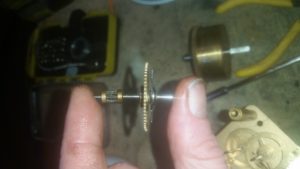
The pins in the pinion gear wear over time and bend. Like uri-geller over 50 years. Eventually they bend so much they dont mesh properly with the cog that the are driven by. This usually means the movement goes bang one day as the pin breaks of bend so much that the driving cog slips. How fast and how badly this effects things depends on the pressures involved at the time – its usually on a full wound which is quite spectacular.

To fix this there is no quick method. Its out with the whole thing and bend the shaft straght. New the old pins need extracting and then their diameter measured. New stainless pins  need to be made and the barrel crimpted back together.

This sounds a bit like I am saying the clock is inferior. I dont see it that way. For me, as a repairer, its good common sense engineering because the eventual destruction is limited to the pinion gear as the weak point. In fixed / cut pinions the same failure of tooth integrity usually destroys both cogs. In addtion the tollerances on the barrel pinion are higher – its a rougher fit quite frankly BUT the clock is designed for this rough fit with stronger springs.

Everyone seems to chase refinement in clock production but in terms “time for the mass market” these clocks  were, and are, good solid workers in attractive understated cases. Its not surprise to me that the modern movements coming out of China at the moment (that are bulletproof) have also gone back to 19th century design principles.

Heres one from Sue’s 1920’s regulator Im doing at the moment. Notice the bend on the shaft and the curve on the pins in the pinion. The pinion goes first and then as the gears jump the shaft is bent. The shaft can be straightened manually as there, again, is tollerance in the shaft fit to the plates. All makes perfect sense to me but many disagree. They are wrong.

People have asked me if they can just send me the damaged piece. Ufortuately not – I need the whole clock as its normally a couple of fails before everything meshes correctly and delivers a solid fix and reliable repair.

bent_ponion_gear


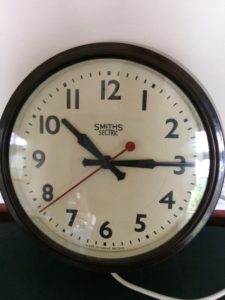
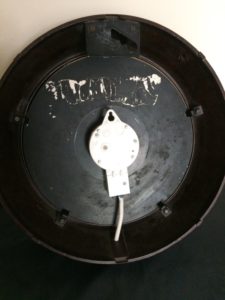
Vintage Bakelite Smiths Wall Clock Repair

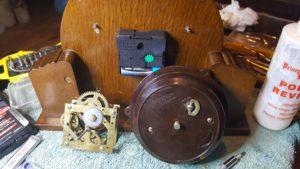
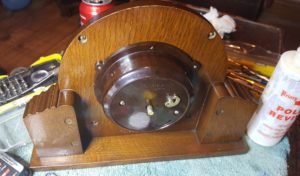
This was a great looking clock to work on and repair. I would like to say the shiny finish is my work but the clock did not need laquering and came to me in almost perfect condition.

As with a lot of these clock the motor coil had given out. I can get them rewound with new copper for the purest but a far far better solution is a modern synchronous cabled movement – its less expensive, more reliable and doesnt change the core technology of the clock. Much better than a quartz movement and able to cope with heavy hands.

Its quite a job to get the old hands on the new collets but I’ve yet to find one I cant do despite the seconds hand normally being behind the minute and the hour. The old collets have to be drilled out and remade and refitted but its worth the effort to keep the old hands and maintain the look of these clocks.

IMG_0353IMG_0354


Metamec Mechanical Carriage Clock Repair

This came in to me today as a “its not working properly” repair. With carriage clocks there are only 3 reasons for this

  1. Fouling and lubrication on the going train and platform escapement components (clean required)
  2. A failed or worn platform escapement (replacement required)
  3. A faded mainspring (replacement required which involves a full clean as well)

I’ve just finished up on the clean and its running on a single wind so thats as much as needs doing on this occasion.

The reason for the article is actually about this being a Metamec machanical carriage clock. The odd thing is I know more about Metamec than any other clock company as they are close to me and somebody was kind enough to write a book. In all my time repairing these clocks I have never come accross a true mechanical carriage clock by Metamec – they were all electric or quartz.

This clock is actually badged “St James” and is a retirement presentation item. I was told by the owner everyone was given the same clock etc. so I assume the company had bought a stock of them. The paperwork however clearly shows its a metamec clock.

Metamec were all over the place from the 70’s onwards due to the quartz revolution and various buyouts and take overs. Its not surprising that they diversified into corporate supply at some point but I cant find a record of it apart from this clock!.

20170801_182031

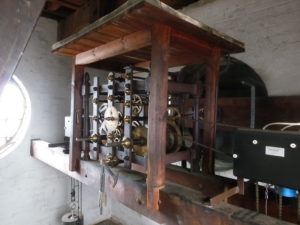
Brentwood School Tower Clock Maintenance

I look after the tower clocks and other fixed clocks for Brentwood school which is great fun and really quite a privilege. Theres not much to say really but it takes a great photograph!. The next job on this is to get it keeping good time (its been running a bit fast recently) and then the larger job of configuring and connecting up the bell chime which was disconneted some years ago. Ill post another article on this part of the work when its completed but for the meantime heres the clock…

DSCN1881

How to repair clocks – DIY home clock movement clean and lubricate

Ok another give away article robbing myself of a days work!.

If your clock doesnt work then cleaning it is a good first step to establishing what the problem might be. You need the thing to tick over under its own steam to diagnose problems beyond cleaning so its pretty much always the first job on the list.  Any clock repair is going to involve this.

Almost all clock hands are held on by one of two methods and you have to get them off to remove the movement from the case.

If its a lynch pin fixing then do the following. You need to remove the lynch pin that is threaded through the centre spigot. Whats not obvious is that this pin is usually tapered. This means its thicker at one end and will only be removable from the thick end. Get a magnifying glass on it and decide which end it is you want before you try to remove it. Now put a cloth or cardboard template over the face to avoid scratching it if you slip while removing the pin. You can make one by cutting slit to the centre of an A4 card or paper and then slide it onto the face with the spiggot sticking through the slit. Now use pliers to remove the pin. The hands will be friction fit so youcan just pull them off. Dont use pliers if they are stiff – oil and a firm grip with your hands through a thin polishing cloth will do it.

Clock_Repair_1


If its a screw fitting then simply unscrew it and pull of the hands as above. Its a normal thread – not a reverse one. If you snap off this nut then the clock is screwed so dont!. If its stiff then get some long handled long nosed pliers and twist it by 5 degrees – enough to loosen it but not enough to torgue snap the spiggot.

Clock_Repair_2

Ok once the hands are off you can remove the movement. If you look in the back of the clock you will see its held in by four screws, one at each corner that are normally on extenstion arms. You should now simply be able to pull the clock movment from the rear of the clock. If your clock has a chime bar that appears to be getting in the way do not try and wiggle it past – you will damage the chimes. Remove the chime bar by unscrewing the fixings that are mormally on the outside of the case underneath although some are fixed internally. My point is that it needs come out even if you can get the movement out without doing so because its fragile and gets easily caught by the snaggy and nature of clock movements generally.

Clock_Repair_3

Ok you have the clock movement out. Now the bad news. You have limited options without disassembling the clock completely and taking the plates apart. Ill come to how you can avoid this but generally speaking you need to get the plates apart for the following reasons.

  1. Its the best way to get at the spiggot holes cleaned.
  2. If you just put it in a bucket of hot soapy water then water gets into the spring barrells. Unless you oven dry the clock after this the springs will rust and your clock is in very bad shape with an expensive repair bill

You probably dont want to attempt to get the plates apart so heres a cheat!….

What you can do is immerse the clock upside down so only half the clock (without the spring barrels) is cleaned. This seems a bit bodge (and it is!) but it will partially clean the wheels at the top of the power train which are most sensitive to dirt. Essentially you are attacking your problems worst effected area in doing this partial immersion. It wont get a really dirty clock going again but it will give a lightly soiled clock another couple of years service before it needs it doing properly by somebody like me. If you have a low value clock you want to repair get going just because you feel like it this is a great way of making fast cheap progress.

Once you’ve soaked the movement top in soapy water then do you can to carefully brush off any dirt with a clean paint brush or ideally jet spray of some sort. You want to avoid putting anything rigid inside the movement as you will snag or force something and its game over. Once you’ve done what cleaning you can then you need to rinse the area that been submerged in boiled kettle water (careful not to get any in the barrells). Kettle water has the minerals such as calcium carbonate partially removed so any residue left by the drying water will be kept to a minimum.

Now oiling….

You need to use clock oil. I get all mine from Priory Polishes which is an old fashioned business with all the right stuff. I wont recommend specific products but have a look at the site as they do all sorts of restoration reagents including amonia based cleaning agents you can use for your immersion clean. Heres a link – you cant go wrong with this company and Paul there makes up a lot of his own chemicals to do an uber job. Hes well known in the clock trade and its “where those who know go” http://www.priorypolishes.co.uk/shop/front/

Overall I have to say that the best advice is to send the clock to me for a service because Ill do the springs for you as well. A lot of the time the main issue with failing clocks is that the main springs are worn down and are not delivering the power the clock needs to run efficiently, if at all. If a clock has been left standing fully wound but not running for a few years the springs take the form of the arbour they are tensioned on an lose power – I see a lot of that. Servicing isn’t particularly cheap, or that expesive either so I now recommend a full set of springs on every service I do on mantle clocks. If you do that you really see and hear the difference and its cheaper in the long run which is what you want if your going to spend a fair amount of money anyway.

Hope this helps your DIY efforts – you know, as always, if you mess it up I can sort it out.