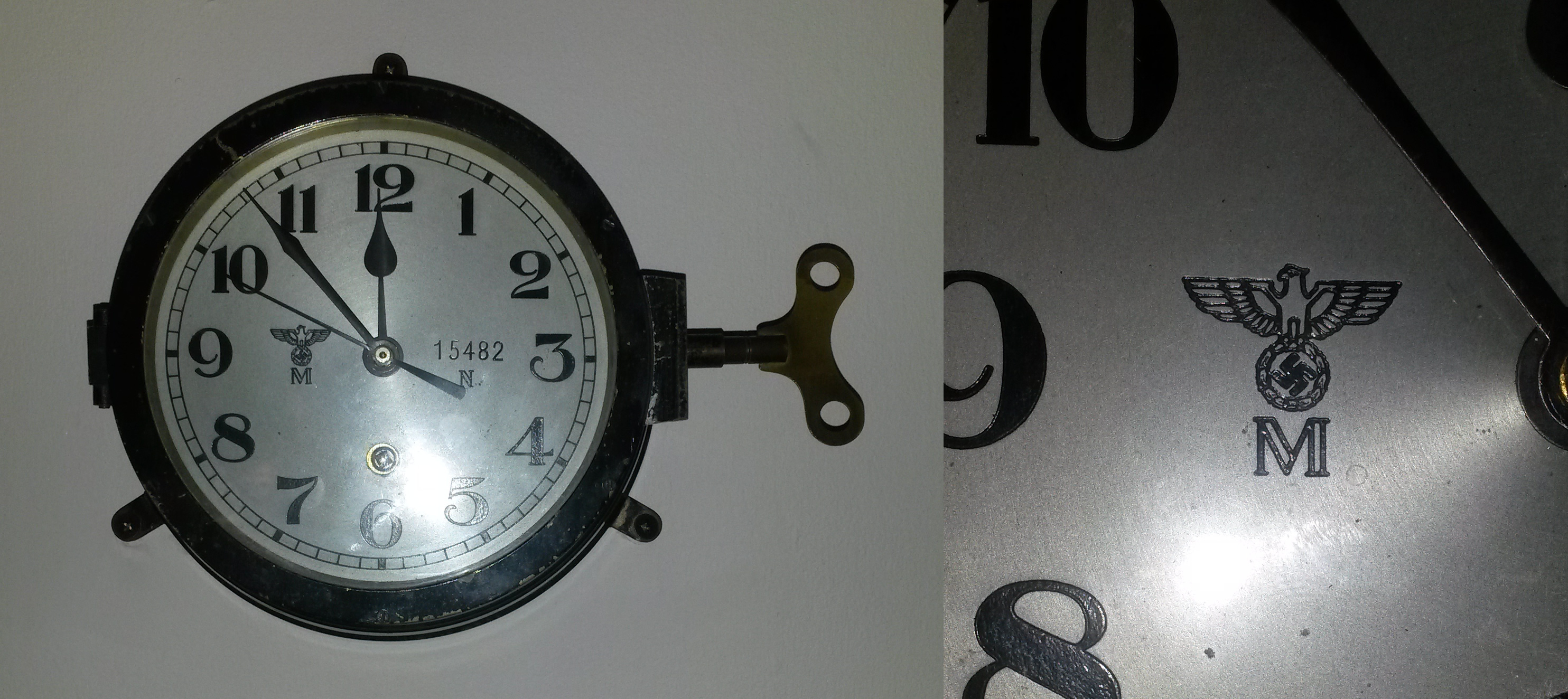
Nazi U-boat bulkhead clock / marine clock


This was not a clock repair job – its a clock I came accross at a friends. Im no fan of the Nazis past or present but this is a little piece of history and quite facinating when you consider the context. This clock used to run in a u-boat. Its a particularly good example for a couple of reasons. Firstly there is no wear on the face. Normally you would see a line of wear around the number ring where years of time resets would leave a finger wear line. Secondly it is black on brass. The owner told me that most examples have / had been polished up to the brass uder the paint by bored sailors. The way it looks now is the way it would have looked in 1944 with no changes. The nazi logo features promiently and is rather ominous, however, from what I have seen of other items at auction the logo features heavily on nazi military objects, much more so tha allied forces equipment of the era. It reflects the abosolute and cultist nature of what nazis and their propaganda machine did at the time.

One of the reasons the clock has no wear on the face is that it wouldnt have needed adjusting that often as it wa, and still is, incredibly accurate. It would have been kept constantly wound on ship so it would only need ajusting when it edged out of time which would have been an infrequent occurence.

I didnt get time to take it apart, however, from my experience of other marine and bulkhead clocks I can predict movement will be beautifully engineered with the minimum of cogs and spindles. Its the same sort of design as a carriage clock and will be regulated by a platform escapement, almost certainly a swiss one, whith 6 jewells. The point about all this is that the design means that the clock can be moved or jarred without significantly altering is time keeping or stopping it. Important features in a carriage clock, wich as the name suggests, were designed towards portability. Napoleon being an early user of a carriage clock during his capaigns.

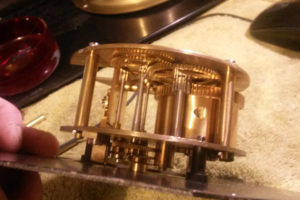
smiths_marine_movement

This picture shows the movement of a Smiths Marine clock from approximately the same era as the u-boat clock. They really were effective scientific instruments and were built and desigened as such. Time matters at sea, and at war, so there would have been no compromise on the quality of the time keeping.

The only other time keeping options would have been electric but electric movements of the era worked off mains power and relied on the standardised phase rate of the electricity supply. I expect they had a set of synchronised electric clocks with its own phase management on board. I say this because I have seen similar networked systems that were used in industry during the 60’s so I expect the military got there a few years earlier.

Common sense dictates that a backup mechanical clock would have been needed in the case of electrical supply failure and this is probably it. Mind you, I expect if your electricity runs out on a u-boat, what time it happened is probably the least of your worries.


How to Replace Grandfather Clock Cat Gut

This tells you exactly how to replace gut, how to go about it, what to avoid, the perfect finish and what gut to buy.

This first section of this article explains the difficult bit in replacing broken cat gut lines on a grandfather clock. Ive sort of started in the middle where the job gets interesting but I also cover the initial steps later on for those who are completely new to clock repairs and maintenance.

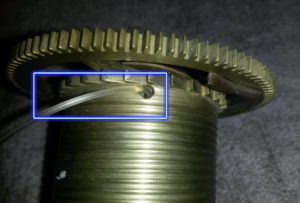
The pictures show the barrel removed from the clock for the sake of clarity. You will not need to remove the barrel, I just did so for you because the ratchet is hidden away somewhat when the barrel is in place and I wanted to show a clear view of the components.

So, you need to fit the new gut….

You will have to remove the old gut which invloves unwrapping what is left of it from the barrel.

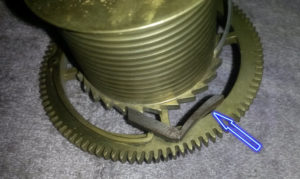
You need to get the barrel free wheeling so you can just peel off the gut by pulling it. To do this you need to find the ratchet which is on the curcumference mounted above the jagged edged ratchet wheel. It might not be in view so you need to rotate the barrel until you can see it. Do this with the key from the front of the clock while looking at the back of the clock for the ratchet to come round to where you can get at it.

As you can see from the picture you need to press this lever ratchet to release the cog to free wheel. Note that the ratchet is sprung with an arc spring. These can be surprisingly heavily sprung and quite hard to press in / release. Beware of using a screwdriver to push back the ratchet as you could stretch its retaining spring and disabling the essentail ratchet function until the spring is reshaped. Use the ratchet handle for this reason, even if its stiff or highly sprung.

Grandfather_Cat_Gut_Replace_Ratchet

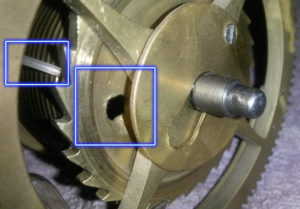
Once you have unwound the line then you need to detatch it from the barrel. Wiggle the gut a little and you will see it and its retaining knot moving inside the barrel through the hole – use a torch or clip on lamp to really help you see what you are doing as it is a fiddly job. You should be able to grip the line with the pliers and pull it out after a few attempts. Cut it and detatch.

The picture below shows the barrel access hole corresponding to the line hole.


Grandfather_Cat_Gut_Replace

Grandfather_Cat_Gut_Replace_Barrel


Now its time to attach the new gut. Once you have threaded the new gut into the barrel then extract the end through the access hole with the pliers as before. Tie a single knot – if you do a double it probably wont go through the access hole – the gut is too stiff. A single knot will become incredibly tight under pressure and will hold securely once you pull it back into the barrel.

The first time you wind the gut on the barrel, do it without the head of the clock on so you can see the exposed movement and ensure the line is flowing into the barrel grooves correctly.

Dont wind the gut back onto the barrel unless you have the movement back in the clock with the weight attached. This is important because if you try and do it by pulling the line with your hand to keep tension, it wont sink into the barrel grooves correctly. Its tempting to do this the first time as you will be keen to test your work while the movement is off the clock. The point is that if the gut is wound loosely it can tighten over and under itself when the weight is attached. Cutting it away and starting again after you have done 95% of the job can be the only option in these instances. In a nutshell, you need to reassemble the clock partially before winding the gut on.

People often ask me if they can or should use modern alternatives to cat gut. The answer is that its perfectly possible to use 60lb fishing line but its not as good for a couple of reasons. Firstly and most importantly it would be like roofing a thatched cottage with Tesco bags. Secondly the fishing line, and other synthetics come with too much “material memory”. In essence they dont take on the shape of the barrel over time as cut gut does. This means every time you take the weights off you risk a birds nest in the clock as the evil nylon instantly goes into a demonic tangle that will take you some time to sort out and possibly give you a heart attack. So dont do it if you value your life and sanity. I probably sound a litte raw from experience. The observant will have noticed that my pictures do actually feature nylon devil line – I am in in the process of replacing it and so its shortfalls are fresh in my mind.

If your taking the head and movement off the clock for the first time be careful. Disconnect the weights and take off the head to start (slide it forwards towards you and it detatches somewhat like an upside down drawer), then remove the pendulum. The main risk is forgetting to remove the pendulum before trying to lift off the movement.

The problem is that its generlly sitting back in the dark case and is easy to overlook unless you are working to a check list method. If you try to remove the movement with the pedulum attached then you may well break the leaf spring that it hangs from. This is a weak point in the whole assembly and easily snapped or creased. Its not the end of the world as modern replacements are available and in some cases you can get a contemporary part if you are fortunate.

Its still a job you dont need so check yourself and have a method and order of things to hand before you start. Proceedure is everything with clock repairs and maintentance, tick off the individual steps as you progress. This helps keep an organised and pleasant pace to things and removes uncertainty. It might seem like overdoing it but mistakes are frustrating and a relaxed pace is the best way. If you do it with a method you know youve done a good job properly. Heres my jotter list in bold for reference.

  • Remove head and store in a safe place. You will be looking up a lot of the time and its easy to put your foot through the nice big pane of glass at floor level if its within 6 feet of the clock on the floor. Replacing glass is expensive and surprisingly difficult on a grandfather clock because of the materials used to set it into the door. Its very hard to get older glass with its delicate imperfections so if your lucky enough to have original glass then take good care of it.
  • Remove weights. Grip the weights, not the gut when you do this. Holding the weights by the gut may seem easier but it will slip through your fingers unexpectedly causing friction burns or cuts. Its abrasive stuff compared to modern equivalents so a bit of respect is due when handling it with weights.
  • Remove the pendulum and place away from the clock. If you leave the pendulum in the case  it will probably get damaged should you drop the weights during the overall excercise. Fumbles happen because everything on a grandfather clock is a bit of a surprise in terms of forces and pressure points. The best thing is to protect against them rather than think it wont happen.
  • Cut the old gut where it attaches at the oppoiste end. This will normally be a peg / stopper type attachement and you can see more if you look into the movement and view the peg. Do this because you are going to replicate whatever you see when you re-assemble the clock.
  • Install the new gut
  • Replace the clock movement to the case
  • Thread the gut through the weight loop pulley wheels. This is easily forgotten and a pain to go back to after youve threaded the leading ends and tied the pegs!.
  • Fasten the leading end of the gut in the same way it was attached in the first place
  • Attach weights
  • Wind on the gut so the weights are raised
  • Fit the pendulum now the weight are raised providing the best possible access.
  • Fit the head on the clock
  • Pat self on back / light up cigar / look smug

Thats 12 steps over a 45 – 90 minute job so its worth doing a check list.

The pendulum is removed by lifting it off its hook at the rear of the movement and sliding it down through its loop on the escapement arm. Take a look at the back of the clock – the aformentioned escapement arm and pendulum are exposed components so its not to hard to work out how it all fits together and should come apart. When you disconnect the pendulum from its hook it might at first feel that the leaf spring connectors are too thick to fit down through the loop. Rest assured that it will definitely fit through because it was assembled that way; its just that the loop needs to be as thin as possible for the clock to run efficiently and connect with the arm that keeps in swinging with a little push on each stroke. It can be tricky and quite tiring on the arms – patience is key. Take a break every minute as your arms and fingers get tired which is often when the pendulum slips out of your hands heads towards your floor.

If it looks initailly that this might take some time its useful to have a friend hold the rod of the pendulum from the inside of the clock while you work on threading it at the top of the clock. This works well because you dont have the weight of the pendulum to deal with as well of the fiddly business of un-threading it through the loop on the escapement arm at the same time.

If your not tall enough to comfortably reach behind the top of the movement then get somebody who is to assist with this bit. Im not being “shortist”, its just that there is a certain element of risk. For instance, dont use a chair or you may end up on the floor under a clock that has fallen on you because you were gripping the top of the clock when you lost your balance. Losing your balance is easy when you are trying to twist about to get half your forearm into the clock.

Its also easy to fumble it / drop the pendulum – its a thin rod with a fair weight on the end and requires a firm grip from an awkward angle. If the pendulum drops it will stick a wooden floor tile like a spear. If on a hard floor it will bend or snap the adjustment screw on the base of the rod. Most grandfather clocks are more than 100 years old so if you look at yours you will almost certainly find it bent already and then bent back! – a message from the past perhaps.

The cat gut itself is 1.4mm diameter for the vast majority of grandfather clocks. It can be bought easily online and prices range from £7 to £20 depending on quality. Make sure you buy enough and measure up beforehand rather than guesstimate. Measure with the gut completely unwound from the barrel of the intact side, pulled firmly straight to simulate its extension in the clock case. You can measure the length with the weight attached in the clock case but in the majority of instances the space is to restricted to use a tape measure accurately and you make a better job of it with the movement detatched on a table. A little more time and care spent here can make all the difference to the end result.

This is because the length is quite important. If its too long the gut double winds on the barrel when fully raised. This can lead to uneven wear and also means you weights will lie down on the floor when fully extended. As they lie down, or you wind them up, they will drag on the floor or clock base.

If on the other hand the gut is too short then it will require winding more frequently, but not significantly. So shorter rather than longer is best when guessing. You will essentailly be guessing even after you measure because however much you simulate weight pressure your probably going to pull up a little short of the true value; the weights are about 12kg each typically and the gut goes very straight under that sort of pressure.

Wether you need to do both sides when only one has failed is really down to wear. Take a good look at the intact side to see if there is significant fraying. Gut can go a bit “hairy” which is fine practically speaking, however, if you see fractured larger fibres that feel firm to the touch / scratchy then replace it. If in doubt replace it as you have the clock apart anyway and its easier the second time you do it.

Good luck with your clock. Email me if you need a hand or advice.

Justin


Redshaw Grandfather Clock Repair – Broken cat gut and dating the grandfather clock.

redshaw_grandfather_clock_fullThis post is mainly about dating a grandfather clock and Elvis.

I came accross this today. The weight cat gut had snapped which is a reasonably straight forward thing to fix and I will be publishing a guide on doing exactly that in my next post.

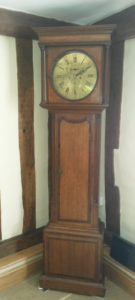
This Redshaw Newcastle clock is intersting for a few reasons. The most noteable is the round dial. It is actually a round dial as opposed to simply a round appeture over a square plate. Ive not seen this before, or convex glass on the head so I did a bit of research.

The maker is Redshaw of Newcastle. John Redshaw apprenticed with John Beech of newcastle in the early 18th century as far as I can work out. This conflicts datewise as the style of the face markings is firmly 1775-1805. It seems likely to me that this clock was produced by an apprentice or journeyman of Redshaws because he would have been getting on a bit when I believe this clock was made which I will come to once I have explained what evidence there is for an accurate appraisal of age.

The clock is original, everything about it is “right”. Ive seen other examples of Redshaws work and its very typical noth in terms of style and materials. As an aside to the date info here it migh interest you o know a very similar clock sold for £2150 in 2012 when values were low – thats a very good price for the buyer in hindsight. Clocks like this were selling for £10,000 ten years ago so even though the £2150 seems low its all comparative – this is a good clock with reasonable bragging rights!.

Dating this clock was more difficult than usual but the same rules applied to this as all the other clocks I see.

The first thing I noted was that the dial doesnt feature any of the legacy markings of the old one handed style clocks, such as markings for the half quarter hour; this means its likely to be 1740 onwards.

To further refine this identification I looked at other face features. The dotted markings for the minute hand refelcts the fashion of the period from 1775 to 1810. Another key feature that allows the clock to be placed is the sequencing of the arabic minute markers as 5, 10, 15 etc which was used until 1805 when it was replaced with 15, 30,  and 45.

A great way to put a grandfather clock within a date range is the face size / diameter. Dials increased in size from 1680 (10 inch) to 1860 (15 inch). This means you can often guess a grandfather clocks age within 15 years each way just by measuring the dial, although there were regional variations in this. An ancillary general rule is that at any given time dial sizes were 1 or 2 inches wider on Northern clocks for some reason. This applies to the clock case as well which increased in size over the 200 years of production with the north of the country being slightly bolder both in terms of size and deviation from the “standard” london design style led by London makers.

So at this point we know the clock is confirmed on three levels as a 1775 – 1810 item. Now, this clock is from Newcastle quite a way from London, however, if you look at it proportionally its not as big as one might expect from a clock from 1810, nor is it particularly grand or overblown. Its therefore less likely to have been produced later in the date range. The midpoint of 1775 – 1810 is 1790 so if we take off 10 years to balance the northern effect then the clock is likely to have been produced between 1780 and 1790.

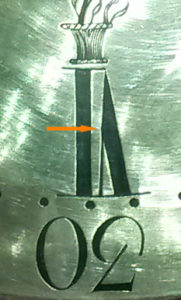
Another hint on dating these clocks… look carefully at the roman numbers that are engraved into the dial. If the clock is original as opposed to a reproduction you will be able to see that the roman numerals have been hand engraved. This shows as a slightly bumpy inset relief on the numbers. Its where hand tools were used to gouge out the numbers into the brass plate. There SHOULD BE MISTAKES. This is important. Machines used in fakery or retro-styling of a modernish item dont make mistakes. If its perfect its not old unless its a really outstanding example from a top end maker which will be obvious anyway. Ive enlarged a picture of one of the numbers to show what I mean.
redshaw_grandfather_clock_engraving

The orange arrow shows where the engraver has had to change direction in the middle of a numeral. Its only a small error but it shows humanity in the production.

When this clock was produced the skills employed were high status. Computing and programming have a similar social status today as occupations. What is also worth considering is that the engraver would have been working on something quite valuable and it would have been a pressurised task to complete. If he had slipped with his chisel and marked the face it would have been a question of scrapping it and starting again.

I never ever swear when I do clocks because that would be wrong. This allows me to predict with some confidence that the engraver didnt swear extensively when he realised he was going in the wrong direction half way up the V.

Its this sort of human connection you get with old clocks that make them a joy to examine.

When buying a grandfather clock, consider that the case and the movement might not be an original pair. This significantly effects value simply because there are far more frankenstien grandfather clocks than there are originals. Its not really surprising as wooden cases rot and movements are engineered for longevity. The movements were always valuable and would simply never have been scrapped unless severely damaged or worn which generally speaking takes hundreds of years.

It can be quite hard to definitely identify an unmatched movement and case but heres what to look out for on a first look.

Is the plate on which the movement sits (a wooden platform that the movement bolts to) the same material, colour and condition as the rest of the clock interior facing panels?. If you can see newer cuts on the seating of this shelf it means its had to be modified to fit. That being the case its not the original movement in all likelyhood.

These items were high value when produced and all the wood would have been cut to fit perfectly and elegantly with room for adjustment where necessary, and tight fitting where it was not. When looking at this dont mistake modification for wear and tear. It might be that the shelf has worn the seating out a bit; after all, that shelf supports between 20 – 30kg of weight on narrow connection points. This means its common to see original parts that have been repaired and replaced in part, however, what you need to do it really look at it and say “can I see a factory fit in there somewhere”.

On this point,  many people believe (correctly) that clock makers bought in cases and case makers bought in movements. It was common sense to farm out the specialist jobs such as engraving to third parties and a surpirsing amount of components, such as the spandrels on the face, were bought in as prefabricated components from a set range common throughout the industry. The point here is that this tends to encourage people to believe that there will therefore be some innocent mis-match at the point of origin. This is a great way of convicing yourself that you are are going to buy an original as opposed to a frankenclock – a little knowledge is a dangerous thing.

To be clear, if a clock was sold by a maker, at the time is was bought the customer would most probably have been unable to tell. This means that you shouldnt be able to either.

If you clock movement looks badly engineered into its case then its probably a frankenclock. If you see one in a shop thats cheaper than it should be its also probably a frankenclock. Any retailer that sells you a grandfather clock is going to know the difference because of the difference in its value. A good frankenclock will cost about £1000 as of today (July 2016) and an original case and movement will cost £3000 for an item of the same approximate age and style. Dont expect the retailer to tell you if its a matched clock and case. Theres a reason for this beyond sales polotics. It is that people who know about clocks use the term “clock” to describe only the movement. This means if a dealer tells you its an original clock what he may be referring to is the clock movement and is not necessarily including the case in his implied description.

This is not subdefuge or dishonesty and happens because people who by grandfather clocks for the first time tend to give the impression that they know what they are talking about and so the conversation is conducted under certain assumptions about terminology. Or your being ripped off  and not told the whole story unless you ask specifically. It depends on how you look at it!.

I hope this encourages you to learn to date grandfather clocks. If you want further reading then I can recommend any book on grandfathers by Brian Loomes who is basicly a clock knowledge demi-god. I emailed him to ask a question, not really expecting a reply. He emailed back to tell me he was too busy to answer my email. I am blessed – I was told to go away by Brian Loomes which is about a high status as being able to say you were beaten up by Elvis. If you like clocks.

[Many thanks to D for letting me take the pics – cheers old bean]