Auction tips for buying a healthy clock

I love auctions. The main reaons for this is that I can look at a clock and give it a once over health check. This avoids buying clocks that look great but are mechanical write offs. So – what can you do as an amateur to reduce your risk buying a three legged donkey that looks like a racehorse?!. There are a few basics.

Is the main spring broken?

If a clock has a broken mainspring then run away. Clocks at auctions, specially those with broken springs, wont have a key included with them. This is deliberate so that you cant test the clock.

The solutions is to go any buy a set of “uiversal clock spider keys” from ebay. They are £7 including postage and have every key size on a cartwheel type of arrangement. Wind all the springs. If they are jammed then thats probably fine – you cant overwind a clock, thats a myth, and the clock is just fully wound. “Broken” clocks are just often clocks that have been assumed to be overwound but have simply been fully wound. They dont work because they are simply suffering from a completely different problem – usually an incorrectly mounted pendulum.

If the clock can be wound up a little and then you hear a gronking scraping sound, thats the broken spring slipping round inside the barrel. Add £300 to get this fixed on top of whater you pay. It can get a lot worse than that if the mainspring took out other cogs when it snapped – they go with quite a bang.

Has the clock sustained internal damage

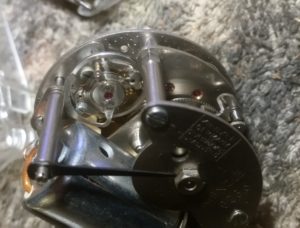
The the first thing to check after the springs is if the escapement cog is turning as the pedlumum is set back and forth. You can see the esacepement cogs on all clocks through a gap at the top of the back plate. Look through the gap and move the pendulum back and forth. If the cog moves one tooth forward on each swing of the pedulum you know power is getting through and the clock is basicly mechanically sound. If it doesnt move add at least £200 for a clean and/or be prpared to discover cog problems or wear that is many hundreds to sort out.

Is there a chiming problem?

Make sure the chime spring is wound up and then turn the hands past the hour. Do this for three hours in sequence to ensure it strikes progresively each hour. If it doesnt do this then add £200 to £400 on top of what you pay. Or dont buy it might be better advice.

Does the clock need a service clean?

Is it cleanworse inside so budget £120 for a basic clean and service on pretty much any clock bought at auction. You might be lucky but in my experience one out of two clocks need work of some sort with the majority of those jobs being service cleans.

Thats the basics and should get you a much safter buying experience. Go and buy a clock!.

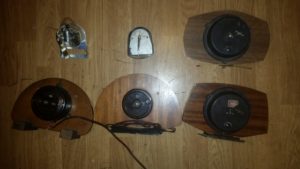
A Smiths Bakelite I have in at the moment (a plug, not advice – shame on me).

Ive got quite a few clocks at the antiques centre if you fancy a browse. I sell mine with 3 month guaratees and they are of the mid range £60 – £120. Ive got a nice Bakelite Smiths in at the moment in very good condition for £80 – all original including the pendum bob – and Ive relaquered it (bargain!).

Good clocking – I try and answer all emails if I can so do feel free to ask questions on follow up to the clock buying advice here.

Justin
Cuckoo clock repairs – common problems & fixes

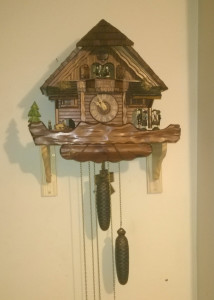
Bavarian_Cuckoo_Clock_Front

I repair a lot of cuckoo clocks. Most repairers wont do them as…well you certainly work for the money and every clock is unique and handmade in some way. In short they are considered a pain in the back side and theres other easier work to persue. Not for me though because I really quite enjoy them. Its as if somebody has spliced train set DNA with an alarm clocks while drunk. Some of the key switches inside the clock that make things happen are simply hand bent wire. Amazingly this architecture keeps running fine and consequently a properly set up cuckoo will be reliable, accurate and about the same to service and run as a more ordinary clock.

Its taken me some considerable effort and investment to honour my “I fix ANY clock” promise on these but I am there now with a full set of spares and all the diagnostic equipment required.

I do a fair amount of Reglula clocks as well as Hubert Herr which I can recommend (the best built and most reliable) and I can cover all the popular makes if yours is not a Hubert.

So what are the common problems….

  1. Dirt. These clocks collect dirt like you wouldn’t believe. To keep a clock clean it needs to be enclosed so the dust doesnt get it. Bearing in mind cuckoo clocks are designed to open and shut a door a hundred or so times a day its hardly surplussing they collect dirt so quickly. Cleaning the movement requires great care and the right cleaning fluids because the clocks often contain plastic components which melt in solvents or degrade in aggressive household cleaning products that are now formulated to remove everything – Cillit Bang doesnt work – “Bang and the clock is gone” springs to mind.
  2. Component seizure. This happens a lot specially around the weight arbors. Reseting requires the clock to be stripped down.
  3. Out of sync automaters. Basicly the chain linkage slips and your little dancers or cuckoo come out at the wrong time or only get halfway through their dance before just stopping. Cuckoos sing the wrong amount of notes and pop out all over the place – all this can get quite comical and its not ucommon for me to spend the first 10 minutes of fix time just laughing at what the owners have put up with before taking the plunge and sending it to me.
  4.  Broken hands and front of face components. These are generally glued on or held with a friction fit so they often fall off or work loose over time. All can be replaced with contemporary spare parts however if you want bone or colour matched hands it takes a bit longer to source parts.

I do repair all cuckoo clocks and am currently restoring an 1860 black forest table top clock in the Dresden style (a stunning clock and its ALL MINE!). Most of the clocks I get in are mid to late 20th century units but its a varied field and cuckoo clocks have been made in volume since about 1800 so its quite a job covering them all (but I do!).

Half the clocks are sent to me in the post which is fine. As long as you use a bigger box than you need with plenty of packaging they travel ok. I send them back set up correctly with all the chains and loose fixings tied into place with cable ties so you can just unbox it and stick it on the wall ready to go – I include written instructions.

Im always happy to exchange emails before quoting etc and I take calls in the day if you want to ring. Some people just work out Im good at these and stick them in a box to send me without any  warning – thats fine too but don’t forget to put a note it with your address and some brief notes on what is wrong and what you want done.

The only thing I dont do on cuckoos are replacing bird skin bellows material (chicken skin was used in the bellows of early clocks) but if you want that I know a man who can!. Even on my expensive Dresden clock Ive just gone with modern replacements – they are consumable items and trying to preserve them through services is just putting off the inevitable and adds rediculous money to repairs bills.  Cuckoo clocks should be fun, not expensive or high maintenance.

In terms of costs its no more expensive to get a cuckoo fixed by me than it is to get a mid range mantel clock fixed so dont worry about it being prohibitive. £60 for an over the counter while you wait fix (where possible) or up to a max of £400 plus parts for a top end modern Bavarian cuckoo that will have typically cost £1500 new.

Any questions…just give me a ring for some help or a chat 07462 269529.


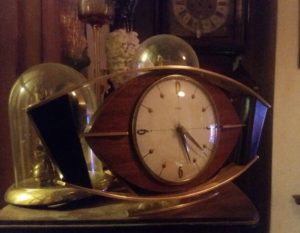
Metamec movement types I repair and restore by post

I have for some years been interested in, and serviced Metamec clocks. This is because you can work with Metamecs and get a bit of everything from a movement perspective. Metamec bought in movements for a good proportion of their clocks over the companies lifetime. Suppliers changed with price point and technology which means that covering Metamec for all the spares I ideally need is challenging!.

It takes some time to source and refurbish good quality components so I tend to use my entire stock myself and do not sell the parts outside of service calls / jobs. I cover all of the following for clocks that are now turning up from all over the UK and in one instance recently, Australia.

Series 1 cabled

Series 1 cabled with base mounted external starting spiggot (becoming rare)

Series 1 Cabled Alarm

Series 2 cabled – wall and mantle clocks

30 hour mechanical

8 day mechanical

Keinzle 606 electro-mechanical (two derivatives shown below)

I also repair or replace all quartz and balance wheel based battery movements. These are not pictured but are fairly easy to identify in that they are oblong with a battery horizontally at the bottom on the shortest edge of the oblong. About 2.5 inches by 3.5. Im out of unit stock for these at the moment but have components so they are not pictured below. They tend to be the least requested units for fixes and are very reliable.

The older sieries 1 and 2 cabled movements are not the same story at all – constant problems with coils, tensioners and wear – often all 3 on any given movement.

I am all for people having a go themselves and publish articles on this blog about how to do quite complex things, however, I have yet to hear back from anybody who has managed a cabled movement fix on their own. Ive tried to help several people via email but all fail. The problem is the series 1 and 2 movements are actually quite finely balanced and require putting together quite carefully once you’ve gutted and cleaned it. All the components themselves look brutal and crudely manufactured but the truth of it is that they are all within quite fine tollerances in terms of their positioning and placement. Wear in quite obscure areas causes problems not least because everything is so cramped you simply cant see “in” to witness the physical symptoms and diagnose the issue.

On the other side of things the Metamec mechanical movements are very good generally speaking although I say that in light of the fact that they were not made to last. When they do fail its normally quite catastrophic as they tend to go around the plates and fixings where things warp or wear. The main plates on the 30 hour movements go all the time and once bent out of shape cannot be returned to the perfect flat surface all the spiggots are expecting.  The 30 hour goes more because the act of winding puts pressure on the plates via leverage when you turn the winder. The 30 hour therefore gets 8 times more wear than its 8 day equivalent so I mostly swap or convert those to an alternative movement – an 8 day if available.

The keinzle 606 is an epic movement and I am quite precious about my stock of them (to my surpise!). If you have one of these keep hold of it – a future classic with a good deal of kudos already; prices are high.

I also do full restorations.

For the brassy Metamec clocks (and there are many!) I a do 3 stage chemical clean that gets the brushed or textured finish back to factory condition. Doing it any other way either doesn’t remove the oxidation deep in brushed texture or takes the brushed finish down by smoothing off the microscopic ridges that give the glowing brushed /textured effect.

In terms of woodwork I can restore most of the Metamec finishes although replacement is often the route for things like sun damaged and crackled acrylic in some of the metallic finishes.

I can replace most glass although this can get expensive for the rarer stuff. Metamec glass faces are particularly convex to accomodate the long spindle clearance that Metamec probably designed in so that they could keep movement variants to a minimum in a range where face depth and material varied greatly.  This means modern replacement glass doesn’t usually fit and vintage spares must be bought specifically, often on sale as one off items.

I really enjoy the Metamec work as its become somewhat of a specialisation for me so pictures of your Metamec are always appreciated. The long term plan is for an indexed gallery somewhere on this site for public reference, however, due to the astonishing time commitments of this job its about as likely to happen as the garden 2m reflecting telescope observatory that is definitely definitely maybe going to happen. Eventually.

If you would like me to fix your Metamec please email me with a description of the problem, and what you would like done. A few pictures of the clock are really helpful if you want restoration work done but not essentail if all you need is to get the clock working again.

20170420_234319

Finally, I recently did a job for a client on a retirement clock they wanted completely restored. I liked it so much I went and bought the identical model which I have just brought back to life with the chemical clean, laquer and silicone UV resistant polish (car polish is good on paint finishes they used). Yes it does have a 606e. Ive never paid too much attention to this model but its really grown on me – the sort of 60’s – 70’s transitional design is very cool. Its come to something when your parents wedding presents come round in fashion again but I cant help liking it!.

20170421_012149

My 1710 John Mason London Clock Repaired and Revived

20170328_012641

Ive done a peice on this before so I wont go on. Its just that I finished the case and head restoration. I left most of its damage intact as it wasnt that bad. The case (not original – c1780) got a tidy up and a good coat of wax. The movement was fine so all it needed was a new pendulum spring and a service. I gave up on getting an original contemporary blued minute hand and left the broken one in place – I rather like it like that and its not as though I refer to it for the time although it keeps it nearly perfectly.

Grandfather clocks are just magnificent looking things and I like this clock because it shows us just how technically and artistically advanced we were 300 years ago. Its tempting to think we didnt really become decent engineers or merchants until the Victorian era but nothing could be further from the truth. When you look closely at a clock like this what you really see is the skills of the people who produced it from mathematics to material sciences – some of the laquer work and decoration on early clocks is breathtaking. Bear in mind these things were being produced for an export market pretty much from the time they were invented. If you want to know more about clocks from this period have a look at the Burpett article in this blog.


Awesome Metamec Repair with a Keinzle 606e movement


20170323_184529This is by far and away my favourite Metamec movement. It isnt a Metamec movement of course but Metamec used other clock makers movements extensively. I’ve even found a smiths stamped movement in one which was definitely an original fitting so they were buying from their main competitor at one point. Heresy but there you go. Im glad they did to be honest because as a Metamec specialist it gives me much more variation and I get to work with masterpieces like this 606e.
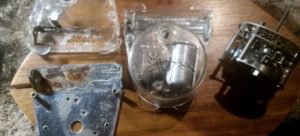
The reason its sooooo good is that its “electromechanical”. To explain…

A clockwork clock is driven entirely by mechanically stored energy in the form of a spring or a weight. An electric clock is driven entirely by electricity. In and electric all the energy comes from a motor that is regulated by the motors speed which is in turn governed by the frequency/phase of the mains electricity supply.

Then there are the electromechanicals. They use electric power to wind up the spring which it turn drives the clock in the tradional mechanical fashion. In the case of the 606 it doesnt use a motor; instead it uses a solenoid. If you dont know what that is then to summarise its like a mouse trap that snaps shut by magnitism when electricity is passed through it. Now if you snap the trap shut and the jaws of that trap push a flywheel then all you need is a spring attached the to the flywheel which then drives a full mechanical clock. Its real genius because it avoids the need for a motor and also means you can drive it with a low voltage battery and let the clock take care of the mechanics in the traditonal fashion.

Its a work of art to see functioning. All these movements, whatever the mounting come with a clear perspex movement case so you can see it all going on. Theres then a metal dust cover over the whole affair for some reason but I suspect a design engineer with a bit of flair specified in a clear case.

The only thing they got wrong was to factor in leaking batteries over time. 90% of the movements I see have battery damage and its heartbreaking as the acid gets right into the solenoid and the thing is really in a mess when it gets that far. I can fix and hold spares for these but they are rare and prices are high so if you have one dont put a cheap battery in it!.

20170323_200813I couldn’t save this one so I had to replace the entire movement inner. I maintained the old movements mounting plates with a bit of modification – the movements are largely the same in the series but each one mounts differently on each model of clock and various plates and spacers are essential. There wasnt a lot of consistency in the production of Metamecs and they did whatever it took to survive commercially including completely changing key elements in identical looking models over the years. This means you can get most clocks with at least 4 movement options all of which change over the years. Its what makes them interesting to work on.
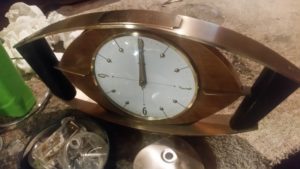
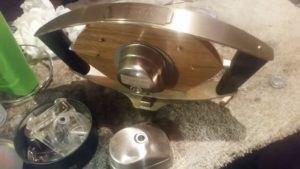
Heres a few pics of the finished clock. Its probably one of the best Metamecs you will see – the body is a classic and the movements the best type. It even looks good from the back.

20170324_002456

20170324_002633