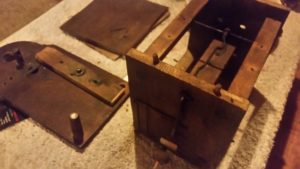
Metamec movement types I repair and restore by post

I have for some years been interested in, and serviced Metamec clocks. This is because you can work with Metamecs and get a bit of everything from a movement perspective. Metamec bought in movements for a good proportion of their clocks over the companies lifetime. Suppliers changed with price point and technology which means that covering Metamec for all the spares I ideally need is challenging!.

It takes some time to source and refurbish good quality components so I tend to use my entire stock myself and do not sell the parts outside of service calls / jobs. I cover all of the following for clocks that are now turning up from all over the UK and in one instance recently, Australia.

Series 1 cabled

Series 1 cabled with base mounted external starting spiggot (becoming rare)

Series 1 Cabled Alarm

Series 2 cabled – wall and mantle clocks

30 hour mechanical

8 day mechanical

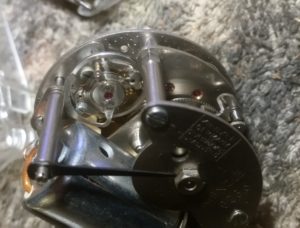
Keinzle 606 electro-mechanical (two derivatives shown below)

I also repair or replace all quartz and balance wheel based battery movements. These are not pictured but are fairly easy to identify in that they are oblong with a battery horizontally at the bottom on the shortest edge of the oblong. About 2.5 inches by 3.5. Im out of unit stock for these at the moment but have components so they are not pictured below. They tend to be the least requested units for fixes and are very reliable.

The older sieries 1 and 2 cabled movements are not the same story at all – constant problems with coils, tensioners and wear – often all 3 on any given movement.

I am all for people having a go themselves and publish articles on this blog about how to do quite complex things, however, I have yet to hear back from anybody who has managed a cabled movement fix on their own. Ive tried to help several people via email but all fail. The problem is the series 1 and 2 movements are actually quite finely balanced and require putting together quite carefully once you’ve gutted and cleaned it. All the components themselves look brutal and crudely manufactured but the truth of it is that they are all within quite fine tollerances in terms of their positioning and placement. Wear in quite obscure areas causes problems not least because everything is so cramped you simply cant see “in” to witness the physical symptoms and diagnose the issue.

On the other side of things the Metamec mechanical movements are very good generally speaking although I say that in light of the fact that they were not made to last. When they do fail its normally quite catastrophic as they tend to go around the plates and fixings where things warp or wear. The main plates on the 30 hour movements go all the time and once bent out of shape cannot be returned to the perfect flat surface all the spiggots are expecting.  The 30 hour goes more because the act of winding puts pressure on the plates via leverage when you turn the winder. The 30 hour therefore gets 8 times more wear than its 8 day equivalent so I mostly swap or convert those to an alternative movement – an 8 day if available.

The keinzle 606 is an epic movement and I am quite precious about my stock of them (to my surpise!). If you have one of these keep hold of it – a future classic with a good deal of kudos already; prices are high.

I also do full restorations.

For the brassy Metamec clocks (and there are many!) I a do 3 stage chemical clean that gets the brushed or textured finish back to factory condition. Doing it any other way either doesn’t remove the oxidation deep in brushed texture or takes the brushed finish down by smoothing off the microscopic ridges that give the glowing brushed /textured effect.

In terms of woodwork I can restore most of the Metamec finishes although replacement is often the route for things like sun damaged and crackled acrylic in some of the metallic finishes.

I can replace most glass although this can get expensive for the rarer stuff. Metamec glass faces are particularly convex to accomodate the long spindle clearance that Metamec probably designed in so that they could keep movement variants to a minimum in a range where face depth and material varied greatly.  This means modern replacement glass doesn’t usually fit and vintage spares must be bought specifically, often on sale as one off items.

I really enjoy the Metamec work as its become somewhat of a specialisation for me so pictures of your Metamec are always appreciated. The long term plan is for an indexed gallery somewhere on this site for public reference, however, due to the astonishing time commitments of this job its about as likely to happen as the garden 2m reflecting telescope observatory that is definitely definitely maybe going to happen. Eventually.

If you would like me to fix your Metamec please email me with a description of the problem, and what you would like done. A few pictures of the clock are really helpful if you want restoration work done but not essentail if all you need is to get the clock working again.
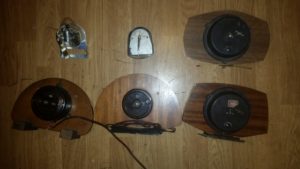
20170420_234319

Finally, I recently did a job for a client on a retirement clock they wanted completely restored. I liked it so much I went and bought the identical model which I have just brought back to life with the chemical clean, laquer and silicone UV resistant polish (car polish is good on paint finishes they used). Yes it does have a 606e. Ive never paid too much attention to this model but its really grown on me – the sort of 60’s – 70’s transitional design is very cool. Its come to something when your parents wedding presents come round in fashion again but I cant help liking it!.
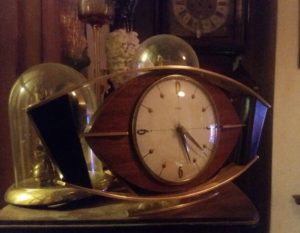
20170421_012149

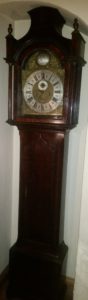
My 1710 John Mason London Clock Repaired and Revived

20170328_012641

Ive done a peice on this before so I wont go on. Its just that I finished the case and head restoration. I left most of its damage intact as it wasnt that bad. The case (not original – c1780) got a tidy up and a good coat of wax. The movement was fine so all it needed was a new pendulum spring and a service. I gave up on getting an original contemporary blued minute hand and left the broken one in place – I rather like it like that and its not as though I refer to it for the time although it keeps it nearly perfectly.

Grandfather clocks are just magnificent looking things and I like this clock because it shows us just how technically and artistically advanced we were 300 years ago. Its tempting to think we didnt really become decent engineers or merchants until the Victorian era but nothing could be further from the truth. When you look closely at a clock like this what you really see is the skills of the people who produced it from mathematics to material sciences – some of the laquer work and decoration on early clocks is breathtaking. Bear in mind these things were being produced for an export market pretty much from the time they were invented. If you want to know more about clocks from this period have a look at the Burpett article in this blog.


Awesome Metamec Repair with a Keinzle 606e movement


20170323_184529This is by far and away my favourite Metamec movement. It isnt a Metamec movement of course but Metamec used other clock makers movements extensively. I’ve even found a smiths stamped movement in one which was definitely an original fitting so they were buying from their main competitor at one point. Heresy but there you go. Im glad they did to be honest because as a Metamec specialist it gives me much more variation and I get to work with masterpieces like this 606e.
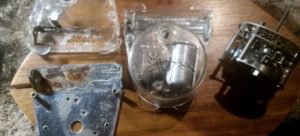
The reason its sooooo good is that its “electromechanical”. To explain…

A clockwork clock is driven entirely by mechanically stored energy in the form of a spring or a weight. An electric clock is driven entirely by electricity. In and electric all the energy comes from a motor that is regulated by the motors speed which is in turn governed by the frequency/phase of the mains electricity supply.

Then there are the electromechanicals. They use electric power to wind up the spring which it turn drives the clock in the tradional mechanical fashion. In the case of the 606 it doesnt use a motor; instead it uses a solenoid. If you dont know what that is then to summarise its like a mouse trap that snaps shut by magnitism when electricity is passed through it. Now if you snap the trap shut and the jaws of that trap push a flywheel then all you need is a spring attached the to the flywheel which then drives a full mechanical clock. Its real genius because it avoids the need for a motor and also means you can drive it with a low voltage battery and let the clock take care of the mechanics in the traditonal fashion.

Its a work of art to see functioning. All these movements, whatever the mounting come with a clear perspex movement case so you can see it all going on. Theres then a metal dust cover over the whole affair for some reason but I suspect a design engineer with a bit of flair specified in a clear case.

The only thing they got wrong was to factor in leaking batteries over time. 90% of the movements I see have battery damage and its heartbreaking as the acid gets right into the solenoid and the thing is really in a mess when it gets that far. I can fix and hold spares for these but they are rare and prices are high so if you have one dont put a cheap battery in it!.

20170323_200813I couldn’t save this one so I had to replace the entire movement inner. I maintained the old movements mounting plates with a bit of modification – the movements are largely the same in the series but each one mounts differently on each model of clock and various plates and spacers are essential. There wasnt a lot of consistency in the production of Metamecs and they did whatever it took to survive commercially including completely changing key elements in identical looking models over the years. This means you can get most clocks with at least 4 movement options all of which change over the years. Its what makes them interesting to work on.
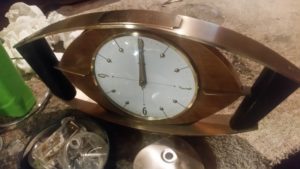
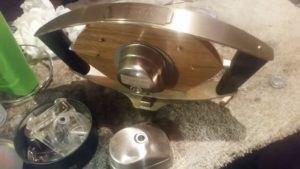
Heres a few pics of the finished clock. Its probably one of the best Metamecs you will see – the body is a classic and the movements the best type. It even looks good from the back.

20170324_002456

20170324_002633

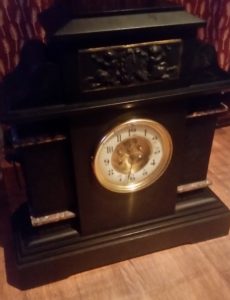
Exposed escapement slate clock c1900

This is a restoration I’ve just completed. Rather than bang on about it ill just summarise what was done.

  1. Movement stripped down and all brass chemically cleaned on a 3 stage process.
  2. Refinishing the black to remove the mineral degradation of the slate over 100 years
  3. Movement setup and calibration

Theres only three operations here but this stuff takes a long time so restorations of this type are quite costly. On a normal slate I would question whether it was worth it due to the flat values at the moment – a good slate is £200 to £500.

I did this clock because…it needed some love and I could see the potential, however, had it not been for the gorgeous ruby escapement paddles it might not have made the restoration que!. I am very glad I put the time in on this one as the photo doesn’t do it justice – its an absolute corker, if somewhat heavy.

If you have a slate you want done I am more than happy to do it but you will have to deliver and pick it up yourself – my back cant take it!.

20170304_223350


Metamec Zodiac Clock Repair

I do a lot of work on Metamecs as they were based just down the road from me in the 80’s and Ive met people who worked there as well as seen a lot of the range over the bench.

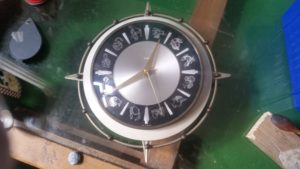
This is the Zodiac which came with every variant of movement when it was produced. I lot of people think this means that a quartz conversion should be straight forward but in most cases it is not. This particular clock was fitted with the cabled version of the movement so the appeture is more than big enough to take a standard 57mm quartz. What did need doing however was re-boring the central spiggot hole which was 3mm too small. The face plate needed the same adjustment. Its all about the hands on an electric conversion and I am lucky enough to have found a source for these that fit on the quartz spindle size.

While electric conversions are a bit “clock heretic”, it is the right thing to do on some of these clocks. I usually stock the original parts to put a clock back to “factory” but sometimes it makes more sense to put a quartz in for one reason or another – usually accessibility and convenience for older customers.

20170321_124007


Repairing & Restoring Clock Cases from the early 20th Century

I got this email so I thought I would do a blog post on this. No pictures for a change – this is a hardcore repair article for those who want to get stuck to a good restoration for pleasure and satisfaction.

“Hi Justin,

I am a clock / watch fan and a bit of an amateur repairer.  I have a number of mechanical clocks around the house that I have breathed life into … most of which have come from lofts and sheds and have been given to me as non-working projects by friends and family.  None are worth much in the material sense but most have some kind of sentimental value, like the mantle clock that was given to my Grandparents on their wedding day and was in turn given to me by my mother.

I bumped-ono your web site when looking for tips on cleaning wooden cases.   I would be very grateful of any tips that you may wish to share on cleaning wooden cases and in particular replenishing the wood – thank you.

Best regards,

John

Colchester”

Repairing and restoring clock cases, specifically those from the early to mid 20th century, can be a minefield. The main problem here is that the veneers used were generally not that high quality. They tend to be thin and dyed. This means if you try to work them they break.

You have to commit to doing the whole case. If you try and refinish part of it you will either create a clock in two colours (one of which you dont want) or you will change the finish on the area you are working on both in terms of texture and colour. If you then apply varinish or laquer to that area it will be very obvious and you will have to start again on a case that was worse than when you started.

Doing the whole case does not necessarily mean stripping off all the old varnish. If the varnish is simply starting to flake then

  1. Use a green scratch rag / sponge to remove the flaking varnish. Apply pressure evenly when you do this so that you dont wear off the varnish in a patches.
  2. Mix 1 part varnish with 2 parts paint thinners. This will create a very thin mixture that you can apply with a sponge. Dont use a brush – its the wrong tool for this and will leave marks and streaks. Apply the varnish thinly so that it is not capable of running / pooling.
  3. Leave 30 minutes between coats and apply 3 coats.
  4. Once dry, buff to a high sheen finish and then use silicone based polish to give it really high gloss UV protective coating.

The above assumes the varnish is just starting to flake and the overall damage isnt that bad.

If the clock has broken sections in its varnish or is excessively worn then you need to strip the old finish away. This is not complicated and simply use regular paint stripper by following the instructions on the tin. All work well and its just a matter of being patient and maybe applying a couple of coats of stripper.

Once thats done give the case a good wash and let it dry thoroughly. You can now apply wood stain to the case before varnishing. When it comes to varnishing you can use a brush but by far the best results will be achieved with the thinning and sponge method described above – lots of layers thinly applied is the rule to follow on this one. If you slap it on thick you will end up with run marks in the varnish, no matter how confident you might be about it applying as you want – just spend the extra time and reap the rewards.

One last thing – your clock might have a toned finish – this being the case avoid the complete strip down option as its hard to replicate.  If thats not an optionthen it can be done by using thinner with a few drops of black paint disolved in it. This allows you to dab on more gradually in the areas to be shaded / toned. The advantage of doing it this way is that you can correct mistakes while you are doing it by simply wiping your dye mixture off with the same thinners you used to dilute it. Also, if you want the darkness to seep into the grain to effect a sort of striped woodgrain effect then you can apply the dyed varnish and then rub it off the relief of the wood. This leaves the stained varnish in relief of the woodgrain. This achieves approximately the same finish as on the originals or these two toned clocks.

One last last thing….invest in a small set of oil paints. Oil paint can be mixed on the palette to get a good colour match and the texture you can apply with a brush makes it easy to simulate wood grain. Give this 48 hours to dry before applying the varnish over the top. Its a great way of filling veneer chips as the paint is thick enough to be used as a filler for most jobs although you will need serious drying time on it.

Im always happy to help people on restorations so just email me if you have any questions or need help on your job.


Bavarian Cuckoo Clock Repair

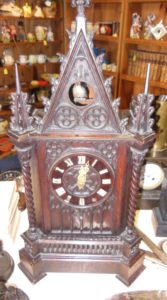
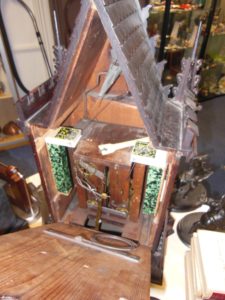
This is an old and rare Bavarian Cuckoo clock Ive just finished. There wasnt really that much to do on it but these old wooden movements need to be carefully handled so it took a bit of time. The results were well worth it. The cuckoo sound is much lighter than on modern clocks and there is not music box. Thats why they sell for so much I imagine!. This one is up for £3000 although I am sure an offer would be considered.

Ive dont peices on wooden movement clocks before as I am a big fan of the genre generally but I have to say this clock is in a league of its own compared to others I have seen. Anyway heres the pictures. I am more than happy to provide more pictures via email for any enthusiasts out there who blog or collect images of these wonderful old clocks.

Bavarian_Cuckoo_Clock_Repair_1

Bavarian_Cuckoo_Clock_Repair_2

Enfield Grammar School Clock Repair

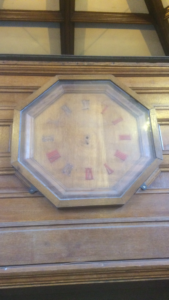
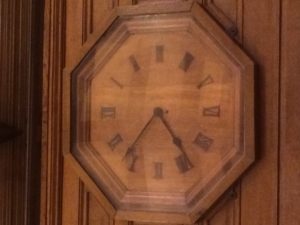
I recently replaced the movement on Enfield Grammar Schools old victorian hall clock. This clock had been build into the panelling so I went out to have a look as seen what needed doing. Mustafa does a great job there keeping everything up to spec and working properly so we agreed a division of labour on this job. I did the mechanics and he arranged to have new roman numerals made up and finished in an appropriate. Hats off to the tech design department who used the remaining metal numerals as a guide for making the missing ones – excellent job and I could not have done better myself quite frankly which is somewhat of an undertatement. You will notice that half the numerals were missing and the wrong colour when we started. At the end we have the clock restored to its former glory which matches the beautiful panelling as if it were new. Its great to get things back to the way they should be!.

On another point I have to say I was particularly impressed with the pupils at this school. Inevitably I became lost in the corridoors and had to seek assistance with directions. I apporoached the first pupil I saw and asked for a bit of help. The student (I wish I had made a note of his name) was one of the most polite and helpful people I have ever met; in or out of shool!.

Here it is before and after.

Enfield_Grammar1

Enfield_Grammar2

David Smith From The Quinpongfangdong province of China. Or India. Probably.

I would love to get feedback from my readers and answer questions and suchlike. I tried it when I launched the blog and while I got some good comments I was besieged with…

“herro good day sir madam, my nam is David Smith. We like blog for good reason. Many good story help me bigger. Very good expert. Many happy. please visit www.PornDe#th_Kill_0908809809808098.co.virus”

I was getting at least five of these a day from people employed, I would guess abroad, to create links to my website in order for google rank their own websites higher.  I had a look at this and thought there must be some way of stopping it. There isnt. Unless you want to force people through a registration system when they want to post on the blog.

Just email me – simple. The alternative is for me to have to log onto the website, go into administration to approve your request, go to your comment, approve it, do that again for everyone who has commented and endlessly go through… computing. I’m not doing it.

Im no big fan of computers to be honest.  I am the first to admit they are an unfortunate necessity with which I could not do without. That doesn’t stop me despising them most of the time. If I had it my way we would communicate by semaphore tower relays and drive clockwork cars wound up at treadmills driven by a slave army of David Smiths and his internet colleagues.

Wall Clock Repair – A Victorian Alarm Clock


20170119_003007

You dont see many of these. They are not that rare but far from common. The obvious difference with these is the abscence of a front and back brass plate – it uses wooden stantions to hold the spindles. The spindle holes are brass lined so from a functional perspective its every bit as good as a brass plate solution, however, it takes a lot less engineering to produce. Its a carpenters clock really.

It was in for a full service so it needed stripping right down. If you do one of these its not easy to work out how to get it apart without pulling joints apart!. Don’t do this. Look for one of the pillar feet having what looks like a slipway in it seating. Pull the pillar out via that slipway and the rest is just lego.

If the feet of the clock have dissapeared (a common problem – they fall out and get lost), then you can make new ones. I hand carved these from 12mm dowel and then applied an antiqued finish. You don’t need to do this and its fine just to paint them black but if you dye the wood a medium stain and then smear black paint on by hand you can achieve a very convincing copy of the originals. I give too much away on this blog I suppose but if your maniac enough to start DIY on one of these then good luck to you and I applaud you. I’m all for people having a go and positively encourage it.

Back to the movement.

The only other place I have seen these wooden cage movements is on mid Victorian Bavarian cuckoo clocks with which they share a great deal in common, although this clock has a single slot count-wheel as opposed to a cuckoos normal 12 hour chime count-wheel with 12 slots on the wheel. In the case of this clock that single action count-wheel releases the chiming mechanisn into free fall and lots of alarm bell noise. You stop the clock by simply turning the dial on the front that changes the time the alarm goes off.

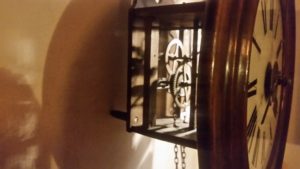
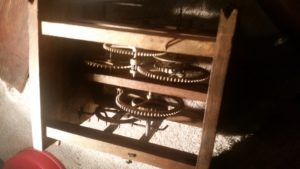
Its a clever and simple arrangement. I should have taken a video as that would have explained it much better than my written attempt. Never mind, pictures speak a thousand words. Even if you didn’t really get how it worked from my explanation you can see the clocks simplicity from some of the photos.

I’ve shown it assembled as well as with the cage stripped of cogs for cleaning. Its interesting that the cage arrangement made it easy to put the drive train of cogs in front of the chiming train as opposed to side by side. This is not possible in a two brass plate arrangement where the trains must stand in line like soldiers next to each other facing forward held in place by the plates.

Frankly Im trying to work out why more clocks were not made this way. Its cheaper and more efficient all round.  In terms of complexity the German ones run a chime train with a matching cuckoo so it proves wood is not a material that would hold you back from increasing functionality. It is rather a large movement for a simple clock mind you. And the large cogs don’t require absolute positioning because the teeth of the cogs are large and don’t need such and accurate meshing.  So I suppose it has its limits in terms of physical scale or the ability to scale down.

I still prefer it to a brass mechanical that does the same thing.

Also this is only going to increase in value. You can just tell.

20170116_213912


20170115_011421