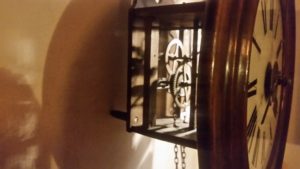
Bavarian Cuckoo Clock Repair

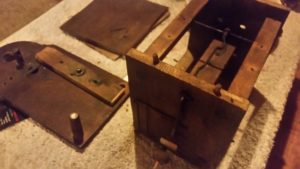
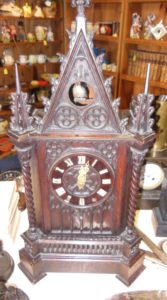
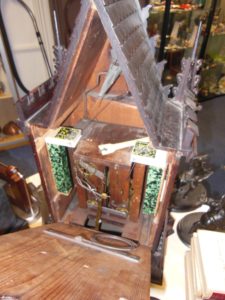
This is an old and rare Bavarian Cuckoo clock Ive just finished. There wasnt really that much to do on it but these old wooden movements need to be carefully handled so it took a bit of time. The results were well worth it. The cuckoo sound is much lighter than on modern clocks and there is not music box. Thats why they sell for so much I imagine!. This one is up for £3000 although I am sure an offer would be considered.

Ive dont peices on wooden movement clocks before as I am a big fan of the genre generally but I have to say this clock is in a league of its own compared to others I have seen. Anyway heres the pictures. I am more than happy to provide more pictures via email for any enthusiasts out there who blog or collect images of these wonderful old clocks.

Bavarian_Cuckoo_Clock_Repair_1

Bavarian_Cuckoo_Clock_Repair_2

Enfield Grammar School Clock Repair

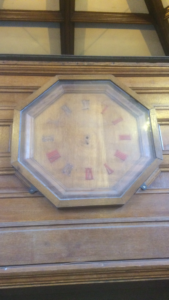
I recently replaced the movement on Enfield Grammar Schools old victorian hall clock. This clock had been build into the panelling so I went out to have a look as seen what needed doing. Mustafa does a great job there keeping everything up to spec and working properly so we agreed a division of labour on this job. I did the mechanics and he arranged to have new roman numerals made up and finished in an appropriate. Hats off to the tech design department who used the remaining metal numerals as a guide for making the missing ones – excellent job and I could not have done better myself quite frankly which is somewhat of an undertatement. You will notice that half the numerals were missing and the wrong colour when we started. At the end we have the clock restored to its former glory which matches the beautiful panelling as if it were new. Its great to get things back to the way they should be!.

On another point I have to say I was particularly impressed with the pupils at this school. Inevitably I became lost in the corridoors and had to seek assistance with directions. I apporoached the first pupil I saw and asked for a bit of help. The student (I wish I had made a note of his name) was one of the most polite and helpful people I have ever met; in or out of shool!.

Here it is before and after.

Enfield_Grammar1

Enfield_Grammar2

David Smith From The Quinpongfangdong province of China. Or India. Probably.

I would love to get feedback from my readers and answer questions and suchlike. I tried it when I launched the blog and while I got some good comments I was besieged with…

“herro good day sir madam, my nam is David Smith. We like blog for good reason. Many good story help me bigger. Very good expert. Many happy. please visit www.PornDe#th_Kill_0908809809808098.co.virus”

I was getting at least five of these a day from people employed, I would guess abroad, to create links to my website in order for google rank their own websites higher.  I had a look at this and thought there must be some way of stopping it. There isnt. Unless you want to force people through a registration system when they want to post on the blog.

Just email me – simple. The alternative is for me to have to log onto the website, go into administration to approve your request, go to your comment, approve it, do that again for everyone who has commented and endlessly go through… computing. I’m not doing it.

Im no big fan of computers to be honest.  I am the first to admit they are an unfortunate necessity with which I could not do without. That doesn’t stop me despising them most of the time. If I had it my way we would communicate by semaphore tower relays and drive clockwork cars wound up at treadmills driven by a slave army of David Smiths and his internet colleagues.

Wall Clock Repair – A Victorian Alarm Clock


20170119_003007

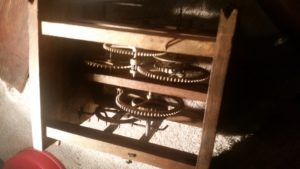
You dont see many of these. They are not that rare but far from common. The obvious difference with these is the abscence of a front and back brass plate – it uses wooden stantions to hold the spindles. The spindle holes are brass lined so from a functional perspective its every bit as good as a brass plate solution, however, it takes a lot less engineering to produce. Its a carpenters clock really.

It was in for a full service so it needed stripping right down. If you do one of these its not easy to work out how to get it apart without pulling joints apart!. Don’t do this. Look for one of the pillar feet having what looks like a slipway in it seating. Pull the pillar out via that slipway and the rest is just lego.

If the feet of the clock have dissapeared (a common problem – they fall out and get lost), then you can make new ones. I hand carved these from 12mm dowel and then applied an antiqued finish. You don’t need to do this and its fine just to paint them black but if you dye the wood a medium stain and then smear black paint on by hand you can achieve a very convincing copy of the originals. I give too much away on this blog I suppose but if your maniac enough to start DIY on one of these then good luck to you and I applaud you. I’m all for people having a go and positively encourage it.

Back to the movement.

The only other place I have seen these wooden cage movements is on mid Victorian Bavarian cuckoo clocks with which they share a great deal in common, although this clock has a single slot count-wheel as opposed to a cuckoos normal 12 hour chime count-wheel with 12 slots on the wheel. In the case of this clock that single action count-wheel releases the chiming mechanisn into free fall and lots of alarm bell noise. You stop the clock by simply turning the dial on the front that changes the time the alarm goes off.

Its a clever and simple arrangement. I should have taken a video as that would have explained it much better than my written attempt. Never mind, pictures speak a thousand words. Even if you didn’t really get how it worked from my explanation you can see the clocks simplicity from some of the photos.

I’ve shown it assembled as well as with the cage stripped of cogs for cleaning. Its interesting that the cage arrangement made it easy to put the drive train of cogs in front of the chiming train as opposed to side by side. This is not possible in a two brass plate arrangement where the trains must stand in line like soldiers next to each other facing forward held in place by the plates.

Frankly Im trying to work out why more clocks were not made this way. Its cheaper and more efficient all round.  In terms of complexity the German ones run a chime train with a matching cuckoo so it proves wood is not a material that would hold you back from increasing functionality. It is rather a large movement for a simple clock mind you. And the large cogs don’t require absolute positioning because the teeth of the cogs are large and don’t need such and accurate meshing.  So I suppose it has its limits in terms of physical scale or the ability to scale down.

I still prefer it to a brass mechanical that does the same thing.

Also this is only going to increase in value. You can just tell.
20170116_213912


20170115_011421


1699 Bracket Clock Verge Escapement Repair

Even after all these years there are some clocks I get in that…

  1. I do immediately.
  2. I should be getting danger money for.

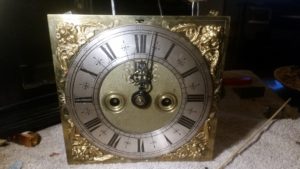
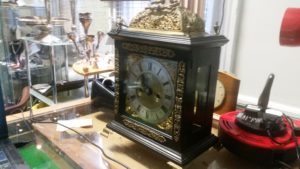
This Bracket clock is one of those. It came into the centre at 3pm, was on my bench by 5pm and finished at 3am. I the customer picked it up at 11am. Thats a 20 hour turnaround. The fact of the matter is that I really care about my reputation for service and this is exaggerated by having a £10k clock on site.  Add to this that old clocks are fragile, impossible to source spares for (you have to manufacture them) and you can see why sleep was not an option.

Ok, so whats a “lever escapement”. Well basically its a crown with two oars hitting it from either side as opposed to a star with an anchor shaped bit hitting it. Its every bit as accurate as an anchor escapement. Its difficult to see why the lever escapement was replaced by the anchor escapement. I suppose the real reason is that the cog on a lever escapement is easier to make as a crown than a star. Its probably as simple as that.  Its a shame really as it looks great when its working.

In terms of maintenance these clocks are just like any other.  Cleaning and lubrication is the same.  This particular clock was running a “bit rough” to give it a technical diagnosis, and with that you have to look for the problem(s). Once I had it apart I could see it was suffering from wear on the escapement paddles. This meant that the teeth of he crown had worn a trench in the paddles where it connected. More of the cog face (the sides as well as the face), was therefore connecting and adding friction. To address this I removed the paddle arm and compound polished out the grooves to a nice flat surface and it was job done. With these clocks you have to work very slowly as accidents CANT happen – there are no spares to rely on. If it was a car it would be a GT40 – the same sort of problems with maintenance.

The next day I fixed two modern kitchen clocks. Thats the great thing – the variety I see.

Anyway feast your eyes on this…..

Sorry about the finger nails. I need them and they get oily!.

20170106_190955

20170106_185522

20170107_104350

c1780 Grandfather clock for sale – £485

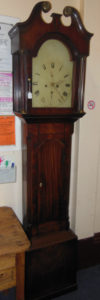
Grandfather_Clock_CheapI run my clock repairs from Braintree Antiques Centre and I try and keep the blog on this site separate from the centres because… well, this blog is about clocks and repairs, not about selling clocks. That said I have been asked several times to source a “grandmother clock”. What people mean by this is actually a cottage style grandfather; there is no such thing as a “grandmother clock” but the term is widely used for smaller grandfather clocks. Thats what this clock is – a short grandfather suitable (in height) for a modern house with lower ceilings. So here it is and here is the link to more info on the Braintree Antiques Centre blog.

Possibly the best mantle clock Ive seen…Grasshopper Escapement!

I was called out on a grandfather clock repair and was asked to quote on a service for this one off grasshopper escapement clock.

Normally I would do a long post but this time I have a video that really says it all.

Servicing a clock like this is not as complicated as you might think. All t he components are exposed and after about 5 minutes (most of which was with my mouth open in awe) I was able to see where the adjustment points were and understand the disassembly and assembly operation order.

Those of you who know such things will have noticed the fusee drive and surmised that the pendulum is probably iridium. Normally I am not really one for iridium pendulums – it seems a step too far, however, if the rest of the clock is this finely put together then iridium is sort of.. expected.