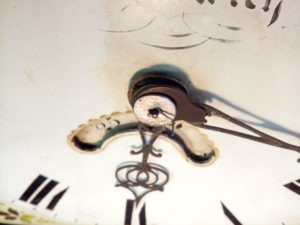
Regency Auction Grandfather Clock Advice

I help people out with clock identification via email. I try to keep it quick but always end up spending too much time on it. I have plenty of proper work to do. I like doing it and it creates the community I like to believe exists for this website but Im wasting my time….unless I publish the enquiries and replies so everyone can benefit from the iformation imparted. I really dont know why Ive not th0ught of this before. So from now on Im going to try and quickly post up any of the longer replies as opposed to the ones that go “.3.5mm, dont bend the hands and makes you use the rubber washer or the face will rotate. All the best justin.”. Incidentally thats fitting sizing and fitting a quartz movement advice. Anyway, heres the first letter Im posting up.

On 2019-09-16 18:27, Derek wrote:
> Can I take you up on your generous offer of a basic evaluation on this
> English long case clock which I bought at auction recently. After
> repairing the foot of the crutch it has been running smoothly and
> accurately driven by its single continuous chain. The name on the dial
> is R. Stevens with Stovesley underneath. The photos are attached.
>
> Thanks
>
> Derek Aspin

Auction_Grandfather_Clock_Advice

Hi Derek,

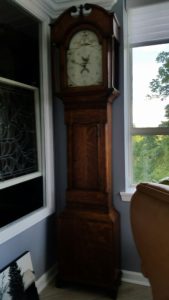
The case is typical of a late georgian i.e. 1770 and the face ans size of the clock push the dating a bit further forward to the regency period when urns and swags were the decorative fashion.

With a chain it must be a 30 hour clock and such things were the equivalent of a cheap car at the time – A major purchase for the owner but done to a budget. The hand decoration on the dial is ok, the hands look original and its a late enough clock for there to be a high chance its in its original case.

Watch out for the chiming mechanism on 30 hour chain clocks. The method the clock uses to stop itself after each chime sequence is pretty brutal so if you just blue-tak the top fly wheel on the chime train firmly this will stop the clock chiming an save your rattling it to bits, realistically beyond repair. Turn the chimes on at xmas and when you have friends over rather than have it on all the time.

Good buy although the clocks wear quickly due to being pretty basic from a movement perspective. When you get your next one talk to me and Ill try and point you in the next direction. I change my grandfather clock every few years – it can refresh the look of an entire room. The best clocks are smaller e.g. 5.5ft, exotic wood e.g. walnut veneer or chinese laquer, brass faced (pre-1770) and in my view the square ones have the edge from a practical and aesthetic perspective. A good reconditioned brass face with polished brass, guilded spandrels, and a re-silvered chapter ring (we can do all that if you buy a dilapidated one) is probably my next clock. At the moment I have a Mason London arch dial 1730 I love but it may be time…. for a change.

Got to go, lots to do. Well done on your purchase and happy to assist.
Regards,
Justin Holt
Braintree Clock Repairs
www.braintreeclockrepairs.co.uk
07462 269529

We now provide balance wheel platform escapement repairs

Ok. A short but not insignificant post about a new sevice we are offering.

We can repair ANY platform escapement with ANY problem.

Prices start at £200 and run to whatever they run to. Under £1000, unlikely to be £750, probably £450 but dont be surpirsed by 550 and if its a clean and refit then your at £200. So bascily no help a at all – I apologise. Theres also a minimum charge of £60 to look at it properly and take it apart to component level before we give you the bad news on price for doing it properly, and then the “this price gets it working” conversation takes place and a fix is agreed and scheduled.

We need the WHOLE clock to do the repair if possible. If its a large heavy 19c slate or an ornately framed clock then just the movement will be enough. Only remove the movement if you are confident in doing so. And unplug it if you need to. Quite important that.  If you know roughly what you are doing but need a hint or two then email or ring me for advice. Its either easy and we can sort it out in two minutes or its a “give up and bring it in when your passing”. All this assumes that postage is your preferred way of doing things.

The reason we need the whole clock is that there is a lot in the fitting of these platform escapements. Ill do a separate blog on that.

Prices vary so much by job as they can include anything from re-manufacture of the balance weel or re-jewelling to pivot holes so theres much more to go wrong that you might think and we do the job properly – we dont say “well thats ok for the moment” if it looks like its going to fail in then next few years.

If you want us to fix yours email pictures and then phone. Its not really worth having a conversation on diagnosis without some idea or what we are dealing with and I can tell a lot from a few pictures at least about the type of unit, if not the cause of the problem, However it does atually help with this as well to a degree as different clock types have typical faults you line up as the usual suspects.

The most common problem we have sees so far is balance staff breakage and/or jewel fracture. Spring damage is common with a broken staff, as is pallet wear or damage, depending on how luck you got with the bang that broke the clock. Pivots and gears are generally ok and dont need too much work, if any; its the staff, jewel points, pallets and spring in that order for the most part.

The skills and extensive experience required has now been acquired so we are very confident this will go very well in terms of adding another complimentary skill set, so much so infact that we need to limit the amount we take in or it will impact our core more general business of repairing just about any clock.

A lot of my friends think it is madness to offer a general clock repair service with such a broad range of clock types (as opposed to sticking to perhaps long case or cuckoo clocks – specialising) but its all part of the fun as far as I’m concerned and I want to keep it that way.

So, we are allowing a capacity of 5 escapements per month and these slots may be taken by jobs that come in and are discovered to need this attention mid-job as has been the case so far – usually with a replacement solution as opposed to a fix.

Thats now changed to a fully tooled and experienced craftsman with decades of experience at the highest end of things. He can fix a Rolex if you take a hammer to it. Genuinely. Totally bad example of course because Rolex themselves are even better tooled up than us so that would be the place to go, however, if gives you and idea of where we are.

If you want your platform escapement repair provided by us then dont wait. Order it now and theres less chance you will get a “no Im sorry I cant store anymore in my small workshop” or “yes, about 6 months. Sorry.”

I have no idea what happens next. Could be nothing or the phone might explode with phone calls. More probably Ill  l will get the really difficult frustrating profit risk work nobody else will take. Or trade enquiries.

I hate trade enquiries. Fix your own bl***** clock if you put “Clock Fixa”on your business card. If you think you probably cant fix the real problem then tell the customer and stop wasting their time with your voyage or discovery into your own incompetence. I have discovered over the years, honestly, to my surprise, that Im better than most and one of the best. Nobody can touch us on cuckoo clock repairs standard and experience backed up by our supply and UK wide accreditation from Loetscher in Switzerland, we are great on grandfather clocks, prepared to take on 20th century overly complicated cheaply producted post war clocks and, as yet, weve not turned down and job and completed to delivery or resolution.

I cant say this doesnt lead to some pretty pressurised situations but its worth it. At the moment Ive got two massive station clocks with broken (split to 3 pieces) faces, rusty iron bezel frames and movements that are industrially joined to the iron frame to ensure structural strength under nazi bombing. So ive got a, finish (rust) problem, a ceramic boding solution to apply on a huge jig, reinforcement of the structure and a high power electricity phase controlled movement. And I have to do it so that its accessible for seasonal time changing. Is that clock repair? I don care because I have a picture in my minds eye of what this will look like and I like the look of it!.

Then I have a Secticon electro-mechanical movement to service – a complex and unique movement. The clock case / dial / hands are together a breathtaking piece of iconic 60’s form and this clock is going to be very sought after when that genre recycles properly and becomes the standard for the few years. And then and then and then and so on and so forth.

Its a jungle out there – even in clock land. Thats why this is a temporary service. We are testing it nationwide as opposed to just offering it to existing customers. If its too much then we will just stop. If its too little, it doesnt matter and if its just right then we will keep it going. So, nows a good time as we wont let anyone down whos already ordered if we suddenly pull the plug on the whole thing. I suspect it will be months but with the speed of the internet it could be days quite frankly.

I left that paragraph to the end to filter out all the “might be interested” people who gave up half way through and you….have a problem you need fixed.

Proverbial “bent pin” bodge and god

Almost all the clocks I repair have had prior repairs – good and bad. You marvel at some of the skills you can see have been put to bear in the past, and on other occasions you wonder what possesses some people when faced with finding a mechanical solution.

Then theres this. Its an aluminum washer secured with a bent pin.

There was a time when I wondered if I could keep busy with clocks full time and would need to do barometers and woodwork. But that was a long time ago and disappeared the more I realised my work is created by human nature as opposed to mechanical failure. Mechanical failure IS human nature. QED.

I’m up at St Mary’s Church in Gt Bardfield today doing a clock strip down demo as part of their harvest festival celebrations – thanking god for the skills he gave us. Think he missed out the guy who did this clock last time. He must have been in the charm que instead assuming he charged for the fix.

IMG_20190914_134946

Loetscher brilliant service story

Ok so you probably dont want me to sell you the values of Loetscher but this is worth hearing if your thinking of buying a cuckoo clock new or even used (avoid used clocks – they are normally sold when they start to fail due to lack of servicing).

A customer came in with a two weight Loetscher he bought 3 years ago in Switzerland. Mots cuckoo clocks need a good clean and service every three to five years or so because they act like little air purifiers. The door flapping open 24 times a day wafts air and particles into the clocks which sticks to the oil.

This forms a glue type paste and power is lost on the top elements of the gearing. Cleaning the clock solves this and a good movement should give you 25 years service if regularly maintained. Half that if you dont, because the oil dust mix acts as an abrasive and wears the pinion holes to oval.

This pivot bush oval wear means the gears dont connect as designed and all the maths for force goes out of the window. At this point the clock needs rebushing or the movement replaced. So get your clock serviced is the obvious subtext here.

By the way this is particularly relevant to 8 day clocks because they use larger weights and wear happens faster. If you’ve spent £1500 – £2000 on an 8 day multi-automata 3 weight for goodness sake get it serviced every three. If its a two weight you can probably leave it for five.

Anyway, this is about Loetscher service.

You see the clock that came it was out of warranty. Repairs were therefore chargeable. But there was a problem. The movement looked a little too worn for a 3 year old clock. The pinions were rattling a bit and it looked like the aforementioned re-bush was necessary.

This made no sense. A three year old clock should not show any visible signs or wear. Something was wrong.

When the customer returned I told him this and asked him if he had bought the clock as a used item. No such thing – he showed me the receipt from the retailer  confirming the date of purchase.

So, I contacted Loetscher on the customers behalf. We looked at photos of the wear and came to the same conclusion that this was not a new clock when purchased. The retailer had sold the customer an ex-demo clock as a new item in all probability. Not good!. So we took on the problem and sorted it out.

Loetscher paid for a new movement and I fitted it for free. This was without any customer intervention. We did this because both Braintree Clock Repairs and Loetscher have high quality standards and the situation offended those standards.

The customer has just picked up his essentially new clock and is delighted. We are delighted. Loetscher are delighted.

Thats the way to do it.

If you buy a cuckoo clock buy a Loetscher. They look great with a fine detail model village type style as opposed to a dolls house style, and the service backing up your clock is brilliant. Specially in the UK because we do it.

More clock repair help less waffle. Probably.

Recently I’ve struggled to get time to publish on the blog. Its a problem because the blog goes to the heart of what we do.

Now as regular readers know I would happily live in a clockwork Nicolai Tesla world where technology, excluding aeronautics, rocket and space tech, medical science, and glass manufacture all stopped in about 1870. Hmmm… That doesn’t make much sense so In will summarise it by saying computers have some link to evil and the Antichrist. But they are sort of handy so I’ve decided to change the blog a bit. More videos.

When I starred this it was firmly aimed at helping people like me who like clocks. Recently a lot of the content has become a bit more towards generic education and theory. So what I’m going to do is unedited “pick up and record” mini tutorial vids on the job. If I come to something interesting I’ll just try and self direct and wing a 1 min video on it. Almost every day there’s something I entertain writing about and don’t have the time. With a bit of luck and assistance from the Beelzebub phone I should be able to rebalance the blog towards real fix solutions and information. Also, I’ve just spent £120 on a Blackview 5800 indestructible water proof phone I am testing out. I can’t believe how good it is for the money but its a bit heavy (which I actually like) and it looks like Optimus Prime (a kids cartoon character – but its bullet proof.

Anyway, thats the news. More videos.

Now, I wrote this about a week ago and saved it to a draft file for later publication. Since this I have done a couple of videos. I have discovered that I have a 120mb upload limit on them, so while I have them now ready to publish, I need some software to reduce the file size. With my love of computers already stated, this may take some time but dont worry theres some decent content on the way for you home DIY fix people and buyers. Ive done a short vid on a delightful little french movement explaining why its better and a buyers guide for turn of the century regulators because I just bought one and I love it. But it cost me loads. Im useless at buying clocks. If I want it I end up paying ticket price because my negotiation skills are right up there with Norman Wisdom and Mike Tyson. Basically I dont think I really understand negotiation. The seller says “its £100” and I say “I really really like it and want it and must have it, how about £95”. For some reason the buyer sees my weakness and ends up charging me £120 because Im showing weakness or something. I dont care. I got the clock I wanted. Vid to follow soon!.

Phil – Clock Curator at the Black Country Living Museum email

I dont know why Im posting this email I received up – I hope its not vanity.

It is vanity.

I get quite a lot of feedback like this on the blog and I assure you it is well received. It takes quite a lot of time to produce the articles and I make an effort to actually do something that people will learn from and be encouraged by. People should learn manual skills. We are built to do that, not sit in front of computers all day (as I am doing at this moment). Now I dont think Im teaching Phil much as you cant do what he has done without some considerable skill. For that reason alone I am flattered that he read the articles and found enough in there to keep going for a couple of hours reading. 

Many of the things I explain on the repair and reason articles are as much as to remind people that getting stuck in is something they should be doing, as they are to get people interested in clocks and understand it a little more (and value!) what they are custodians of. Nobody gets cremated with a clock. Yet. Yes. 

Phil is a museum curator volunteer of their clocks and obviously spent some time writing to me so I thought it would be complimentary to publish the email as he mentions some stuff about the Museum he works at. I may well visit but probably not as its far too far and I could be mending clocks or sitting on the motorway – tough one. Anyway Thanks Phil.

He didnt ask me to plug his workplace or big him up or any such thing but I found this website online which I assume is his. https://www.bclm.co.uk/. Its got 20 clocks. Oh and 250,000 people visit a year so its not a knackered old shed with 20 clocks and some guy on the gate asking for £175 for a family ticket if your girlfriend in pregnant. Thats my shed. Anyway Im handing over to Phil now.

Hello Justin,

My name’s Phil and I’m a retired Chartered Engineer and now volunteer clock repairer to the Black Country Living Museum in Dudley, West Midlands.

I stumbled across your website and blog this evening, and spent two enjoyable hours reading a few of the stories! Keep up the good work, I’ll visit the site again and read more soon. I must say I am amazed at your energy and enthusiasm. You must work all hours, sometimes at your own expense, which is very creditable in this day and age.

All the clock repairs I do are as a volunteer, but the Museum reimburses me for any parts and materials I have to order (I use Cousins UK). I’ve been doing this work for about three years, one day a week. I’m completely self-taught, and I’ve now repaired or restored around 20 American, German and English clocks which are dotted around the Museum. Every week I start the day by going round, winding them all up and setting or regulating them, then I go to the little workshop in the basement and carry on with the particular clock I’m working on. Some have taken me 30-40 hours to restore, possibly more. Many of them had clearly been donated to the Museum because they didn’t work, and a large proportion had suffered some very crude previous ‘repair’ work. In the process I have learned a huge amount, supplemented by reading a lot of books by the likes of TR Robinson, Donald deCarle, Eric Smith and Laurie Penman.

Can I conclude by wishing you and your business continuing success, and thank you again for the blog.


Kind regards,


Phil Harris


Another one came in today I just found. This blog really does help people and that makes me very happy indeed.

Hi
We discovered your website when googling how to replace the gut on a grandfather clock (it snapped at 3am with an almighty crash!).
The help was invaluable and I have replaced both bits without any difficulty and, more importantly, with confidence.
Thank you
Kind regards
Alan