What a one handed grandfather clock is, and why they were made

I did a quick repair on this grandfather clock. I dont see many one handers so I thought I would do a quick article on them explaining… well, why they only have one hand.!

Before the invention of the pendulum , most clocks only had one hand and were regulated by a thing called a lever escapement which was in turn regulated by a fly wheel or balanced weights going back and forth on a spring. The link below is from the turret clock in Salisbury cathederal which was installed in around 1386 – 300 years before the pendulum clock was invented.

If you want to have a look at the Salisbury clock please follow the wikipedia link below.

https://commons.wikimedia.org/wiki/File:Salisbury_Cathedral,_medieval_clock.JPG#/media/File:Salisbury_Cathedral,_medieval_clock.JPG

The point about this weighted regulation on a spring is that it was terribly inaccurate because the oscillation of the weights regulating the clock overall was not particularly consistent.

By about 165o clocks were not expected to run on an accuracy of quarter of an hour a day. On that basis there was no point in trying to add a minute hand as the clocks regulation was not accurate enough to make minute measurement useful.

So, along came Christian Huygens and upset the entire apple cart by attaching a pendulum as the regulating device.

Now, if you dont know, a pendulum will always swing at the same rate on the same arc providing it is not slowed down by friction (which of course it is). The escapement wheel is designed to push the anchor at the top of the pendulum just enough to counter this friction and keep the clock in perpetual motion while its spring or weight is applying force.

Its a brilliant system because its cheap to produce and easy to adjust. The only other option up until the 19th century was to use a platform escapement which to all intents and purposes is what you will find in a mechanical watch. These wear out, can only be adjusted withing certain limits, and they are fragile. All this meant that a reasonably priced accurate clock made between 1658 and around 1960 uses a pendulum for regulation.

The problem with the “new fangled” pendulum clock in the first few years of its production is that it was so accurate it was possible to add an accurate minute hand. This might seem like a great improvement but actually the largely illiterate population didn’t understand how to read two hands. They were used to just looking at a clock face with one hand and reading what time it was to the nearest quarter of an hour. Imagine if we lived in a world where everything timed, e.g. meetings, events, scheduled tasks, was only planned to the nearest quarter of an hour!.

So from 1658 to about 1700 the majority of clock were produced with just the one hand. Two handed clocks did appear during this period but the majority were single handed. By 1700 two handed clocks were being sold BUT they still had the one handed markings. If you see a grandfather clock that has both minute markers on the outer chapter ring AND quarter hour markers on the inner ring then its was almost certainly made between 1690 and 1720 although some makers persisted with dual marked faces up until 1740.

Note also the half hour markers which, again, made it through to the two handed version but were marked for the second hand and 7.5 minutes, 22.5, 37.5 and 52.5 minutes.

An example of a clock head (my own John Mason London Clock) below. Note that the chapter ring appears to be steel – it is not, it is a slivered brass chapter ring produced by a silvering process that predates any kind of electroplating by a couple of hundred years. The black letters are filled with wax – if you doubt the autheniticity of a 1700 clock check to see if the roman numerals have been carved in and then filled with a black wax which should be cracking a bit and possibly the odd flake missing.

john_mason_london_clock


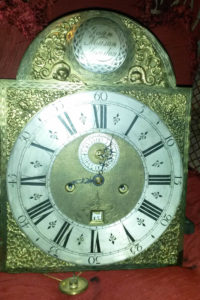
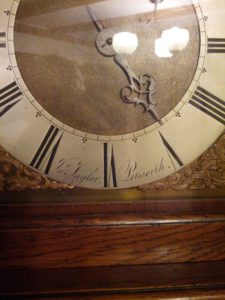
The clock below is a John Taylor clock from about 1680 -1700 and as you can see it just has the single hand and the inner chapter ring marks, which at first glance look like minute markers for a second hand, but are of course quarter hour markers for this single handed clock.

Incidentally the other thing that dates this clock to the period is the lack of an arch over the dial. These were common after 1700 so along with the one handed format we can take a good guess (without looking up things!) that this clock was produced within the dates previously mentioned.

img_20161205_171030

Heres a picture of the whole clock.

img_20161205_171008

Comitti Clock Repair

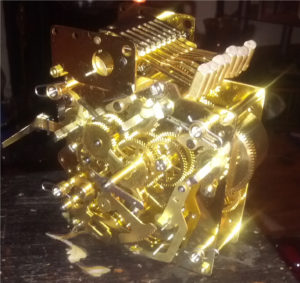
I have nothing but praise for this clock. I dont get to work on many well engineered modern clocks as they last at least 50 years before anything needs replacing. On this occasion the clock had been “repaired” by somebody else and they had not mounted the mainspring in the barrel correctly. Therefore, when the ratchet gave out on the winding spindle the tension reduced to zero and the end of the spring failed to catch its loop in the barrel. The effect of this was the spring slipping back after a couple of winds i.e. no power.

Basicly this meant taking the whole clock completely to bits which is a long and slow job. Having said this the design of this clock made the job particularly straight forward. It was the little quality touches such as the mounting of the chime bars that made a huge difference.

If your thinking of buying a new or second hand clock then have a look at a Comitti as they seem to be very well engineered. Other modern clocks I work on often have a 3rd party movement and are all brass and boasting whereas these Comitti clocks are the real deal – they make the whole thing (very well).

Expect the pay low thousands but also expect to get your moneys-worth. Good clocks.

Heres a picture of its naked fabulousness!

comitti_clock_repair


Braintree Clock Repairs Is Going Global – Why not?

Braintree Clock Repair by post / mail.

Increasingly I am being asked to do clocks from further afield. Further, frankly, than it is economical to drive. Due to what appears to be an expanding reputation regionally I have now done a few jobs by post. This has worked well but I run it a certain way to make sure it all goes well and good communication is maintained.

What to do if you want your clock repaired by post / mail.

If you want to send me your clock its really the best idea to ring me as well as email me in the first instance, so include your phone number in your email or text. Long email exchanges are not the way to go about diagnosing a mechanical fault, so a quick email about the nature of the problem with your phone number and any pictures you can provide is the best start to things.

I’ve got very good at assessing problems via a quick and gentle interrogation (!) on the basics and from thereon the conversation can quickly move to a fairly accurate estimate. Having said this I normally end up having an extended clock-centric chat with my customers on various clock related issues which I thoroughly enjoy and often learn a thing or two. Contact me as described above on email at admin@braintreeclockrepairs.co.uk or on 07462269529

How to send the clock to me

If, after speaking to me, its decided to post the clock then pack the clock properly with good materials designed to do the job. Use bubble wrap, polystyrene worms / beads, or I have found that a lot of screwed up newspaper balls does a really good job if you pack them tightly. Pack at least 4-6 inches around all the clocks sides – if this means using a bigger box that you first envisaged, then so bit it.

While it costs more to send because it will most clocks into the medium royal mail package price band, its well worth it. If the clock arrives with structural damage during transit then estimates for work will at least double. Smashed convex glass in most cases has to be sought and bought internationally for instance. Some, like Smiths deco era square convex glass (think top of soap bar shape) is almost impossible to get hold of without buying an entire orignal and probably working clock to butcher to spares. I am only pointing this out because you might be surprised that fixing the outside of a clock can be more expensive than fixing what goes on inside and how rare the fixtures and fittings on it have become. Your investment in good packaging is valuable insurance.

Send the Clock To:

Justin Holt

Braintree Clock Repairs

59 Notley Road

Braintree

Essex

CM7 1HE

How long it is likely to take to repair your clock

My turnaround varies. It s depends on several factors such as parts availability and delivery time, current workload, which is generally one to two weeks ahead. However its often more efficient to do some of the smaller jobs earlier than they arrived in date order. For a tricky clock with multiple problems – say a 1910 Ansonsia American Wall clock that “just stops sometimes” its can be a 3 or 4 week process of testing faults that can take days to manifest on test runs.

So really there is not delivery timescale promise at all really but what I will say is that I have never been chased on a job and have been complimented more than once with excellent turnaround time, so read into that what you will!. I think the fact of the mater is that people sort of know when a clock has something seriously wrong with it and are realisitic on how long its going to take to fix. Their unspoken estimate must match my own!. It would be convenient if you could post the clock to me so it arrives on a Monday or Tuesday. These are my reserved tooling workshop days and I am generally in to receive deliveries although I have a local postal depot quite close where I can pick up from relatively easily if you need to post on days off during the week or suchlike

Special considerations when you want your carriage clock repaired by post

Carriage Clocks and Clocks with Platform Escapements are long jobs and the parts are expensive. Its at the higher end of costs so expect a bill of no less that £240 for a basic service on a chiming clock.

If main spring on the clock needs replacing add £80 to the £240 service.

If the platform escapement has worn out or is broken its not worth getting them fixed – it just ends up being too expensive compared to fitting an accurate modern platform escapement that can be sourced for £100 or so. This may involve drilling new locating holes wich need to be die tapped and/or reshaping the chasis of the platform escapement with a cutter or grinder. Its a fair amount of work.

If the cogs are gone it become prohibitively expensive to have them made. Basicly you need a laser cutting clock part making machine. These cost about £250k for a good one of those that can do watch parts as well….. so that particular Braintree Clock Repairs service is not available directly for the meantime (ehem!). Essentially, I have to contract that element out but it really doesn’t make it much easier as you have to know what to specify in terms of dimensions – information you cannot retrieve from a worn part. Its much easier with Grandfather clock components for instance, where you can measure where things should be and specify to within .1mm without worrying. With carriage clocks the higher wheels and the platform escapement itself are really closer to a pocket watch – small fiddly un-measureable tolerances. I  don’t do watches for this reason – you cant really craft anything yourself.

All that said, costs are not prohibitive in most cases unless the clock is a particularly fine one with several problems. A small Matthew Norman (not a chimer) is around £100 – £150 to service. As a mainstream modern clock its also much easier to find after market parts that will fit so even if the platform escapement needs replacing this can be done for between £150-250 depending on the model and including a service clean,

Insure your clock as part of the shipping cost / option – its standard service on Royal Mail. I will insure it for the same value on return. I far prefer Royal Mail to any other carrier – they really are much easier for me (thanks).

Well going global was easy. Done!.

Clock repair – How to fit a platform escapement to a carriage clock or french barrel movement

I get asked to replace a lot of platform escapements – or at least this becomes part of the job as the movement is cleaned and it has been discovered that the platform is worn out. The first thing is to get the old one off and count the amount of teeth on the escapement pinion gear. Look at the angle the pinion gear has been set at as well. With a carriage clock it will normally be facing a 90″ tangent to the clock escapement drive wheel (the one that looks like a crown). On a french barrel movement it really could be anywhere however. This is because unlike the carriage clock, they do not have a crown cog that is inverts force by 90″ and the ideal direction for the pinion wheel facing teeth could be anywhere. I mention this because if you buy the wrong platform escapement type you are not going to get anywhere – they cannot be modified easily and are fragile.

Once you have sourced the correct platform escapement then you are going to need to fit it. This is difficult unless you know the trick……which is blu-tak.

You blu-tak the escapement to the back plate with the clock unwound. You can then side it into position so the protruding platform escapement pinion gear is touching its drive cog and give the key one wind (you want to check it will work at low power). If its in position it will start to run. If it doesn’t then just slide it a very small amount to re-engage the drive cog and you will find the sweet spot.

Once you have positioned it then leave the clock to check if its running in time for an hour or so. You will pick up any serious deviation in this timescale if there is one.

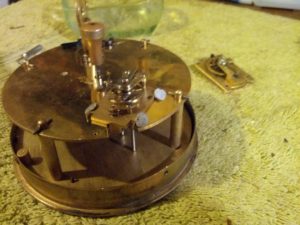
Heres one I’m doing today.

img_20161213_180257

The next step is to mark up the new screw points using the platforms holes as a guide. Then its a matter of measuring your screw diameters and drilling / tapping holes to mount the platform – you will need a standing drill for this job; never drill clock holes “by hand” – all sorts of things can go wrong but mostly its about keeping the hole at 90 degrees to the face.


A Braintree Grandfather Clock Repaired!

20161107_173511This is a clock thats just been serviced and repaired on my testing jigg. Im narrowing down the accuracy ready for delivery in a couple of days.

I didnt know Braintree  had a clock maker, “J Wing – Braintree”, and anyone who does know – please email me at admin@braintreeclockrepairs.co.uk 

What I will say is that the clock is not fantastically made. The pendulum, which is obviously original due to its upper fixing, is too heavy. This has caused a lot of wear on the escapement cog which is really on its way out – 10 years perhaps.

When it can no longer maintain its arc (which fades as the cog wears) it will need a new escapement but thats an expensive job I only do where necessary. – i.e. the clock simply wont work without it.

Its got quite a nice face on it in good condition. It was common to get these submanufactured at the time so Wing didnt do the painting – just the movement and possibly the case but even that is unlikely for a provincial maker who could buy in these components cost effectively. The clock is about 1790 I would guess.

20161107_173517

A Metamec 830 Repair

Metamec clock repair

20161122_205106

20161122_175211

This is just a quick post to showcase a new clock I couldnt resist on ebay. These dont get repaired strictly speaking; you replace the whole movement in most cases. Motor burn out is common which means totally dead parrot movement. Modern quartz replacement is possible – Ive got a couple of converted ones and theres no shame in it!. Having said that Id love to own a mechanical 822 – mine is a filthy mongrel quartz conversion ehem!.

Its heavy and exceptionally well engineered. This one is the brass variant – it was also available in brushed steel with a pearl acrylic inlay which looks even better than this brass one.

Its a cabled clock which normally I dont go for but it sort of seems ok with yhis one as it would look good on a small side table.

The best thing about it is the prominent sweeping seconds hand – it just looks right for the design.

If you see one of these at a boot fair just buy it. Its probably in the 5 most desirable Metamecs and a solid investment – pay up to £60.

How to replace an electric wall clock movement yourself

I repair clocks for people who don’t want to repair them themselves. Its an obvious statement but that’s why I publish my “how to” guides on this blog. Im not robbing myself of a job as the people who do this are going to do it whatever and good luck to them. I’d just sooner they had a good time doing it and avoid the annoying pitfalls.

The inspiration for this article came to me after I received a text enquiring about a wall clock repair. A straight forward movement replacement. I text back saying that he was welcome to bring it into the Bratiinree Antiques Centre where I am based Wednesday through until Sunday on most weeks  10am – 4.30pm. If you are coming to see me then you are welcome to use the car park at the back of the centre which is much more convenient than the towns facilities for parking in the area. The centre has served as an excellent drop off point for clocks and many customers now bring theirs in. This is however subject to size on most occasions.

Meet Lyndon and his wall clock.

big_clock_repair

For those with the enthusiasm to attempt this DIY here are a few tips.

All this assumes you have got as far as looking for  replacement units on ebay and are faced with a choice you don’t know how to make.

With larger clock (say up to half the size of Lyndons above) its often essential, or desirable to fit a high tork movement. It just beefs up the turning and lifting power of the hands. Bigger hands need this extra power. The only thing about this is that you will find there is less choice in mandatory options e.g. spindle size, but get one if you can if you  have a larger clock; its likely fitted with one already as you cant tell the difference from the outside. I get the feeling there is better engineering behind the high tork and the standard units I have taken apart. Those looked like they were made to last only so long and economically basic.

If you buy a standard unit try and get a Seiko. At the moment they are the best in a field of cheaply made alternatives. I’ve had units from many suppliers and quality really does vary with delivery if you shop at the cheap or even mid-priced level. Its not that the others wont work, its just that 1 in 10 turns up dead and if you drop it on a wooden floor it will likely simply stop working with no apparent damage.

The only down side on the better quality Seiko movement is the price. In addition they are hard to source with hands inclusive which should be your preferred option if you can get a hand match. But they are 3 times the price. I think its still worth it but then again I can charge my expense on for repairs. I might see it differently for a simple cheap fix for myself on an unimportant clock of some sort.

The other thing that goes in cheap movements favour is that they are excellent for making mistakes on. If you find out you have ordered the wrong dimensions when it comes to fit it, its not a financial disaster. Equally if you need to modify the unit or cut bits off it then that is better off going wrong on a cheap one. If you are successful you’ve got a cheap good fix that will last a couple of years or more.

The next thing to consider is the option of radio controlled movements which set their own time automatically. I say “consider” because if you buy a good brand unit it should keep pretty much perfect time. People forget that you have to allow for the fact you are forced to change it twice a year anyway and in doing so reset the accuracy of the clock. It only has to run at an accuracy of 1 min in 6 months in reality. Radio controls primary advantage is that it sets the clock for you seasonally like a network linked device. I am speaking of course as somebody who enjoys setting clocks back and forward seasonally. Its probably not for everyone.

Dimensions are the next thing and this is where its gone wrong a few times for me. Despite knowing what I’m doing I make errors from time to time doing this.

The pitfalls are the spindle length, the hand fixing type (euro or standard) and the spindle diameters. You need to know these accurately. This means you have to remove the failed movement before you start to think about what you need to order.

You have to be accurate with your replacement but its often the case that you cant get exactly the right option on hands or spindle length. You have to compromise within the tolerances of the clock body and movement mounting design. I have made up fitted jiggs in some instances just to reduce exposed shaft length by 3mm where I haven’t been able to source the right spindle length with the essential hand fixing size.

At any rate you will need to get the movement out before you do anything. Getting the face off so you can remove the hands is the core challenge – the rest is reasonable obvious. I cant tell you how do do this – it really is a work it out yourself job on every clock. The only thing I will say is that fixings like bezels or glass mounting are rarely screwed (theres a joke there somewhere) and everything tends to be clipped or held by friction fit, screws or “turn and unlock” fixings. The advice here is that if you are really giving it any kind of force that will permanently bend or scratch anything then you are taking the wrong approach.

The clock is designed to come apart and its usually the order in which you remove sets of pins and types of fixing in layers in a sequence. Layers that look separate can often be joined at points you cants see while they are in place. The face bezel may be a single unit for instance, with its fixings sticking through the back of the clock as pillars with bolt fixings. You need to really check it out work out whats going on before you apply any force – the fixings are designed to be invisible from the front of the clock and the method of connection is often counter intuitive.

Once you have the face off then unscrew the central nut which is normally round and simply unscrews as you would expect. Note that I am  not referring to the larger base nut directly against the face.  While removing the central nut above the minute hand you need to hold the minute hand. If its stiff just start it off with a pair of small pliers and it will unscrew easily.

If you have a seconds hand instead of a central nut simply pull it off. Use your fingers as pliers will damage it. The same then goes for the minute and hour hand – they will simply pull off and can be quite stiff so get a firm grip on the central area and pull up. As a last resort lever it up with a flat tool like a metal ruler but be careful not to scratch the face or mask it beforehand.

Once the hands are off in most cases there is also a ring nut you can see on the expose thread of the spindle sticking through the face. You must get that off before you pull the movement off or you will damage the face and probably ruin the look of the clock – if you warp the centre the bend on metal clock faces distorts right across in most instances so take care on this nut removal. Beware, its really easy to scratch the face doing this so if you want to be sure cut a paper mask (paper circle with a radius slit in it) and apply it to the face before any sharp tools go near it.

Some movements come with hands when you buy them. This is the option you should choose if you don’t mind changing your hands but there are limited styles and sizes available. Most people I do this job for want to keep their original hands or get something very close. My advice however is that if your doing it yourself I highly recommend you buy your movement and hands together. Fitting old hands to new movements is often a bit of a mish-mash and its easy to order the wrong specification. The rest of this article is about how do do it while keeping the original hands intact.

Once the movement is out, measure the spindle length with a ruler or vernier gauge (digital vernier gauges are £12 on ebay by the way! amazing.) This length should be measured without the rubber collar that sometimes sits on it to act as a gripping pod between the movement and clock face.

When you buy the movement on eBay or Amazon you will notice they are listed by spindle length or in some cases “to fit a face of {a number}mm thickness”. This “face fit” way of describing length is a terrible way of listing the spindle lengths as it simply isn’t possible to measure face width on many clocks – try it!. For this reason I always buy from a vendor who lists in actual spindle length, do this and you wont get it wrong.

Its tempting to guess the face width or attempt to measure it with a matchstick or suchlike but its unlikely you will get it accurate to 1mm. That may well make all the difference getting the spindle nut back on.

The other thing it is tempting to do is to imagine that ordering a longer spindle than you need ensures it will absolutely poke right through. The problem is that it will do exactly that and then jam up against the glass. Note that you have to fit a seconds hand on top of the minute hand which normally raises the three hand assembly by 3mm. In summary, getting the movement right out and measuring everything as accurately as you can saves all the trouble that can crop up on this job.

The next thing is identifying the hand types and spindle diameters.

  1. If your middle spindle, the one inside that sits stepped in and above the second hand spindle, has a FLAT double edge then you have EURO hands and you need to select a movement specified as this. Some vendors dont specify this so take a good look at the photos to check you have the circle with the flat sides in the centre of the minute hand.
  2. If your spindle is round simply measure the diameter of each with a ruler in mm (or with a handy vernier gauge!) and ensure this matches the details of the listing. If it isn’t listed find one that is because there are a couple or three of variants (?).

In most cases there is the option of a sweeping or ticking movement type. Please just skip two paragraphs if you don’t want to be bored to death by my quasi religious beliefs on sweeping clock hands being mechanical heresy.

I prefer ticking because if the second hand stops for some reason, you can tell if its just slipping  by checking for the tick. However on a sweeping movement, if the seconds hand is a bit lose on its crimping / poor factory fit, it can simply continually slip on its spigot and the clock appears not to be working – you can’t hear it tick. This means you have to re-recrimp the spindle mounting on the seconds hand and hope you guessed it right when you put it back on. If it doesn’t work then your back to square one with the added uncertainty that you might have made it worse.

I just find them frustrating to work with and very un-clock like. Clocks are full of moving ticking tangible sequential parts and forces on a unitary basis – thats what makes them a joy to work with. If you take a ticking quartz movement apart its still got the same gears and ratios that clocks have always had although to be fair the sweeping variety is only minutely different. Sweeping hands are are a less functional step away from a near perfect mechanical design principle.

Lastly, if your movement is not square 56 x 56 mm or its oblong with a larger battery then it all gets rather complicated and indicates you have a pre 1975 movement which you probably need my help with. Do feel free to call or email me to discuss – click the link to the contact page.

There is one more thing. If you convert a mechanical clock to a quartz movement you remove at least 50 if not 90% of its value. Its worth more broken with the original movement than it is converted to a working quartz one.

Good luck as always and thanks Lyndon for you excellent clock picture and a good laugh.

 

John Mason London Grandfather Clock Head – Building a clock part I

Ok, so I’ve not reached the stage where clock snobbery is effecting me. It is a powerful and damaging condition that effects the vital organs of finance such as the wallet and debit card.

Ive have a Grantham made grandfather clock that has a tooth missing from the escapement cogg. While this is not a terminal condition for a clock, its expensive to get new wheels made and hard to find anyone who will do it. I therefore decided to replace the complete movement with something a bit better.

In grandfather terms “better” generally means older so Ive been looking out for an early 18th century face and movement for some time. My ship came in and now I have it. I know this is an early movement because the face dial is hand engraved and features the old one handed clock markings. You can see the quarter hour divisions on the innner chapter ring of the clock for this. There are a few other features that confirm its date to 1725 – 30 as well as the fact that John Mason, the London clock maker, was released from his apprenticeship in 1711.

The intention is to fix the assorted problems with the movement and then put it into my 1780 Grantham case. If you can get a good condition head its easy to build the clock you want to see. It does of course effect value if the head is not original to the clock but to be fair most old heads are in newer cases simply because the cases are the first things to rot and wear away.

Ill be doing a post on the finished article shortly. Im fizzing with excitement about building this thing and will be getting on with it!.

If you want to build your own grandfather you have to learn about clock face design in relation to date. Grandfather clocks, specially from London makers, are very regimented in thier design and certain features were incorporated for short periods so by examining things like dial size and clock face markings so its possible to date any clock within about a 10 year time frame. Brian Loomes does an excellent book on Grandfather clocks that I highly advise you purchase before looking for your components. Its on Amazon and Ebay most of the time and about £30 – 50. Well worth the investment to do your research.

Anyway, heres the clock head and watch this space to see where I get to with it!.

john_mason_london_clock


What a worn spring looks like

This post is really just for those interested in what “a worn spring” means.

When a spring is wound it is peeled from the outer or the barrel onto the winding spiggot. Over time the spring loses its elasticity and starts to take on the shape of the spiggot as opposed to the outer barrel. This is a complicated clock repair because it takes some time to dissassemble the movement, remove the barrel and then extract the spring. A new spring must then be wound to a lower diameter, inserted into the barrel and then released to a snug fit inside.

The picture below shows the extracted spring and the new spring. You can seet the difference!.

20160917_181232


What to do when a clock spring repair goes wrong

The job

Sometimes things dont go as planned. In these instances its necessary to weigh up the options and get on with it.

I have been asked to repair a rather nice 1930’s regulator. The problem was manifesting itself as slow laboured chiming and illogical chime sequences. This is typical of a chime spring having degraded and lost its power over time. Chimes get halfway through and then just stop, only to restart as the beginning of the next chime sequence. It sounds as if the clock has lost its mind!.

At any rate the solution was a spring replacement which was measured and ordered. The owner of the clock decided to replace both the drive and the chime spring at the same time on my advice. Generally speaking, when one goes the other is not far off. Chime springs are usually the last to go as over time they get used less as people elect to turn the chime off.

This clock uses surpisingly strong springs. Spring strenth is rated on the springs thickness which ranges from .1mm through to about .7mm for most clocks. The spring is attached to the inside of the barrel by a metal pin drilled in and sealed as a rivet from the outside.

The unexpected problem

When I installed the new spring the pressure of the spring sheared off this pin and the spring would not hold firm in the barrel and slipped when tightened.

There were two approaches available here and thats important to mention. If you run accross a problem on a clock that you had not expected it really is important to just stop and consider the options rather than rush towards the first obvious method or fix.

Firstly I could source a new barrel but this would take time and its relative wear could cause unpredictable results. The other things of course is that you might be able to get the same guage of barrel but you would be very lucky if the style and colour were identical – new barrels are obvious visually.

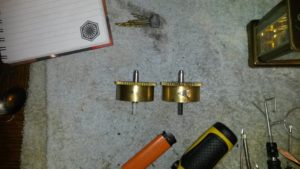
The second approach was to use a spring attachement method I have seen on other barrels which invloves folding a tongue of the barrel inside to catch the loop on the end of the spring. This approach guaranteed a fix but also meant getting it right first time because if I underestimated the strength of the components the barrel or spring would split. So, to spread the load a bit at the join I created as wider V as I dared and then enlarged the hole loop in the end of the spring by 30%. The result was a strong effective repair. It looks a little brutal however it definitely wont slip or shear and the combination of a hardened steel spring edge on soft brass can produce spectacular breaks.

Ill now polish the barrel marks out and re-assemble the clock.

The pic shows both the repaired barrel and its twin (although not a strict twin as I found it had a slightly different strength spring). You can see the original pin in the left barrel. Note that I cut the poing of my “V” to match the position of the pin. This would ensure it had the best chance of catching the spring loop. To stand the V section ready to catch the spring I inset it (hammered it in) to the barrel so it was proud by about 3 or 4mm. It has to stand that proud to catch a fast moving loop that sets in when you release the spring in the barrel.


barrel_pin_shear_clock

Could I have done this differently?

Well yes is the honest answer. I could have hammered the bent barell back into shape. I tried to do this but wasnt bold enough and when the new spring went in it only half caught on what remained of the pin and sheared it even further. Next time ill go straight for the method I have used here as this is really the way the manufacturer should have done it in the first place. The method of cutting a tongue into the barrel was used later on in clock manufacture which I had assumed was a cost cutting modifcation. Having had to deal with the problem myself I can confirm is the better way in all respects as well as saving money in production. I find the same sort of modifications on modern chinese movements which are produced very cheaply but unbelievably well in terms of the no frills design.